


Cryptocurrency may have an interesting technology, a large network, and a growing number of users. But all of this does not yet mean that the network’s growth itself automatically creates value for the token holder.
Axelar has a mechanism that makes this question especially interesting.
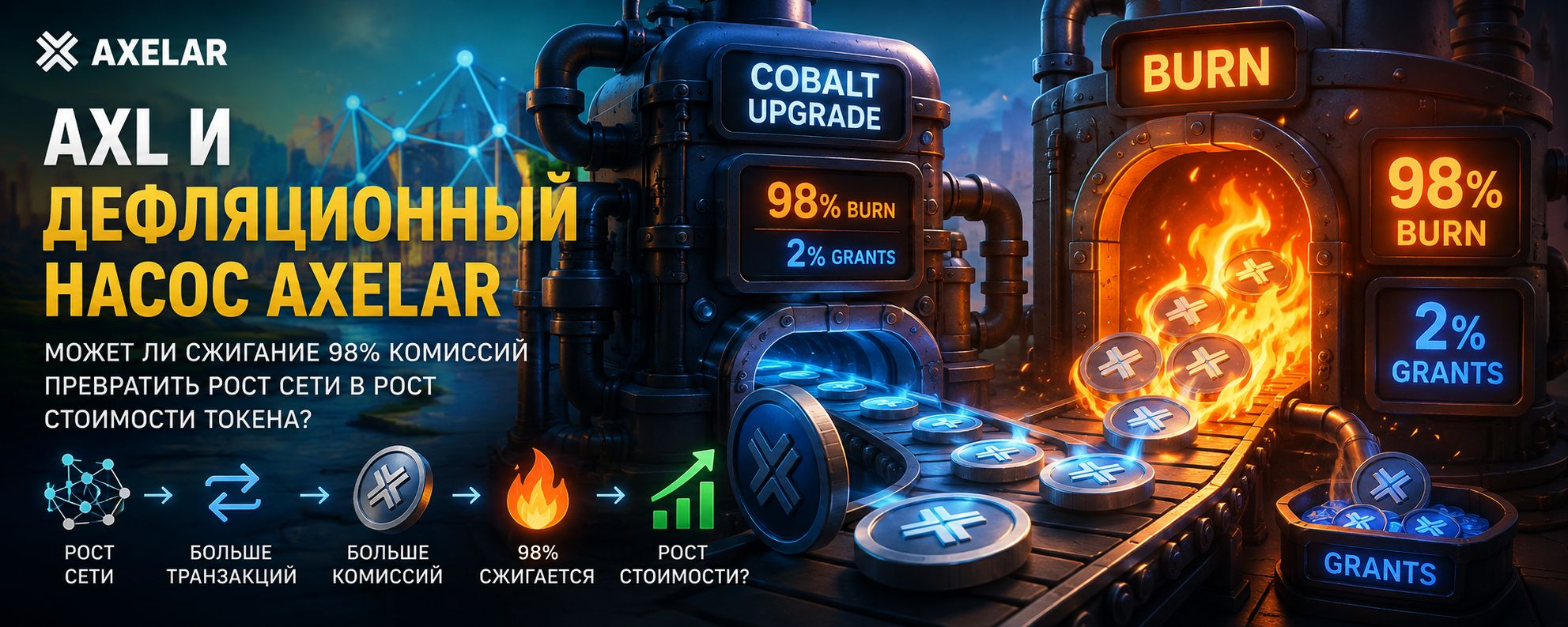
After the Cobalt upgrade, the network directs 98% of AXL fees to burning, and the remaining 2% to the grant pool. At the same time, the network continues to mint new AXL to reward stakers and maintain security.
So it turns into a kind of economic pump:
growth in usage → more fees → more burning → less supply.
But there is the main “if.”
Can the amount of burning exceed the amount of new tokens?
That’s where marketing ends and math begins.
WHAT IS AXELAR AND WHY DO YOU NEED AXL
Axelar is infrastructure for interoperability between different blockchains. It allows apps and assets to work across networks, and developers to build interchain applications.
AXL is used inside this system as the network’s native token: for staking, governance, and paying for network operations. And an ordinary user does not necessarily need to hold AXL themselves: through Gas Services, the user can pay fees in the native token of the source network, and the required conversion into AXL happens inside Axelar’s infrastructure.
This is an important point.
Economic demand for AXL may arise not only because someone decided to buy AXL on an exchange.
It can happen because the real infrastructure needed AXL to process interchain operations.
WHAT DID COBALT CHANGE
Previously, AXL network fees were distributed among network participants. At the same time, the system itself used inflationary rewards to incentivize validators.
Cobalt changed this design.
Now 98% of AXL fees are sent to a burn address, and 2% go to community grants. For newly connected blockchains, Axelar has also moved to reward pools, which are formed from the existing AXL supply instead of the former model where new connections increased inflationary incentives.
Thus, the fee stopped being simply income for participants.
It became a mechanism for reducing supply.
THE FORMULA BECAME SIMPLE
You can write the main mechanism in a single line:
Net Supply Change = New AXL Issuance − Burned AXL
If 40 million AXL are minted and 20 million are burned, then supply increases by roughly 20 million.
If 40 million are minted and 40 million are burned, then there is practically no net change from these two mechanisms.
If 40 million are minted and 50 million are burned, then a net reduction in supply occurs.
And only the last option is truly deflationary.
HOW MUCH AXL IS BEING MINTED RIGHT NOW?
At the time of checking, Axelarscan shows about 1.25 billion AXL total supply and inflation of 3.4%. The interface also lists the reward parameters: 1% base inflation plus 0.2% for the EVM network.
If you mechanically apply the current 3.4% to 1.25 billion AXL, you get approximately:
1.25 billion × 3.4% ≈ 42.5 million AXL per year.
This does not mean that exactly 42.5 million tokens will be minted every year: the network parameters can change via governance.
But for our model, this is a good current baseline.
So for burn to fully compensate for such issuance, the network must destroy about 42.5 million AXL per year.
And since 98% of the fee is burned, the total fee volume should be even higher:
42.5 million / 0.98 ≈ 43.4 million AXL in fees per year.
THIS IS WHERE THE MOST INTERESTING PART STARTS
Axelarscan currently lists a base fee of 0.0014 AXL for a regular transfer.
If we assume purely mathematically that each operation brings exactly that amount of fees, to compensate for the current emissions you would need about:
31 billion operations per year
or roughly:
85 million operations per day.
That’s a huge number.
But drawing the conclusion “Axelar will never become deflationary” from this would be incorrect.
Why?
Because 0.0014 AXL is a metric for a normal transfer, and the economics of interchain operations are more complex. Fees depend on the type of operation, the chain, gas, and other parameters.
Therefore the correct conclusion is different:
For pure Axelar deflation, it’s not just about having a large transaction counter. You need a large volume of economically meaningful fees in AXL.
And this is a much more interesting metric.
WHAT HAPPENS WHEN THE NETWORK GROWS BY 2×, 5×, AND 10×
If the average fee and the structure of operations remain roughly the same, you can use a simple model.
If usage grows by 2×, the potential volume of fees and burn also tends to increase by about 2×.
If it grows by 5× — then roughly by 5×.
If it grows by 10× — then roughly by 10×.
But there’s an important condition:
You need to scale not the number of pretty statistics figures, but the network’s real fee economics.
If right now burn is B AXL per year in conditional terms, then:
2× usage → about 2B burn
5× → about 5B
10× → about 10B.
The point of transition to deflation is where:
Burned AXL > New AXL Issuance.
So for an investor, it’s much more useful to track the ratio of:
annual burn / annual issuance
not just by the number of connected blockchains.
NETWORK GROWTH IS NOT EQUAL TO PRICE GROWTH
Here is the main trap of the whole story.
Let’s assume Axelar really increases the number of operations by ten times.
This may lead to an increase in burn.
But the AXL price still doesn’t have to rise.
Because the price is determined not only by supply.
You need demand.
If supply is decreasing, but at the same time interest in the token itself is also falling, the price can keep dropping.
If the network is growing but its usage does not create sufficient demand for AXL, the economic impact may be weak.
If the market is in a bearish phase, the deflationary mechanism may simply not be able to keep up with selling pressure.
So the correct chain of reasoning doesn’t look like this:
network growth → burn → price growth.
And much more:
growth in usage → growth in fees → growth in burn → slowdown in the rate of supply growth → if demand is sustainable, a potential improvement in the token’s economy → possible impact on price.
Each link here has to work.
RISKS REMAIN
First risk — weak activity.
If Axelar usage does not grow fast enough, burn remains small relative to issuance.
Second — competition.
Interchain interaction is becoming an important infrastructure category, which means Axelar must continually prove that its network is receiving this flow.
Third — changes in issuance parameters.
Inflation and other network parameters depend on governance. The current 3.4% is not a forever constant.
The fourth — unlocks and the movement of previously distributed tokens.
Even if the protocol burns part of the fees, the market can receive additional supply from other sources. So looking only at burn is wrong.
The fifth — the price of the AXL itself.
The fee expressed in AXL depends on the network parameters and the economic model. When the token’s price changes, the dollar value of the same AXL volumes changes as well.
And finally, the main risk of any infrastructure token remains:
technological usefulness does not guarantee that value capture will happen in the token.
WHAT REALLY SHOULD BE TRACKED
If we treat AXL as an investment hypothesis, I wouldn’t start with the question:
“How high can the price of AXL go?”
It’s much more useful to ask four other questions:
How much AXL is minted?
How much AXL is being burned?
How fast is the network’s economic activity growing?
And how fast is real demand for Axelar’s infrastructure growing?
Today, the very design of Cobalt looks more interesting than the usual token burn mechanism precisely because burn is tied to network usage.
Axelar doesn’t promise to just burn a fixed amount of tokens from the treasury.
The mechanism tries to link supply reduction to the protocol’s real activity.
And this is a fundamental difference.
AXL IS A BET ON USAGE
Therefore, the investment thesis here can be formulated much more precisely.
Buying AXL is not just a bet that “the crypto market will go up again.”
This is essentially a bet that interchain interaction will become such a highly demanded infrastructure that the volume of Axelar’s economic activity will be able to create substantial ongoing demand for AXL fees while simultaneously burning enough tokens to offset emissions.
As long as we don’t see a sustained situation where burn exceeds issuance, calling AXL a purely deflationary asset would be premature.
But this is exactly where a measurable investment thesis appears.
No:
“AXL is burned — therefore it will go up.”
A:
“If Axelar’s usage grows fast enough, the network fee could start compensating for emissions. And if, at the same time, demand for the infrastructure itself remains or increases, AXL tokenomics becomes significantly more interesting.”
The deflationary pump really exists

But the pump by itself guarantees nothing.
It needs a flow.
And in the case of AXL, that flow must become the real economy of interchain interaction.
🔥 #AXL
🌐 #Axelar