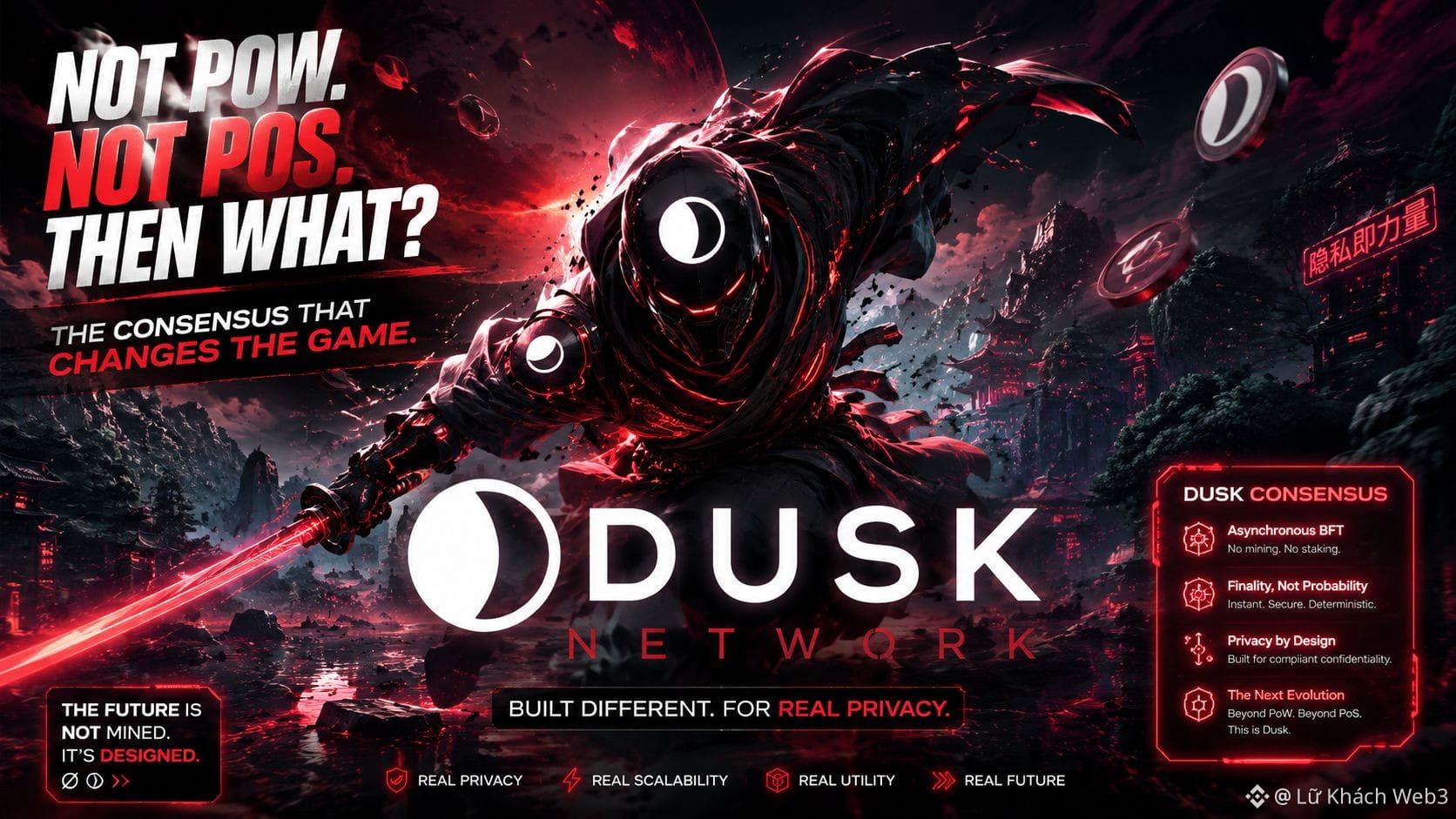
There’s one detail that made me re-read Dusk’s consensus section a few times. At first, I thought Succinct Attestation was just another name for PoS, but the internal flow has a few points worth noting.
According to the current documentation, DuskDS uses Succinct Attestation (SA), which Dusk describes clearly as a permissionless, committee-based Proof of Stake consensus protocol. A provisioner who wants to participate in consensus must stake at least 1,000 DUSK.
I went further into the process. A round isn’t simply validators voting on a block—it’s divided into three steps: Proposal, Validation, and Ratification. One provisioner proposes a block; then one committee checks it, followed by another committee confirming the result and finalizing the block. Once ratification is complete, Dusk achieves deterministic finality.
At this point, I had to revise my initial understanding.
SA isn’t “a completely different consensus from PoS.” The economic foundation is still staking; what Dusk re-designed is the committee selection, the separation of confirmation steps, and how blocks reach finality.
Hold on—this still isn’t enough to claim that SA is better than PoW or traditional PoS.
PoW relies on computational competition, and SA doesn’t need that mechanism. But saying that Dusk “replaces PoS with something entirely new” isn’t accurate.
What I find more worth researching is: when finality is designed to be deterministic, how does it change the settlement experience for financial applications?
#dusk $DUSK @Dusk $BTC
According to the current documentation, DuskDS uses Succinct Attestation (SA), which Dusk describes clearly as a permissionless, committee-based Proof of Stake consensus protocol. A provisioner who wants to participate in consensus must stake at least 1,000 DUSK.
I went further into the process. A round isn’t simply validators voting on a block—it’s divided into three steps: Proposal, Validation, and Ratification. One provisioner proposes a block; then one committee checks it, followed by another committee confirming the result and finalizing the block. Once ratification is complete, Dusk achieves deterministic finality.
At this point, I had to revise my initial understanding.
SA isn’t “a completely different consensus from PoS.” The economic foundation is still staking; what Dusk re-designed is the committee selection, the separation of confirmation steps, and how blocks reach finality.
Hold on—this still isn’t enough to claim that SA is better than PoW or traditional PoS.
PoW relies on computational competition, and SA doesn’t need that mechanism. But saying that Dusk “replaces PoS with something entirely new” isn’t accurate.
What I find more worth researching is: when finality is designed to be deterministic, how does it change the settlement experience for financial applications?
#dusk $DUSK @Dusk $BTC