

$KC.US The key takeaway from this Q2 earnings report is not just that revenue accelerated, but that the company, driven by AI cloud demand, achieved positive GAAP operating profit for the first time. The issue is also clear: net profit still hasn’t turned positive, and capital expenditures remain high to meet AI compute demand.
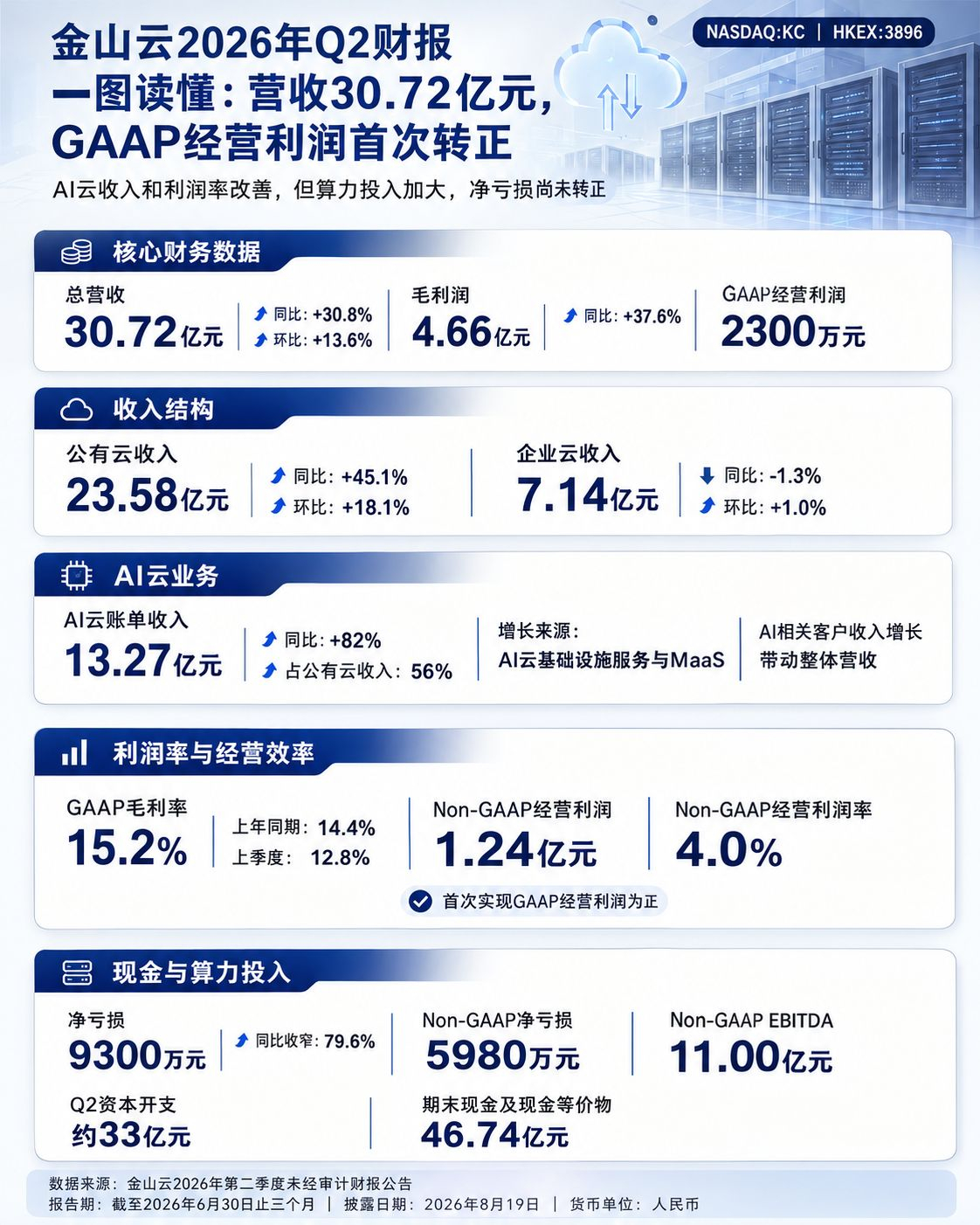
Start with the core data
Q2 Kingsoft Cloud total revenue was 30.72 billion yuan, up 30.8% year over year and up 13.6% quarter over quarter. Gross profit was 4.66 billion yuan, up 37.6% year over year; GAAP operating profit was 23.0 million yuan, compared with operating losses in the same period last year and the previous quarter. Non-GAAP operating profit was 124 million yuan, corresponding to an operating margin of 4.0%.
Operating-side turned positive for the first time—this is the most important change this quarter. Revenue, gross profit, and cost control improved at the same time, suggesting that scale growth driven by AI cloud demand is starting to flow through to operating leverage.
Public cloud is the core of growth
Public cloud service revenue was 23.58 billion yuan, up 45.1% year over year and 18.1% quarter over quarter; enterprise cloud service revenue was 7.14 billion yuan, down 1.3% year over year and up 1.0% quarter over quarter.
The revenue mix is already fairly clear: growth mainly comes from public cloud, especially demand from AI-related customers; enterprise cloud is still at a relatively steady stage. For Kingsoft Cloud, whether the AI cloud business can sustain high growth is the core variable for the subsequent revenue trend.
AI cloud has become the main revenue support
In Q2, AI cloud billings revenue reached 1.327 billion yuan, up 82% year over year, accounting for 56% of public cloud revenue. The company said the growth came from incremental contributions from AI cloud infrastructure services and the MaaS product.
This set of data shows that AI’s impact on Kingsoft Cloud is no longer just market narrative—it has entered the revenue structure. However, billing revenue doesn’t equal all recognized revenue, and it can’t be directly equated with long-term profit. Going forward, we still need to see the continuity of customer demand, the quality of cash collections, and the efficiency of compute resource utilization.
Margin improvement, but net profit still not positive
In Q2, GAAP gross margin was 15.2%, higher than 14.4% in the same period last year and also higher than 12.8% in the previous quarter; Non-GAAP gross margin was 15.4%. At the same time, GAAP net loss was 93 million yuan, narrowing 79.6% year over year; Non-GAAP net loss was 59.8 million yuan.
Turning operating profit positive doesn’t mean net profit has already turned positive. Kingsoft Cloud still has items affecting the income statement, such as interest expenses and depreciation and amortization; therefore, this earnings report is better understood as an improvement at the operating level rather than a fully stabilized profitability outlook.
Compute investment determines how difficult the next validation will be
The company’s Q2 capital expenditures were about 3.3 billion yuan, further increasing from Q1, mainly used for AI compute equipment and related infrastructure investment. Cash and cash equivalents at quarter-end were 4.674 billion yuan, down from 6.018 billion yuan at the end of 2025. Operating cash flow for the quarter was 2.851 billion yuan, while cash outflow from investing activities reached 2.913 billion yuan.
High growth in the AI cloud business requires higher upfront investment. What truly needs to be tracked next is whether additional compute can maintain a relatively high utilization rate, whether gross margin can continue improving, and whether after operating profit turns positive it can further drive net losses to narrow.
In one sentence: Kingsoft Cloud’s Q2 highlights include AI cloud driving revenue acceleration, improving gross margin, and turning GAAP operating profit positive for the first time; however, net losses have not yet disappeared, and high capital expenditures mean the market will focus next on whether incremental compute investment can continue to translate into revenue and profit.

Follow me—I'll keep updating with an easy-to-understand one chart of key earnings reports for major Hong Kong and U.S.-listed companies.
#KingsoftCloud #KC #HKUSearnings #CloudComputing #AICloud #ComputeInfrastructure