@Dusk In the materials, phrases like “tens of trillions” and “trillions of dollars” appear over and over again. You can anchor it back to the system: it’s nothing more than an exchange managing €300 million in assets, with roughly 17,500 active investors, plus over a hundred small and mid-sized enterprises. When the three sets of numbers are laid out, the meaning is very straightforward: the narrative is priced in trillions, while the agreements are actually priced in €300 million. The former is the imagination of the denominator; the latter is the reality of the numerator.
DUSK’s position depends on actual throughput, not on the scale of the narrative. It’s gas—the cross-chain and settlement unit. Demand comes from real trades that accumulate over time. Holding $DUSK is like buying a forward cash flow where the denominator is “trillions” and the numerator is “€300 million.” The market likes to price what hasn’t appeared yet ahead of time—that’s not unusual. The problem is that, right now, even the anchor of such early pricing hasn’t formed a sufficient scale.
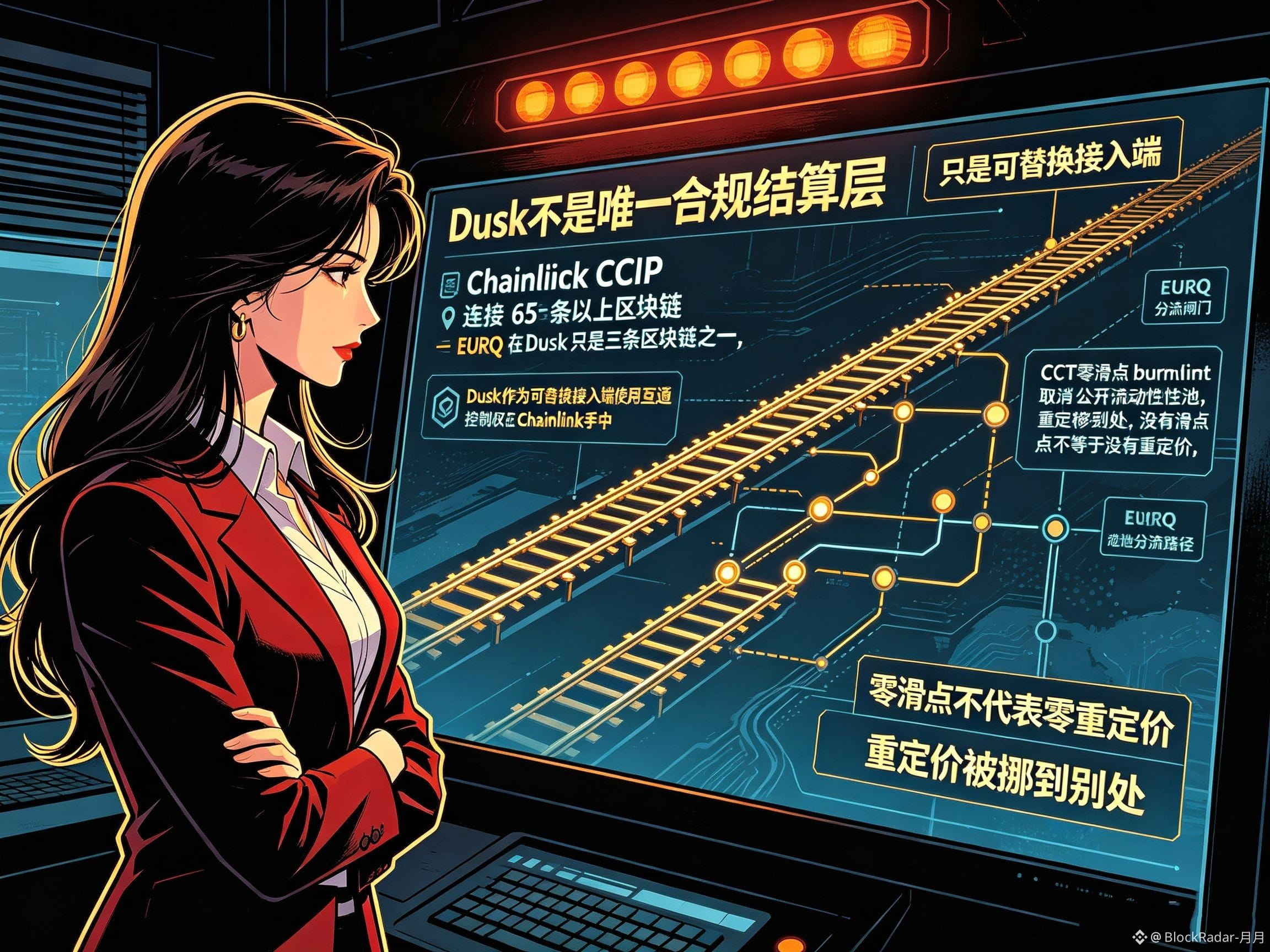
The system also does not deny substitutability. The materials admit that Chainlink CCIP has already supported more than 65 blockchains. In Dusk, EURQ is only “one of three blockchains.” Dusk is not the only compliant settlement layer; it’s a replaceable access point. The actual interoperability rails are held by Chainlink, and DUSK holders are simply paying to use that access. CCT’s zero-slippage burn/mint—when you look closely—cancels the public pricing venue of a liquidity pool and moves re-pricing elsewhere. No slippage doesn’t mean no re-pricing; it just means it’s been moved.
The risk trigger is simple, at least as far as the narrative is concerned: the numerator “€300 million” fails to keep up with the denominator “trillions of dollars.” EURQ’s circulating supply in Dusk stays below expectations long term; active addresses and the deviation from 17,500 remain persistently off-target. Then the market-paid future will be re-settled. What’s paid in advance isn’t the asset—it’s the expectation of a market size that doesn’t exist yet. The larger the denominator, the bigger the price gap that will have to be paid back later. #dusk
I’m not denying early pricing—I’m only objecting to treating the denominator as if it were the numerator. Budget it like a growth option, not a cash-flow asset. For exit, look at whether “the ratio of actual on-chain settlement scale to narrative scale continues to expand,” not at coin price volatility. Keep an eye on a few numbers day to day: on-chain AUM, DUSK gas consumption per transaction, EURQ’s circulating supply in Dusk, and the deviation between active addresses and 17,500. Trillions may arrive on their own—or they may never. Until then, the denominator is just a denominator.
DUSK’s position depends on actual throughput, not on the scale of the narrative. It’s gas—the cross-chain and settlement unit. Demand comes from real trades that accumulate over time. Holding $DUSK is like buying a forward cash flow where the denominator is “trillions” and the numerator is “€300 million.” The market likes to price what hasn’t appeared yet ahead of time—that’s not unusual. The problem is that, right now, even the anchor of such early pricing hasn’t formed a sufficient scale.
The system also does not deny substitutability. The materials admit that Chainlink CCIP has already supported more than 65 blockchains. In Dusk, EURQ is only “one of three blockchains.” Dusk is not the only compliant settlement layer; it’s a replaceable access point. The actual interoperability rails are held by Chainlink, and DUSK holders are simply paying to use that access. CCT’s zero-slippage burn/mint—when you look closely—cancels the public pricing venue of a liquidity pool and moves re-pricing elsewhere. No slippage doesn’t mean no re-pricing; it just means it’s been moved.
The risk trigger is simple, at least as far as the narrative is concerned: the numerator “€300 million” fails to keep up with the denominator “trillions of dollars.” EURQ’s circulating supply in Dusk stays below expectations long term; active addresses and the deviation from 17,500 remain persistently off-target. Then the market-paid future will be re-settled. What’s paid in advance isn’t the asset—it’s the expectation of a market size that doesn’t exist yet. The larger the denominator, the bigger the price gap that will have to be paid back later. #dusk
I’m not denying early pricing—I’m only objecting to treating the denominator as if it were the numerator. Budget it like a growth option, not a cash-flow asset. For exit, look at whether “the ratio of actual on-chain settlement scale to narrative scale continues to expand,” not at coin price volatility. Keep an eye on a few numbers day to day: on-chain AUM, DUSK gas consumption per transaction, EURQ’s circulating supply in Dusk, and the deviation between active addresses and 17,500. Trillions may arrive on their own—or they may never. Until then, the denominator is just a denominator.