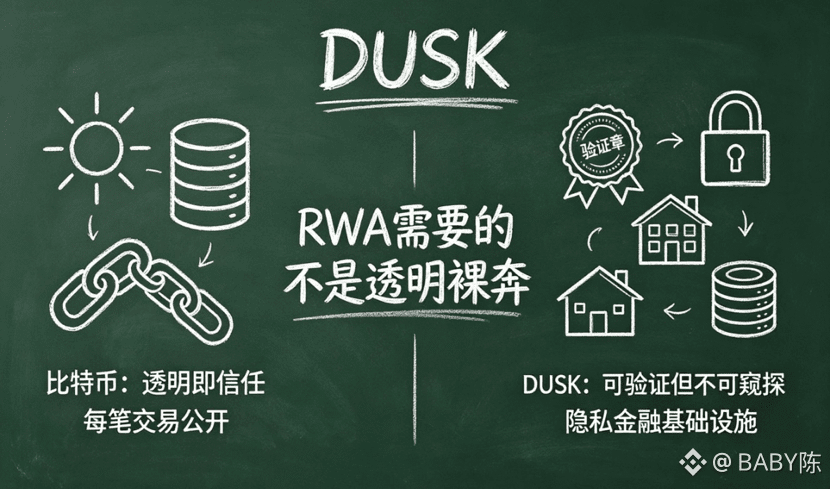
Bitcoin earns trust through transparency—every ledger entry is laid under the sun. That’s its strongest ace. But when you want to move real-world assets like real estate, private equity, and bonds onto the blockchain, this logic becomes a weakness instead.
Why would institutions expose their holdings details, trading strategies, and even their customers’ identities to everyone? This isn’t a technical problem—it’s a fundamental conflict in business logic.
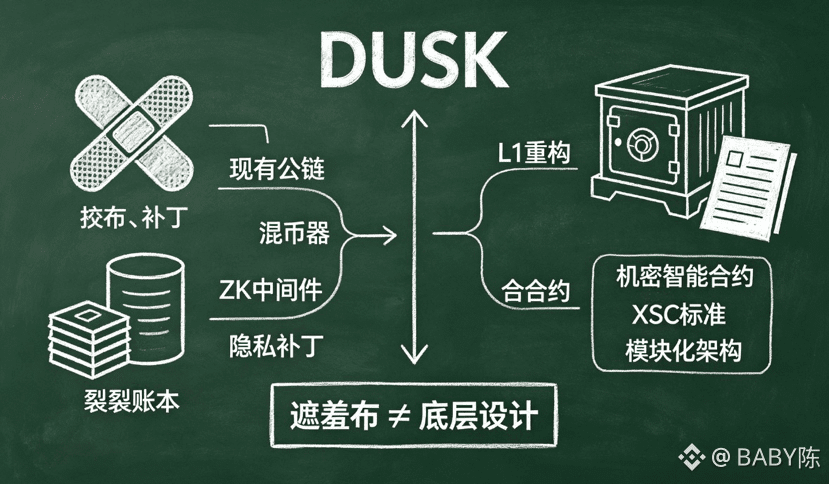
This contradiction has existed for a long time. The industry has tried all kinds of “patches” to cover it up—mixers, zero-knowledge proofs, privacy middleware. But a cover-up is still a cover-up; it never addresses the underlying issue.
Re-reading the Dusk documentation, I found that @Dusk took a completely different path. It doesn’t simply add privacy features on top of existing public chains. Instead, it goes back to the starting point and redesigns the entire financial infrastructure stack. Confidential smart contracts make data verifiable but not inspectable. The XSC standard provides a compliant issuance framework for equities and bonds, and modular decomposition ensures that privacy computation won’t drag down network efficiency.
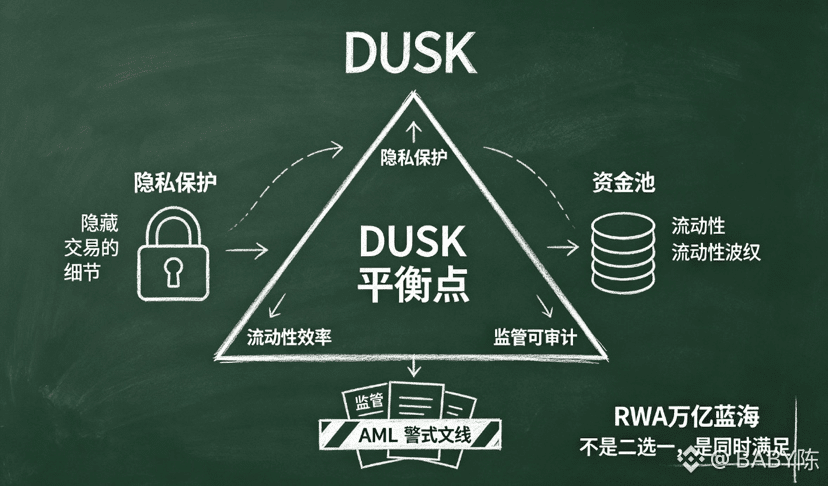
The clever part of this architecture is that it acknowledges: “transparent verification” and “privacy protection” are not an either-or choice—they must both be satisfied. You can verify that a transaction is authentic, without needing to know who the counterparties are or what the price was.
But here’s the question: when privacy becomes the default, won’t the risk of liquidity fragmentation increase as well? Under the strict enforcement lines of anti–money laundering, can this kind of “auditable privacy” truly satisfy regulators? If not, then the trillion-dollar blue-ocean of RWA will remain an illusion.
Discussion
For more than a decade, the industry has kept making trade-offs between transparency and privacy. Dusk chose not to make that trade-off. But if this balance really exists, why has only it rebuilt from the L1 layer over the years, rather than making do with Layer 2? Perhaps only when the market shifts from a “traffic game” to a compliance contest will this answer finally come to the surface. What do you think?
#dusk $DUSK @Dusk
Why would institutions expose their holdings details, trading strategies, and even their customers’ identities to everyone? This isn’t a technical problem—it’s a fundamental conflict in business logic.
This contradiction has existed for a long time. The industry has tried all kinds of “patches” to cover it up—mixers, zero-knowledge proofs, privacy middleware. But a cover-up is still a cover-up; it never addresses the underlying issue.
Re-reading the Dusk documentation, I found that @Dusk took a completely different path. It doesn’t simply add privacy features on top of existing public chains. Instead, it goes back to the starting point and redesigns the entire financial infrastructure stack. Confidential smart contracts make data verifiable but not inspectable. The XSC standard provides a compliant issuance framework for equities and bonds, and modular decomposition ensures that privacy computation won’t drag down network efficiency.
The clever part of this architecture is that it acknowledges: “transparent verification” and “privacy protection” are not an either-or choice—they must both be satisfied. You can verify that a transaction is authentic, without needing to know who the counterparties are or what the price was.
But here’s the question: when privacy becomes the default, won’t the risk of liquidity fragmentation increase as well? Under the strict enforcement lines of anti–money laundering, can this kind of “auditable privacy” truly satisfy regulators? If not, then the trillion-dollar blue-ocean of RWA will remain an illusion.
Discussion
For more than a decade, the industry has kept making trade-offs between transparency and privacy. Dusk chose not to make that trade-off. But if this balance really exists, why has only it rebuilt from the L1 layer over the years, rather than making do with Layer 2? Perhaps only when the market shifts from a “traffic game” to a compliance contest will this answer finally come to the surface. What do you think?
#dusk $DUSK @Dusk