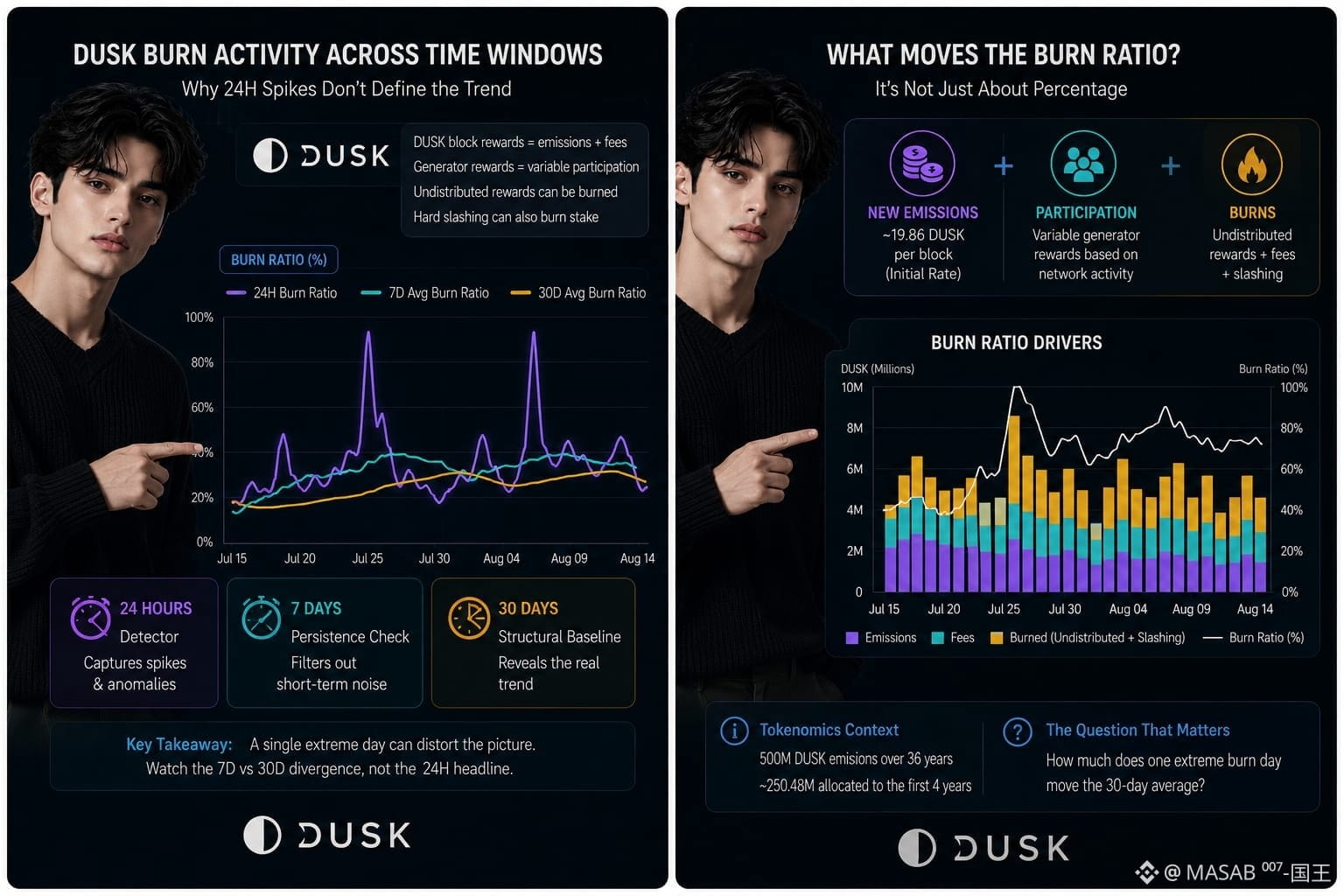

I was comparing how DUSK’s burn activity looks across different windows, and one thing kept bothering me: a dramatic 24-hour burn ratio can say very little about the underlying token economy.
The reason is mechanical.... DUSK block rewards combine newly emitted tokens with transaction fees, while generator rewards include a variable participation component. Any undistributed portion can be burned. Hard slashing can also burn stake.
That makes the daily number partly a measure of network behavior, not simply “deflation.” .....If participation changes sharply for a few hours, the burn ratio can jump without representing a lasting trend.
The scale matters too. Current tokenomics target 500 million DUSK of emissions over 36 years, with about 250.48 million allocated to the first four years. The initial emission rate is roughly 19.86 DUSK per block.
So I would treat 24 hours as a detector, 7 days as a persistence check, and 30 days as the structural baseline.
But a percentage alone hides whether the change came from fewer rewards, more burns, or both.
The uncomfortable question is: how much does one extreme burn day move the 30-day average?
That 7-day versus 30-day divergence is the number I would watch next.
@Dusk $DUSK #dusk
The reason is mechanical.... DUSK block rewards combine newly emitted tokens with transaction fees, while generator rewards include a variable participation component. Any undistributed portion can be burned. Hard slashing can also burn stake.
That makes the daily number partly a measure of network behavior, not simply “deflation.” .....If participation changes sharply for a few hours, the burn ratio can jump without representing a lasting trend.
The scale matters too. Current tokenomics target 500 million DUSK of emissions over 36 years, with about 250.48 million allocated to the first four years. The initial emission rate is roughly 19.86 DUSK per block.
So I would treat 24 hours as a detector, 7 days as a persistence check, and 30 days as the structural baseline.
But a percentage alone hides whether the change came from fewer rewards, more burns, or both.
The uncomfortable question is: how much does one extreme burn day move the 30-day average?
That 7-day versus 30-day divergence is the number I would watch next.
@Dusk $DUSK #dusk