Previously, I used to think proving you're eligible to invest always meant handing your personal data to whoever was checking it.
That was simply how KYC worked, or so I assumed.
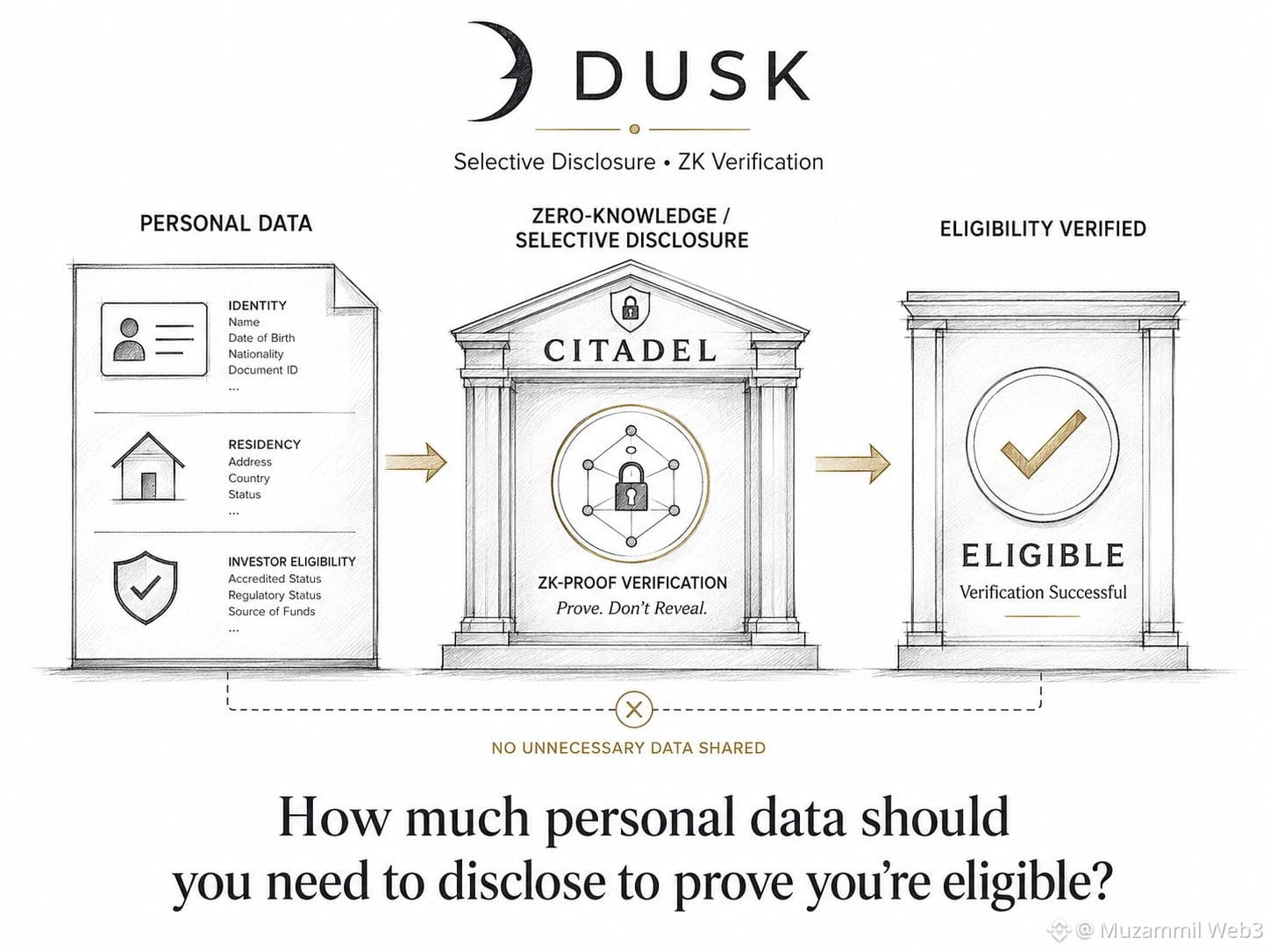
@Dusk 's materials made me question that assumption. Its Citadel framework uses zero-knowledge proofs and selective disclosure to let applications verify information such as eligibility or residency without requiring all of the underlying personal information to be exposed.
That changes the way I think about compliance.
The interesting part isn't simply keeping personal data private. It's separating proving that a condition is true from revealing all the information behind that condition.
For financial applications, that distinction could matter. An institution may need to know that an investor satisfies a requirement without necessarily needing access to every piece of personal information used to establish it.
I still want to see how this model works when real institutions and regulated processes have to rely on these proofs in practice.
The technology can reduce data exposure, but adoption ultimately depends on whether the verification model is trusted.
When you invest or trade, how much of your personal data should actually need to be disclosed just to prove you're eligible to participate?
#dusk $DUSK @Dusk
That was simply how KYC worked, or so I assumed.
@Dusk 's materials made me question that assumption. Its Citadel framework uses zero-knowledge proofs and selective disclosure to let applications verify information such as eligibility or residency without requiring all of the underlying personal information to be exposed.
That changes the way I think about compliance.
The interesting part isn't simply keeping personal data private. It's separating proving that a condition is true from revealing all the information behind that condition.
For financial applications, that distinction could matter. An institution may need to know that an investor satisfies a requirement without necessarily needing access to every piece of personal information used to establish it.
I still want to see how this model works when real institutions and regulated processes have to rely on these proofs in practice.
The technology can reduce data exposure, but adoption ultimately depends on whether the verification model is trusted.
When you invest or trade, how much of your personal data should actually need to be disclosed just to prove you're eligible to participate?
#dusk $DUSK @Dusk