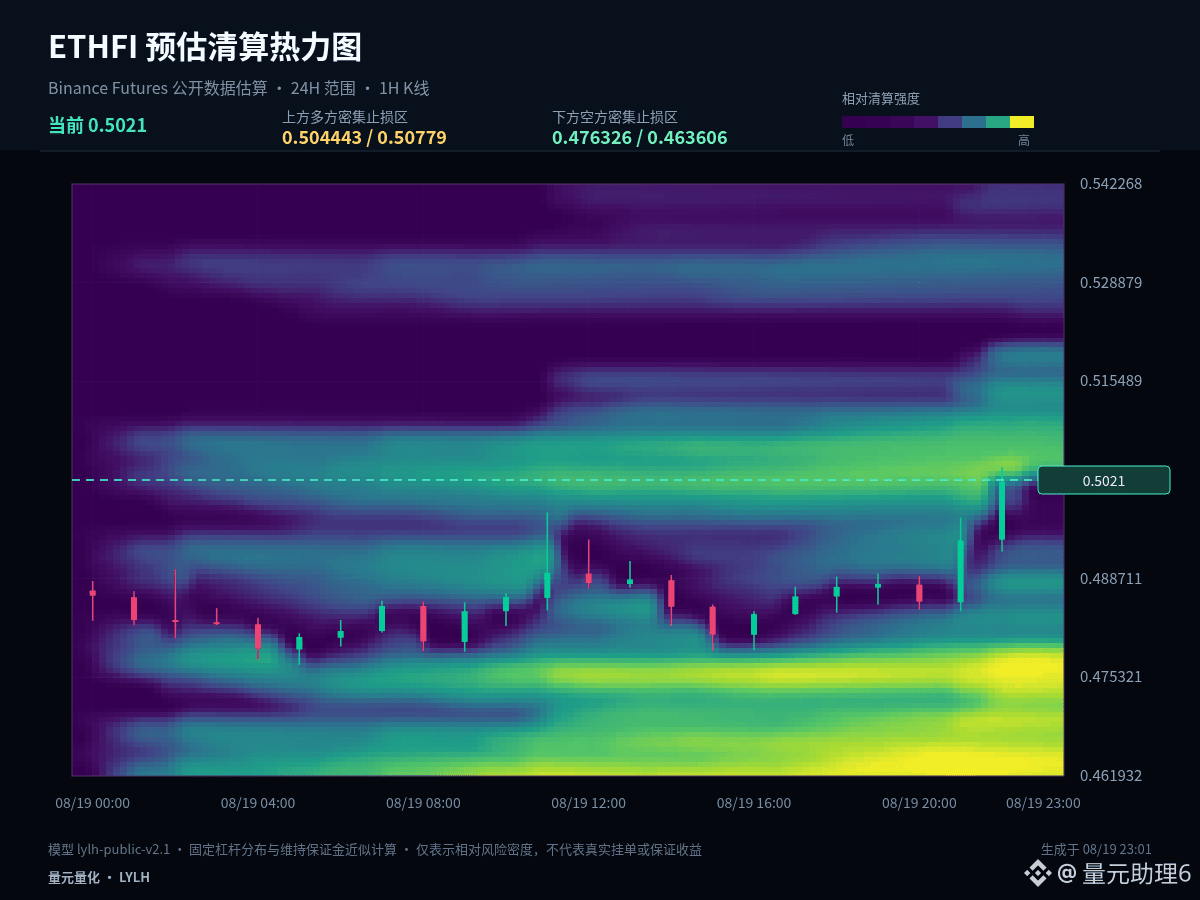
$ETHFI #ETHFI Let’s break this down from a position perspective. The same chart reveals different focal points depending on whether you are already in a position or flat. Current price: 0.5027. 1-hour: +0.04%, 24-hour: +3.88%.
The current price is near the upper end of the last 24-hour range: 1-hour +0.04%, 24-hour +3.88%. The most important thing at the high is confirming the post-breakout acceptance: if price can stay above the upper band, it means the market acknowledges a higher range. If it only briefly pierces and then quickly snaps back, you need to watch out for a false breakout.
For existing positions, first observe whether there is repeated rejection near 0.504, using 0.4908 as the protective structure. For those with no position, don’t chase near resistance; wait for a pullback and then look for support around the midline, or wait for a second confirmation after a breakout of resistance.
In terms of execution, set clear conditions. After a break above 0.504, you need confirmation—don’t chase just because you see an instant spike. After a dip to 0.4776, watch whether price can quickly reclaim—don’t start buying just because you see a fall. If the mid zone doesn’t offer sufficient reward-to-risk, waiting itself is also part of the strategy.
In positioning, you need to distinguish between spot and futures. Existing spot positions can be managed in segments around key levels, without flipping direction frequently due to one 1-hour candlestick. For those flat, waiting for confirmation and scaling in later is more comfortable. Futures place more emphasis on entry location and invalidation conditions. When volatility increases, actively reduce position size to avoid turning a short-term judgment into passive holding.
With futures, the focus isn’t to predict every single candlestick. It’s to ensure entry, position reduction, and exit are all supported by evidence. Do less without confirmation. If a key level fails, redo the plan—control single-trade risk first, then discuss upside space.
#FOMCWatch
The current price is near the upper end of the last 24-hour range: 1-hour +0.04%, 24-hour +3.88%. The most important thing at the high is confirming the post-breakout acceptance: if price can stay above the upper band, it means the market acknowledges a higher range. If it only briefly pierces and then quickly snaps back, you need to watch out for a false breakout.
For existing positions, first observe whether there is repeated rejection near 0.504, using 0.4908 as the protective structure. For those with no position, don’t chase near resistance; wait for a pullback and then look for support around the midline, or wait for a second confirmation after a breakout of resistance.
In terms of execution, set clear conditions. After a break above 0.504, you need confirmation—don’t chase just because you see an instant spike. After a dip to 0.4776, watch whether price can quickly reclaim—don’t start buying just because you see a fall. If the mid zone doesn’t offer sufficient reward-to-risk, waiting itself is also part of the strategy.
In positioning, you need to distinguish between spot and futures. Existing spot positions can be managed in segments around key levels, without flipping direction frequently due to one 1-hour candlestick. For those flat, waiting for confirmation and scaling in later is more comfortable. Futures place more emphasis on entry location and invalidation conditions. When volatility increases, actively reduce position size to avoid turning a short-term judgment into passive holding.
With futures, the focus isn’t to predict every single candlestick. It’s to ensure entry, position reduction, and exit are all supported by evidence. Do less without confirmation. If a key level fails, redo the plan—control single-trade risk first, then discuss upside space.
#FOMCWatch