On-chain DUSK data was originally just a random test action. Today, I spent a few extra seconds in the “coin-holding distribution” section.
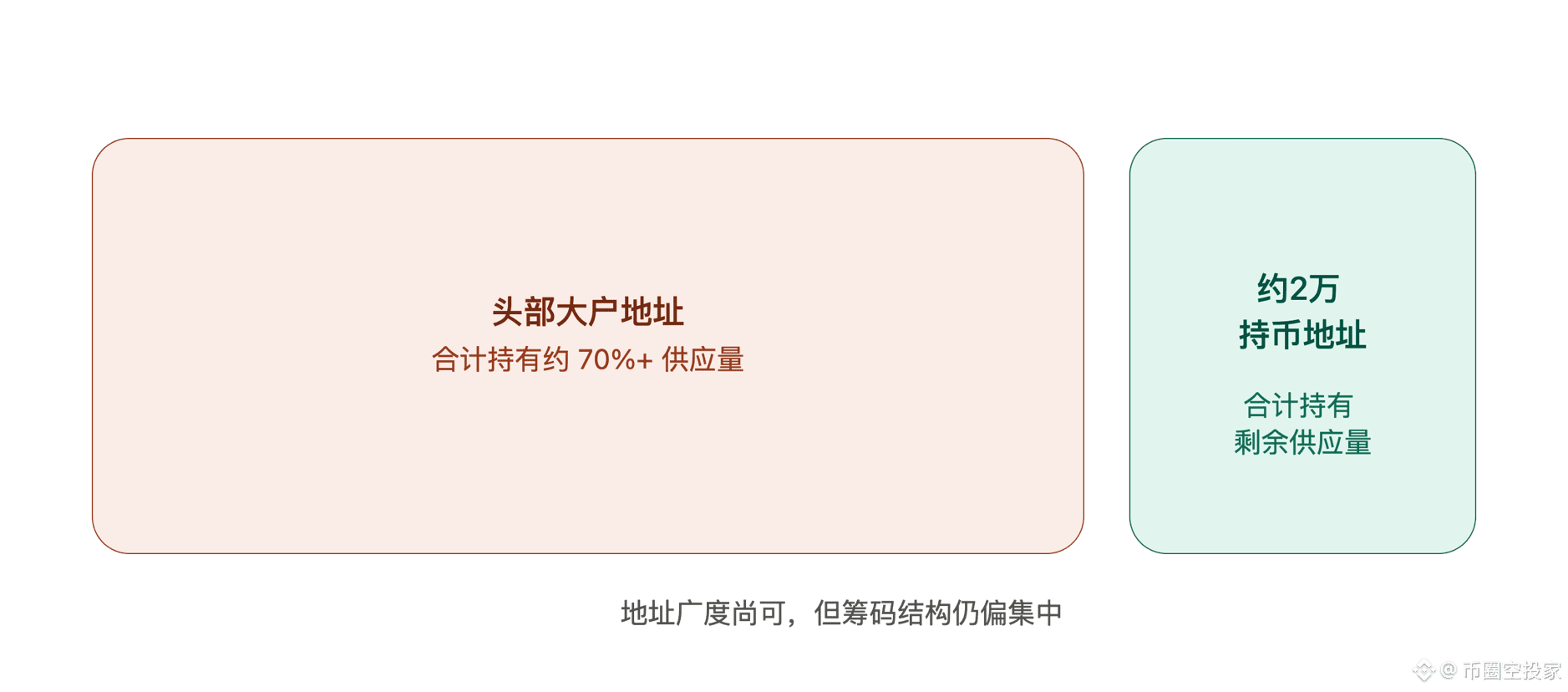
I checked a few on-chain tracking tools, and the concentration of top holdings seems to be around 70%. The number of addresses holding coins is close to 20,000, so breadth isn’t bad, but the token-coin allocation structure is still fairly concentrated. I can’t guarantee this figure is the latest precise value; I suggest you verify it yourself on Etherscan, but in terms of direction it generally matches the state of things after more than a year on the mainnet.
At first, my intuition was: high concentration = the risk of a sell-off at any moment. That conclusion is too blunt. Looking back at the token release mechanism—total supply is capped at 1 billion; only half is released initially, and the rest is gradually released to nodes over staking reward cycles spanning roughly a decade-plus to several decades. In theory, this part isn’t the traditional “early investors dump when it’s due” kind of sell-off logic. However, high concentration carries another risk that this release mechanism doesn’t resolve: if the whales themselves are addresses tied to early funds or teams, then even if they don’t actually sell, the mere expectation that “they might sell at any time” will still weigh on market sentiment and liquidity depth.
After I ran the numbers, I felt that looking at the concentration figure alone has limited meaning—it needs to be paired with a few other factors:
Let me list the risks and things to watch: the chips/tokens continue to unlock, but ecosystem consumption scenarios haven’t kept up, so the pressure will remain; on the institutional side, collaborations like NPEX and Quantoz are currently still on the order of tens of millions of euros—still far from the “long-term demand” envisioned in the token economics; the ratio of daily trading volume to market cap indicates liquidity is currently thin, and large in/out flows can easily cause noticeable slippage; if the regulatory framework itself changes, the current advantage of compliance “moat” could be redefined.
So I set some thresholds for myself: if the conditions aren’t met, I won’t add to the position. Specifically—(1) the holding concentration should show a trend of real, substantial decline, not just occasional fluctuations in a single quarter; (2) on-chain settlement volume should be able to stabilize at a higher magnitude, not propped up by one or two large demo transactions; (3) there should be at least one unofficial application that has been actively running in a real production environment for the long term.
Until all three are fulfilled, for me this position is still an “observation position,” not a “faith position.”
@Dusk #dusk $DUSK
I checked a few on-chain tracking tools, and the concentration of top holdings seems to be around 70%. The number of addresses holding coins is close to 20,000, so breadth isn’t bad, but the token-coin allocation structure is still fairly concentrated. I can’t guarantee this figure is the latest precise value; I suggest you verify it yourself on Etherscan, but in terms of direction it generally matches the state of things after more than a year on the mainnet.
At first, my intuition was: high concentration = the risk of a sell-off at any moment. That conclusion is too blunt. Looking back at the token release mechanism—total supply is capped at 1 billion; only half is released initially, and the rest is gradually released to nodes over staking reward cycles spanning roughly a decade-plus to several decades. In theory, this part isn’t the traditional “early investors dump when it’s due” kind of sell-off logic. However, high concentration carries another risk that this release mechanism doesn’t resolve: if the whales themselves are addresses tied to early funds or teams, then even if they don’t actually sell, the mere expectation that “they might sell at any time” will still weigh on market sentiment and liquidity depth.
After I ran the numbers, I felt that looking at the concentration figure alone has limited meaning—it needs to be paired with a few other factors:
Let me list the risks and things to watch: the chips/tokens continue to unlock, but ecosystem consumption scenarios haven’t kept up, so the pressure will remain; on the institutional side, collaborations like NPEX and Quantoz are currently still on the order of tens of millions of euros—still far from the “long-term demand” envisioned in the token economics; the ratio of daily trading volume to market cap indicates liquidity is currently thin, and large in/out flows can easily cause noticeable slippage; if the regulatory framework itself changes, the current advantage of compliance “moat” could be redefined.
So I set some thresholds for myself: if the conditions aren’t met, I won’t add to the position. Specifically—(1) the holding concentration should show a trend of real, substantial decline, not just occasional fluctuations in a single quarter; (2) on-chain settlement volume should be able to stabilize at a higher magnitude, not propped up by one or two large demo transactions; (3) there should be at least one unofficial application that has been actively running in a real production environment for the long term.
Until all three are fulfilled, for me this position is still an “observation position,” not a “faith position.”
@Dusk #dusk $DUSK