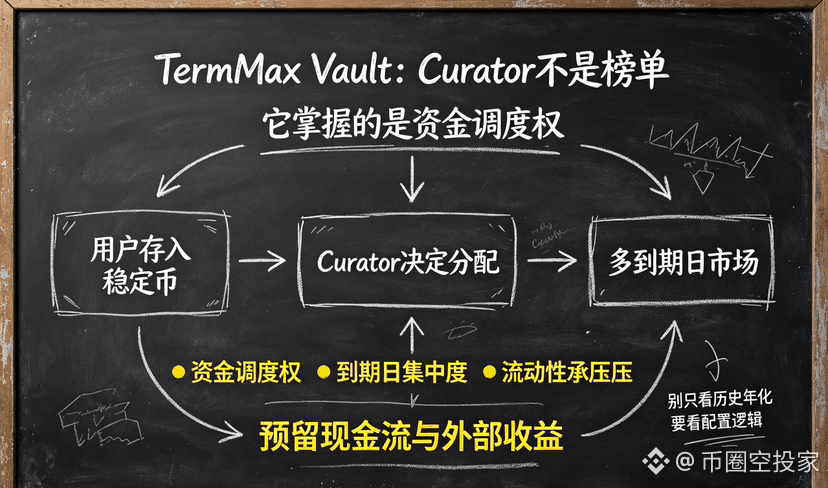
I took a closer look at the Vault portion of TermMax over the past couple of days, and I finally realized I’d been misunderstanding the curator. I used to think it was just a “strategy recommendation leaderboard,” showing different Vaults’ historical annualized returns so users could choose which one to deposit into. After reading the documentation, I found that’s completely not the case. What the curator actually holds is real, on-chain capital allocation power: when users deposit stablecoins into the Vault, the curator decides which markets across different maturity dates the funds should be allocated to, what the exposure cap should be for any single maturity date, whether to reserve part of the cash flow to handle redemptions, and even whether to route the idle portion to external protocols like Morpho to earn variable-yield incentive rates.
The benefits of this design are obvious. Most regular users don’t have the time or energy to monitor the depth and interest-rate curves across more than a dozen maturity dates every day, and they also don’t need to decide on their own whether a given market has enough liquidity. By delegating this to the curator for bulk decision-making, the efficiency is far higher than manually picking markets one by one. In effect, the Vault smooths out TermMax’s learning curve, which is otherwise pretty steep.
But what I care about more is the trust assumptions behind this mechanism. If the curator misconfigures maturity-date concentration—for example, by stacking most funds into the same maturity date—then if that date experiences concentrated redemptions or borrowers clustering for rollovers, the Vault’s liquidity can come under instant pressure. Or if the curator’s risk assessment for a certain type of collateral is off, and when collateral prices swing violently liquidations aren’t handled fast enough, those losses are shared by all depositors in the Vault. Unlike off-chain asset management, where you can replace the manager if performance misses targets, on-chain you can only withdraw your funds yourself, and withdrawals themselves also take time and depend on liquidity windows.
So when I look at a Vault now, I don’t just focus on the historical annualized returns shown on the surface. I first check whether, in the curator’s past management, there have been any incidents of maturity-date congestion, how quickly liquidations were handled, and whether at the protocol layer there are hard caps on positions for a single maturity date. Whether the capital-allocation work is done well usually isn’t noticeable when everything is calm and uneventful. The real test is always the moment maturity dates get crowded and market conditions become volatile—this is when the curator’s configuration logic is fully exposed.
@TermMax #TermMax
The benefits of this design are obvious. Most regular users don’t have the time or energy to monitor the depth and interest-rate curves across more than a dozen maturity dates every day, and they also don’t need to decide on their own whether a given market has enough liquidity. By delegating this to the curator for bulk decision-making, the efficiency is far higher than manually picking markets one by one. In effect, the Vault smooths out TermMax’s learning curve, which is otherwise pretty steep.
But what I care about more is the trust assumptions behind this mechanism. If the curator misconfigures maturity-date concentration—for example, by stacking most funds into the same maturity date—then if that date experiences concentrated redemptions or borrowers clustering for rollovers, the Vault’s liquidity can come under instant pressure. Or if the curator’s risk assessment for a certain type of collateral is off, and when collateral prices swing violently liquidations aren’t handled fast enough, those losses are shared by all depositors in the Vault. Unlike off-chain asset management, where you can replace the manager if performance misses targets, on-chain you can only withdraw your funds yourself, and withdrawals themselves also take time and depend on liquidity windows.
So when I look at a Vault now, I don’t just focus on the historical annualized returns shown on the surface. I first check whether, in the curator’s past management, there have been any incidents of maturity-date congestion, how quickly liquidations were handled, and whether at the protocol layer there are hard caps on positions for a single maturity date. Whether the capital-allocation work is done well usually isn’t noticeable when everything is calm and uneventful. The real test is always the moment maturity dates get crowded and market conditions become volatile—this is when the curator’s configuration logic is fully exposed.
@TermMax #TermMax