I used to think putting financial assets on a blockchain was mostly a technology problem.
Put the asset on-chain, make it tradable, and let the blockchain handle the rest.
But the more I looked at DUSK, the more I started to question that idea.
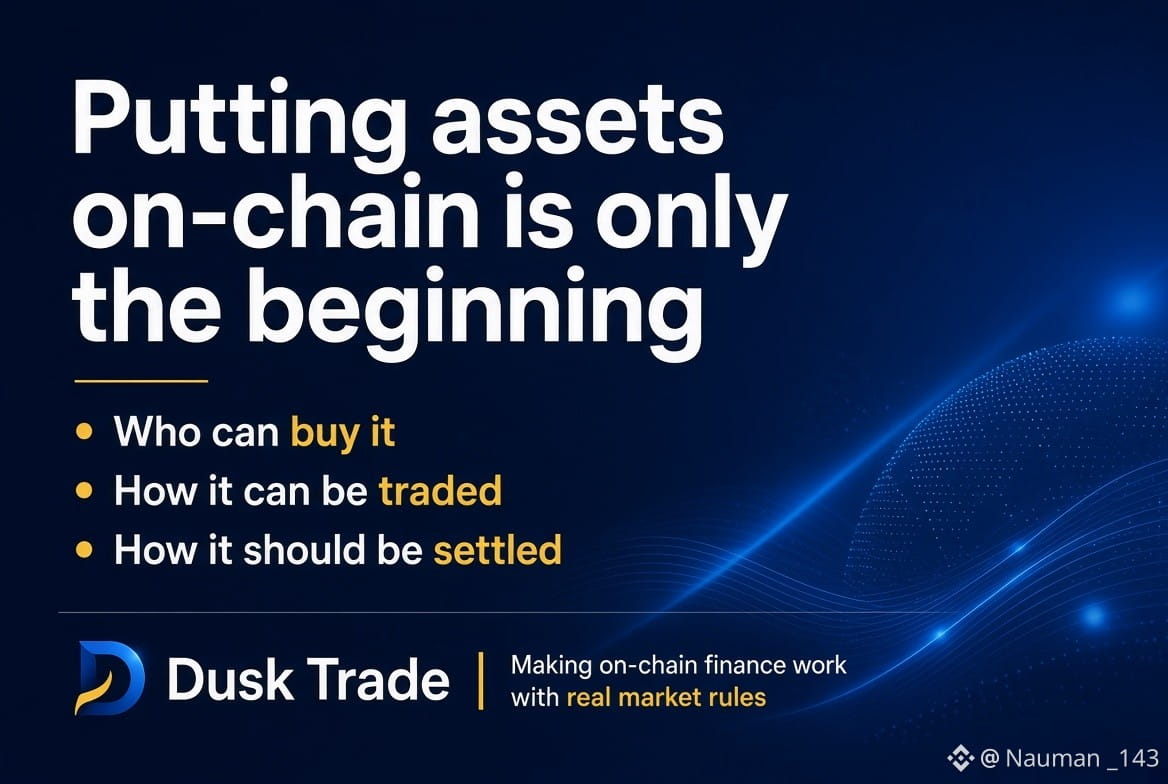
If the asset is a bond, ETF, or money market fund, putting it on-chain is only the beginning.
There are still rules around who can buy it, how it can be traded, and how the transaction should be settled.
That is what made Dusk Trade interesting to me.
It is not presented simply as another place to trade crypto tokens. The idea is to bring assets from traditional financial markets into a blockchain-based environment while keeping the rules around those assets in mind.
That changes how I look at tokenization.
It isn't just about making an asset digital.
The harder part may be making that digital asset usable inside a market where compliance, access, trading, and settlement still matter.
And honestly, this is the part of DUSK I find more interesting.
Blockchain can make assets programmable, but real financial markets have rules that cannot simply be ignored.
So maybe the bigger challenge isn't putting finance on-chain.
Maybe it's making on-chain finance work with the rules that real finance already has.
That is the part of DUSK I want to keep watching.
Do you think bringing traditional financial assets on-chain is more about technology, or about making technology work with existing financial rules?
#DUSK @Dusk $DUSK
$BTW
$HEMI
Put the asset on-chain, make it tradable, and let the blockchain handle the rest.
But the more I looked at DUSK, the more I started to question that idea.
If the asset is a bond, ETF, or money market fund, putting it on-chain is only the beginning.
There are still rules around who can buy it, how it can be traded, and how the transaction should be settled.
That is what made Dusk Trade interesting to me.
It is not presented simply as another place to trade crypto tokens. The idea is to bring assets from traditional financial markets into a blockchain-based environment while keeping the rules around those assets in mind.
That changes how I look at tokenization.
It isn't just about making an asset digital.
The harder part may be making that digital asset usable inside a market where compliance, access, trading, and settlement still matter.
And honestly, this is the part of DUSK I find more interesting.
Blockchain can make assets programmable, but real financial markets have rules that cannot simply be ignored.
So maybe the bigger challenge isn't putting finance on-chain.
Maybe it's making on-chain finance work with the rules that real finance already has.
That is the part of DUSK I want to keep watching.
Do you think bringing traditional financial assets on-chain is more about technology, or about making technology work with existing financial rules?
#DUSK @Dusk $DUSK
$BTW
$HEMI