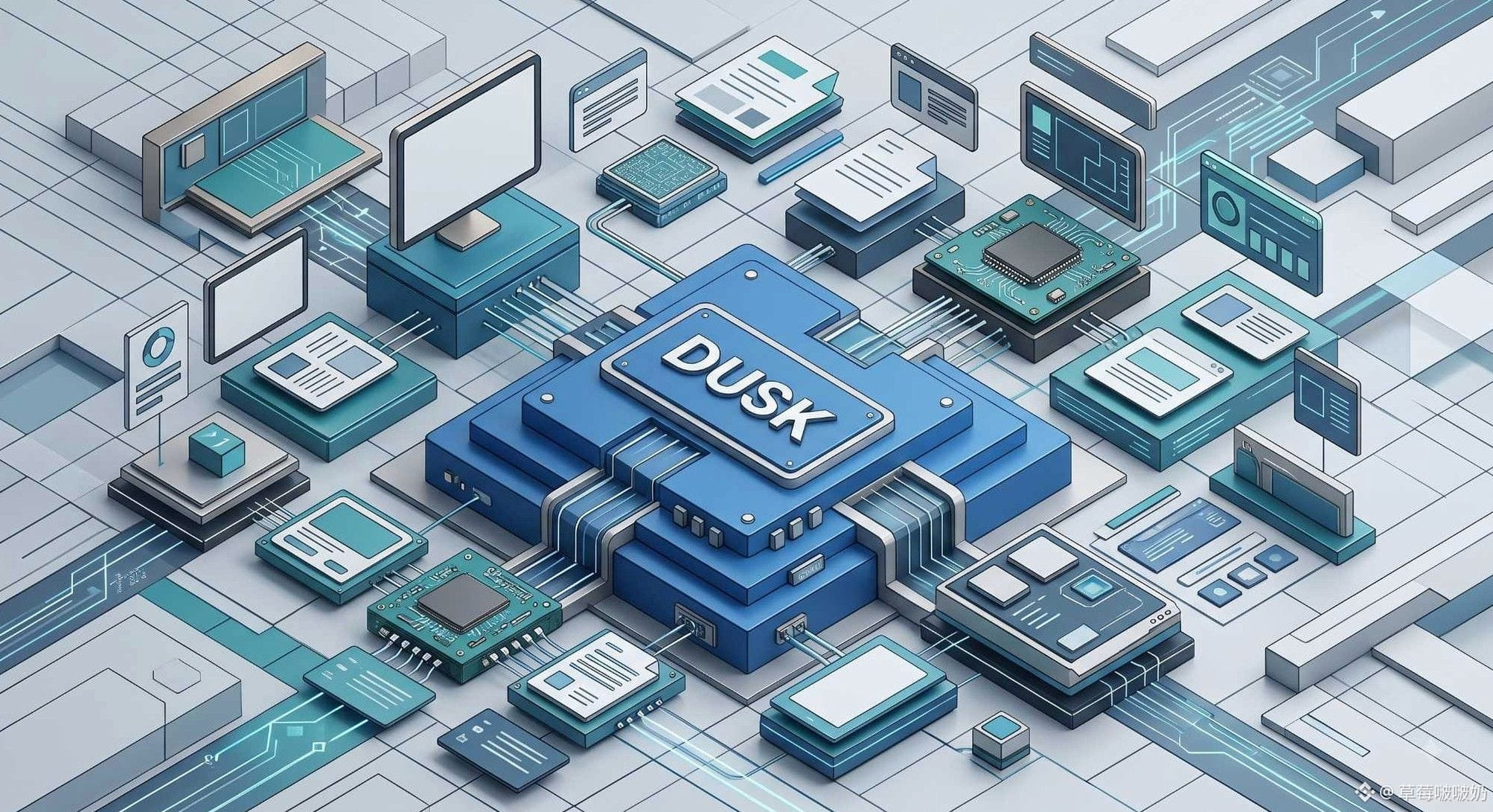
When I watched @DuskFoundation release Dusk Connect and the new wallet preview this year, I cared more about which part of the usage flow it filled in—not how many endpoints it supports. The old Web Wallet could transfer and manage assets, but it was more like a standalone page. It was hard for dApps to be standardized in discovering the wallet, requesting accounts, and initiating signatures. For developers, this isn’t a minor UX issue—the app entry point simply isn’t connected.
Dusk Connect provides a unified provider interface, using a method similar to EIP-6963 to discover compatible wallets. It covers account requests, signatures, transactions, and network methods. The new first-party wallet plan will cover browser extensions, desktop, and mobile, supporting public and private transfers, shield/unshield, staking, reward claiming, and DRC-20 and DRC-721 assets. Keys remain local, with different encryption storage schemes across different devices. The product direction is very complete, but the official positioning at the moment is still a developer preview.
This means that the easiest thing to misread right now is to treat “the code repository being open” directly as user growth. The real stress test will happen in details like dApp permission requests, private transaction generation, network switching, failure retries, and mobile recovery. As long as the authorization prompts aren’t clear, users may not know what the app actually obtained. As long as switching between private and public addresses is ambiguous, even the most complete cryptography can lose at the operational layer.
So for #dusk ’s next phase, I don’t think it will just be about counting wallet download numbers. What’s more worth watching is the number of active dApps integrated with Connect, connection success rates, signature rejections and error distributions, time-to-completion for private transfers, whether permission revocation is intuitive, and how many steps a newcomer has to go from installation to completing their first $DUSK action.
Dusk’s technical story ultimately has to pass through the wallet layer. Contracts can be written, and networks can settle payments—that only shows the foundation exists. It’s only when users can understand permissions, get stable signatures, and recover after errors that the product loop truly starts to form.
@Dusk $BTW $STAR
Dusk Connect provides a unified provider interface, using a method similar to EIP-6963 to discover compatible wallets. It covers account requests, signatures, transactions, and network methods. The new first-party wallet plan will cover browser extensions, desktop, and mobile, supporting public and private transfers, shield/unshield, staking, reward claiming, and DRC-20 and DRC-721 assets. Keys remain local, with different encryption storage schemes across different devices. The product direction is very complete, but the official positioning at the moment is still a developer preview.
This means that the easiest thing to misread right now is to treat “the code repository being open” directly as user growth. The real stress test will happen in details like dApp permission requests, private transaction generation, network switching, failure retries, and mobile recovery. As long as the authorization prompts aren’t clear, users may not know what the app actually obtained. As long as switching between private and public addresses is ambiguous, even the most complete cryptography can lose at the operational layer.
So for #dusk ’s next phase, I don’t think it will just be about counting wallet download numbers. What’s more worth watching is the number of active dApps integrated with Connect, connection success rates, signature rejections and error distributions, time-to-completion for private transfers, whether permission revocation is intuitive, and how many steps a newcomer has to go from installation to completing their first $DUSK action.
Dusk’s technical story ultimately has to pass through the wallet layer. Contracts can be written, and networks can settle payments—that only shows the foundation exists. It’s only when users can understand permissions, get stable signatures, and recover after errors that the product loop truly starts to form.
@Dusk $BTW $STAR