I’ve been looking at DUSK’s Hedger and one thing keeps bothering me.
Calling it a “privacy blockchain” doesn’t really explain why I find it interesting.
The better question is:
What if financial apps could behave like normal EVM apps without showing the whole world everything they’re doing?
That’s a much harder problem.
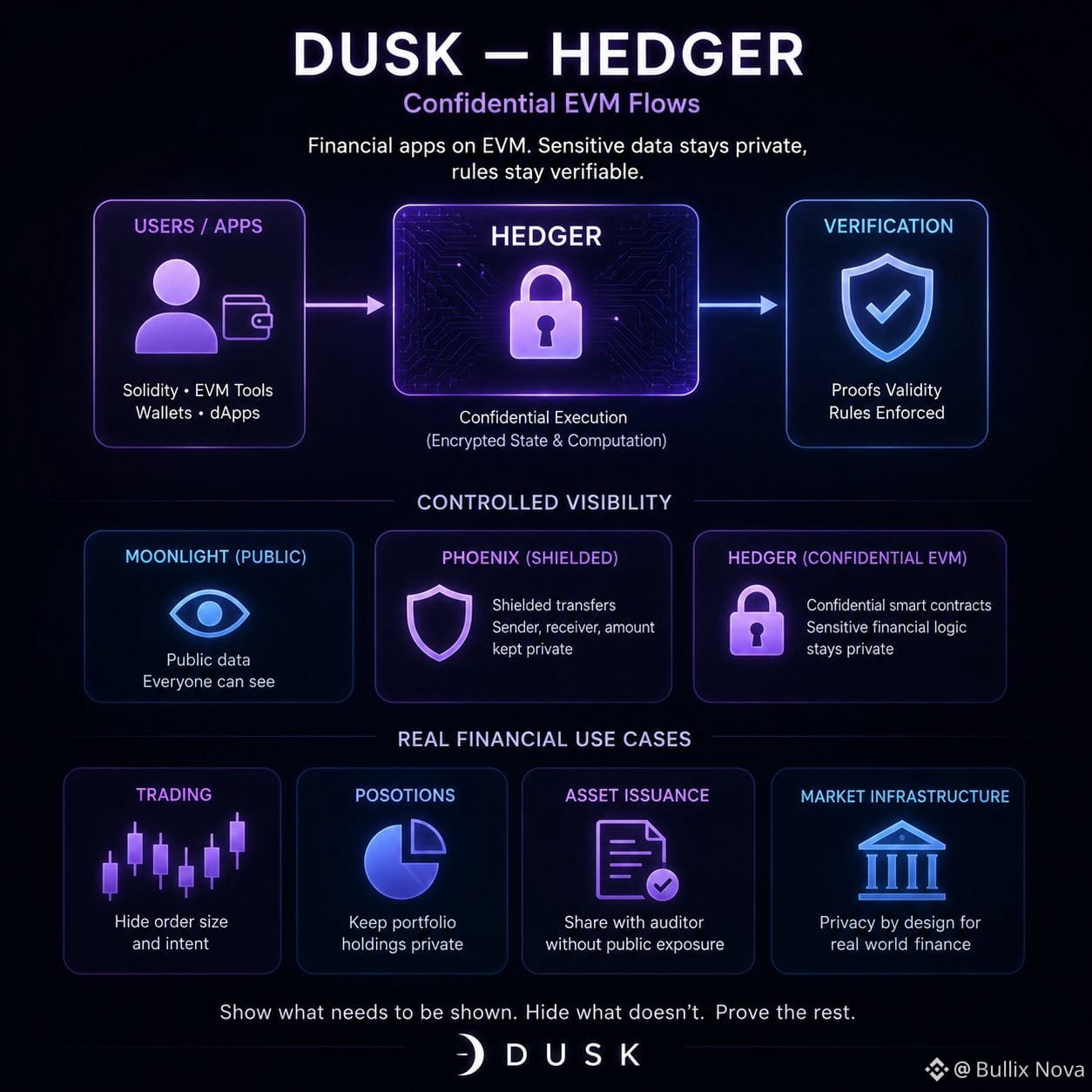
Hedger sits on DuskEVM, so on the surface it still feels familiar — Solidity, EVM tooling, the usual developer environment.
Underneath, Dusk is trying to keep sensitive financial data private while the network can still verify that the rules were followed.
That distinction is easy to miss.
Privacy here isn’t about becoming invisible.
It’s about not leaking information you never needed to publish.
Think about trading.
If I place a large order, I don’t want the whole market watching it.
If I hold a large position, I don’t want everyone knowing the exact size.
If I’m issuing an asset, I may want an auditor or regulator to see certain details without publishing everything.
That’s where Hedger starts making sense.
Not “hide everything.”
More like:
show what needs to be shown. hide what doesn’t. prove the rest.
And Dusk treats privacy as something more nuanced than one big switch — public flows, shielded transfers, and confidential EVM execution through Hedger.
That feels much closer to how real financial systems work.
Because complete transparency sounds great until you think like a trader.
Then you realize some information being public isn’t openness.
It’s leakage.
That’s the quiet part of Hedger.
It’s not trying to make blockchains disappear.
It’s trying to make them a little less predictable to everyone watching.
And for financial applications, that may matter more than the word “privacy” itself.
#dusk $DUSK @Dusk