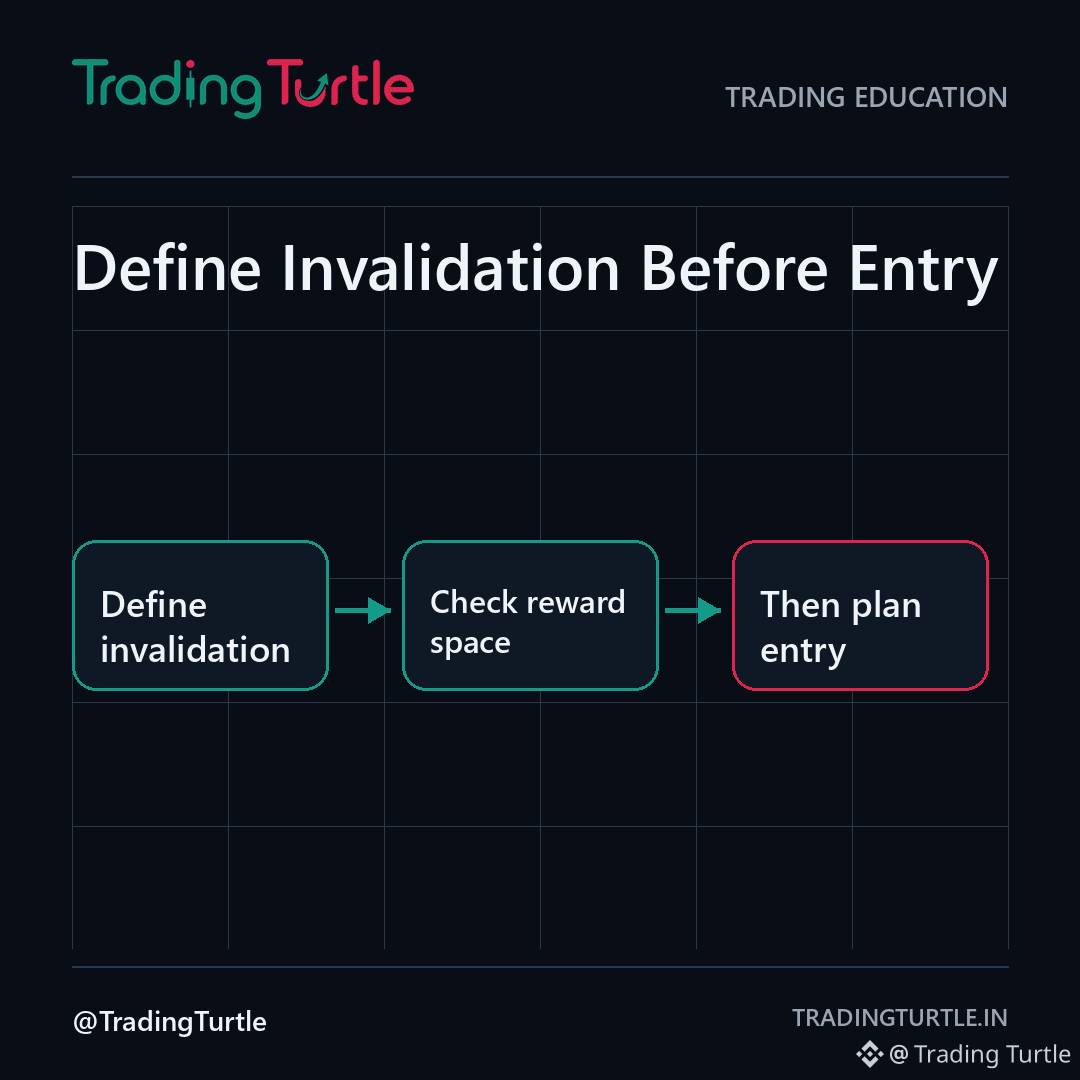
Define Invalidation Before Setting an Entry
1. Identify the core thesis of the setup (e.g., price will break the resistance because momentum is strong).
2. Ask: What specific market move would prove this thesis wrong? Write that condition down as the invalidation point.
3. Verify that the invalidation point is observable on the chart before you even consider an entry price (e.g., a close below the swing low for a long bias).
4. Only after the invalidation is clearly defined, calculate risk: place the stop at the invalidation level and size the position so that loss equals your predefined risk unit.
5. Confirm that the reward target is at least twice the distance to the invalidation; if not, discard or adjust the setup.
A trade is not fully defined until you know exactly what will invalidate the idea; use that point to set entry, stop, and position size.
#TradingTurtle #PositionSizing #RiskManagement
1. Identify the core thesis of the setup (e.g., price will break the resistance because momentum is strong).
2. Ask: What specific market move would prove this thesis wrong? Write that condition down as the invalidation point.
3. Verify that the invalidation point is observable on the chart before you even consider an entry price (e.g., a close below the swing low for a long bias).
4. Only after the invalidation is clearly defined, calculate risk: place the stop at the invalidation level and size the position so that loss equals your predefined risk unit.
5. Confirm that the reward target is at least twice the distance to the invalidation; if not, discard or adjust the setup.
A trade is not fully defined until you know exactly what will invalidate the idea; use that point to set entry, stop, and position size.
#TradingTurtle #PositionSizing #RiskManagement