
Delos Q&A: Decoding the Agent Era and the Road to Web4.0
Welcome to the Collaborative City of Delos
A new kind of conversation is unfolding in the crypto and Web3 space, and it's happening inside something called "Delos" — described as a "collaborative city" where community questions are answered through a series called *Delos Q&A: Messenger's Answer*. The first installment of this series has just dropped, and it tackles three of the most important — and most confusing — concepts shaping the next phase of blockchain and AI convergence: **Agents**, **execution programs**, and **Web4.0**.
If you've been active on Binance Square or following the broader crypto discourse lately, you've probably noticed the word "Agent" popping up everywhere — attached to tokens, protocols, and entire new narratives. But what does it actually mean? Delos aims to answer exactly that.
---
Today's Big Question: What Exactly Is an Agent?
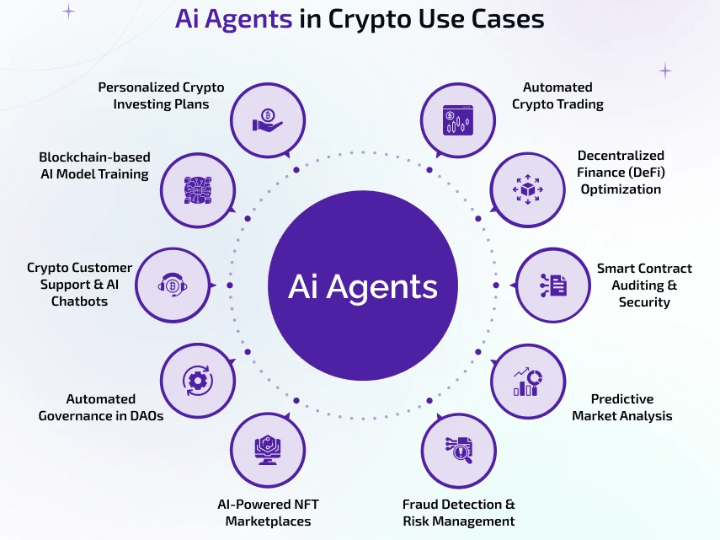
In the simplest terms, an **AI Agent** is not just a piece of software that follows a fixed script. It is a system designed to perceive its environment, make autonomous decisions, and take actions toward a goal — without requiring a human to manually approve every single step. In the crypto context, this means an Agent could analyze on-chain data, execute trades, manage a wallet, interact with smart contracts, or even negotiate with other Agents, all based on a set of objectives it has been given.
This is a fundamental shift from how most crypto tools have worked until now. A trading bot, for example, typically follows pre-programmed rules: if X happens, do Y. An Agent, on the other hand, is expected to reason, adapt, and make judgment calls in situations its creators didn't explicitly anticipate.
---
Agent vs. Execution Program: What's the Real Difference?
This is where a lot of confusion happens, and it's the second question Delos tackles directly.
An **execution program** is deterministic. It's a fixed sequence of instructions — think of a smart contract function, a script, or a bot that always does the same thing under the same conditions. It has no independent judgment; it simply executes what it was told to execute, every time, in the same way.
An **Agent**, by contrast, is closer to a decision-maker. It can:
- Interpret goals rather than just following rigid commands
- Adjust its behavior based on new information
- Chain multiple actions together dynamically
- Potentially coordinate with other Agents to achieve a shared or competing objective
Put simply: an execution program is the "hand" that carries out a task, while an Agent is closer to the "mind" that decides what needs to be done and how. Many next-generation crypto products are now being built where Agents sit on top of execution programs — the Agent decides, the execution program acts.
---
So What Is Web4.0?
This is arguably the most forward-looking part of the Delos Q&A. If Web1.0 was about reading static information, Web2.0 was about interactive platforms and social media, and Web3.0 introduced decentralization, ownership, and on-chain assets — then **Web4.0** is being framed as the era where autonomous Agents become first-class citizens of the internet and blockchain economy.
In a Web4.0 vision, it's not just humans and wallets interacting with dApps. It's Agents — representing users, protocols, or even other Agents — transacting, negotiating, and building on-chain relationships largely without direct human micromanagement. Humans set the goals and boundaries; Agents handle the execution, adaptation, and even some of the strategic decision-making.
This is why the "Agent era" is being positioned as more than just another buzzword cycle. It represents a structural shift in how value moves and how decisions get made across decentralized networks.
---
Why This Matters for the Crypto Market Right Now
The timing of this narrative isn't random. As **$BTC**, **$BNB**, and **$ETH** continue to anchor the broader market, the "AI Agent" narrative has become one of the most talked-about themes of the current cycle. Projects that combine autonomous AI decision-making with on-chain execution are attracting significant attention, and platforms like Delos are positioning themselves as an entry point into this emerging space — a place where the community can learn the fundamentals before diving into the tokens, protocols, and products built around this theme.
For traders and investors, understanding the distinction between a simple execution bot and a true autonomous Agent isn't just academic — it's becoming essential to evaluating which projects have real technical substance versus which are simply riding the trend with buzzwords.
---
🌊 The Entry Point to the Agent Era
Delos closes its first installment with an invitation: if you're looking for your entry point into the Agent era, more answers are coming. This suggests an ongoing educational series designed to build a foundational understanding of Agents, execution logic, and the Web4.0 framework before the ecosystem matures further.
As the market continues to watch **$BTC**, **$BNB**, and **$ETH** for direction, the conversation around Agents and Web4.0 is likely to keep growing louder. Whether this becomes the next major narrative shift or simply an evolving piece of the broader Web3 story, one thing is clear: understanding the difference between a script that executes and an Agent that decides will be a valuable skill for anyone navigating the next phase of crypto.