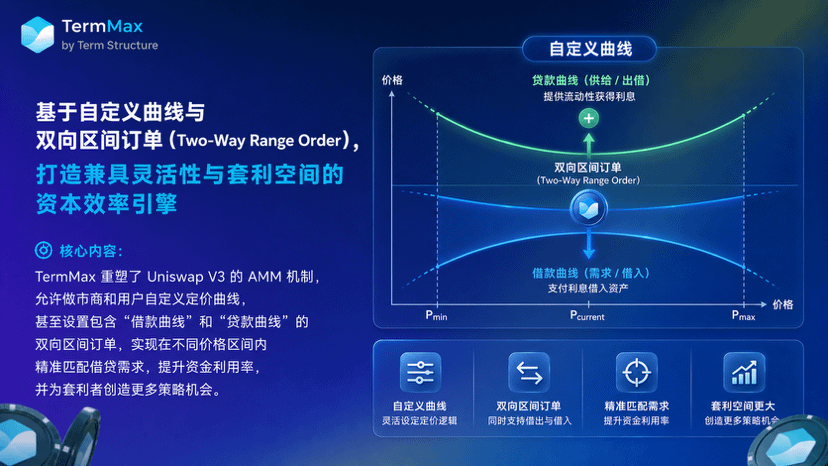
When researching DeFi lending protocols, I have a habit: before I look at how they brag about capital efficiency, I first check what the order structure actually allows users to do. Many protocols claim they’re highly efficient—then you go in and find that it’s basically just utilization maxed out, and you’re offered a passive APY, with almost no room for users to actively act. My view started to change when I looked at TermMax’s bidirectional range orders.
It takes the concentrated liquidity idea from Uniswap V3 into the interest-rate market, but goes one step further than V3. In V3, you choose a price range to provide liquidity. TermMax lets you place two curves at the same time: one curve for the interest-rate range you’re willing to lend at, and another for the range you’re willing to borrow at. The spread between the two curves is your profit. It’s not the protocol calculating a “good APY” for you to passively accept—you’re the one defining your pricing strategy.
What makes me think more is the arbitrage space. If you judge that floating rates are too high, you can lend at a fixed rate (@TermMax ) while borrowing in the floating market, locking in the spread. More directly: if a borrower notices their FT is trading at a discount in the secondary market, buying it back means repaying debt early at a lower cost. This is something people do all the time in traditional bond markets—yet in on-chain lending, almost no protocols give you this kind of tool.
That said, this setup isn’t low-barrier. Customizing curves means you need to predict interest-rate movements—if you draw them wrong, you’re precisely losing money. Bidirectional orders sound flexible, but if only a small number of professional market makers are playing, liquidity concentrates in a few large accounts. Casual users who enter are likely just to be the counterparty. “Capital efficiency” sounds great, but the prerequisite is that you have capital and the right understanding—missing either one means you can’t make it work.
What I want to see now isn’t just how clever the mechanism is. It’s the real order book depth: how many people place bidirectional range orders, what the spread distribution looks like, and whether borrowers truly would go back to repurchase FTs. Until the data runs, the capital efficiency engine is still only a design.#termmax
Have you done active interest-rate strategies in DeFi, or are you mostly just passively eating APY?
It takes the concentrated liquidity idea from Uniswap V3 into the interest-rate market, but goes one step further than V3. In V3, you choose a price range to provide liquidity. TermMax lets you place two curves at the same time: one curve for the interest-rate range you’re willing to lend at, and another for the range you’re willing to borrow at. The spread between the two curves is your profit. It’s not the protocol calculating a “good APY” for you to passively accept—you’re the one defining your pricing strategy.
What makes me think more is the arbitrage space. If you judge that floating rates are too high, you can lend at a fixed rate (@TermMax ) while borrowing in the floating market, locking in the spread. More directly: if a borrower notices their FT is trading at a discount in the secondary market, buying it back means repaying debt early at a lower cost. This is something people do all the time in traditional bond markets—yet in on-chain lending, almost no protocols give you this kind of tool.
That said, this setup isn’t low-barrier. Customizing curves means you need to predict interest-rate movements—if you draw them wrong, you’re precisely losing money. Bidirectional orders sound flexible, but if only a small number of professional market makers are playing, liquidity concentrates in a few large accounts. Casual users who enter are likely just to be the counterparty. “Capital efficiency” sounds great, but the prerequisite is that you have capital and the right understanding—missing either one means you can’t make it work.
What I want to see now isn’t just how clever the mechanism is. It’s the real order book depth: how many people place bidirectional range orders, what the spread distribution looks like, and whether borrowers truly would go back to repurchase FTs. Until the data runs, the capital efficiency engine is still only a design.#termmax
Have you done active interest-rate strategies in DeFi, or are you mostly just passively eating APY?