I’ve been looking at TermMax less as another DeFi lending protocol and more as an attempt to separate parts of risk that are usually packaged together.
What caught my attention is the FT/XT structure.
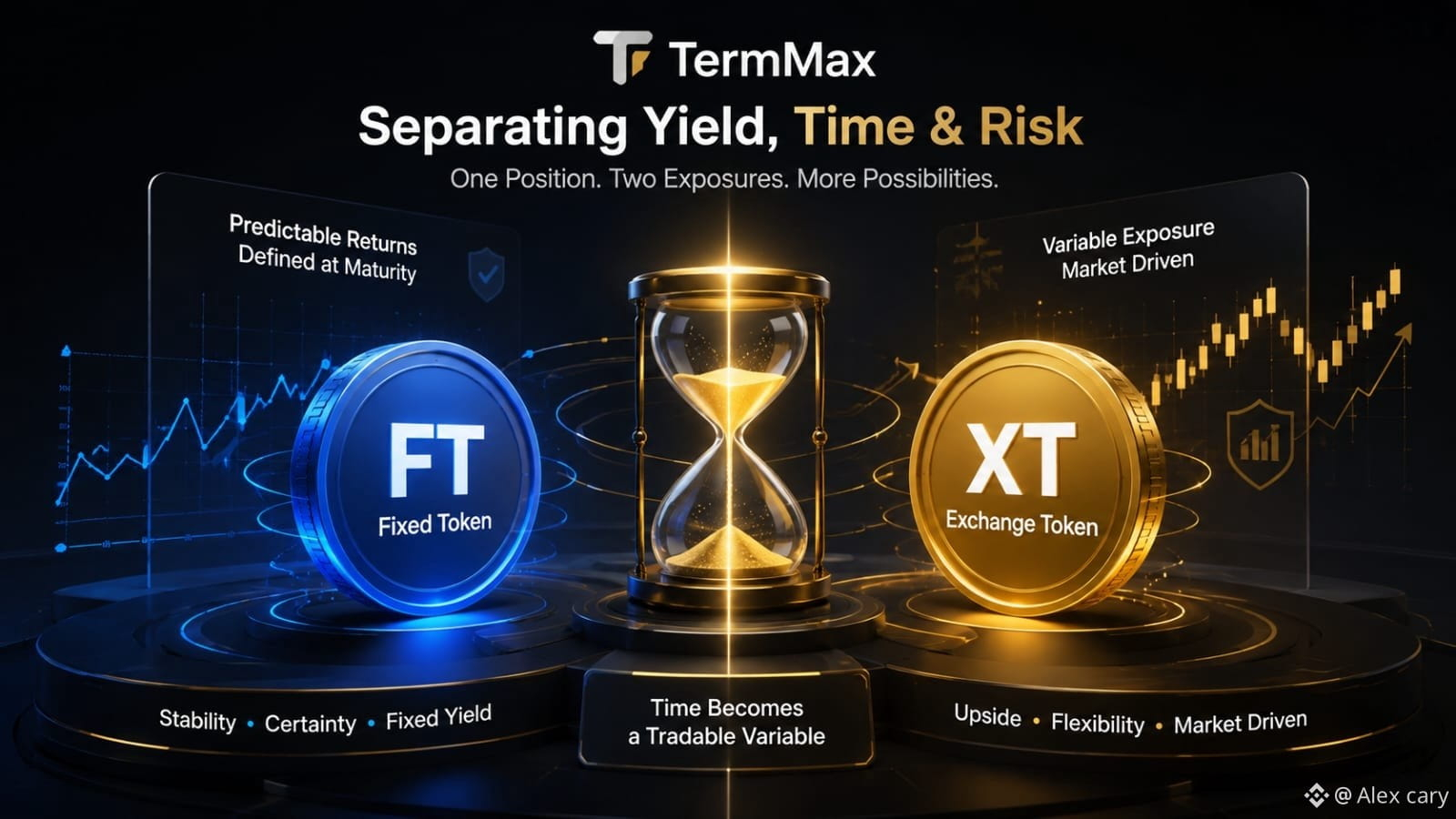
Instead of treating one yield-bearing asset as a single position, TermMax splits the exposure into two different instruments. The Fixed Token gives a defined claim toward maturity, while the Exchange Token keeps the remaining variable exposure.
That separation is more interesting than the terminology suggests.
For me, the important idea is that time itself becomes something the market can price. If an FT trades below its maturity value, the difference can reflect the return implied by holding it until maturity. That makes the position conceptually closer to a fixed-income instrument than a typical floating-rate DeFi loan.
But I think the bigger question is risk separation.
A user may want predictable returns without taking the same level of market exposure as the underlying asset. Another participant may prefer the variable upside and accept the uncertainty. TermMax creates a framework where those preferences can potentially exist in separate markets.
Still, I wouldn’t judge the model only by how clean the mechanism looks on paper.
The harder test is liquidity.
What happens when volatility rises, buyers disappear, or FT and XT markets become inefficient? That is where the difference between an elegant financial structure and a resilient one becomes visible.
From my perspective, TermMax is interesting because it is experimenting with something DeFi has struggled to represent cleanly: the ability to separate yield, time, and asset exposure instead of treating them as one bundled risk.
That is the part worth watching.
@TermMax #TermMax
What caught my attention is the FT/XT structure.
Instead of treating one yield-bearing asset as a single position, TermMax splits the exposure into two different instruments. The Fixed Token gives a defined claim toward maturity, while the Exchange Token keeps the remaining variable exposure.
That separation is more interesting than the terminology suggests.
For me, the important idea is that time itself becomes something the market can price. If an FT trades below its maturity value, the difference can reflect the return implied by holding it until maturity. That makes the position conceptually closer to a fixed-income instrument than a typical floating-rate DeFi loan.
But I think the bigger question is risk separation.
A user may want predictable returns without taking the same level of market exposure as the underlying asset. Another participant may prefer the variable upside and accept the uncertainty. TermMax creates a framework where those preferences can potentially exist in separate markets.
Still, I wouldn’t judge the model only by how clean the mechanism looks on paper.
The harder test is liquidity.
What happens when volatility rises, buyers disappear, or FT and XT markets become inefficient? That is where the difference between an elegant financial structure and a resilient one becomes visible.
From my perspective, TermMax is interesting because it is experimenting with something DeFi has struggled to represent cleanly: the ability to separate yield, time, and asset exposure instead of treating them as one bundled risk.
That is the part worth watching.
@TermMax #TermMax