Last night I pored over DUSK’s technical documentation until midnight, repeatedly drawing lines through the chapters on Phoenix’s covert trading model and Piecrust zkVM. I noticed a niche detail that very few people mention: its state-transition validation mechanism, left in a read-only proof interface unlocked by a specific key at the circuit level for compliance purposes (Selective Auditability).@Dusk
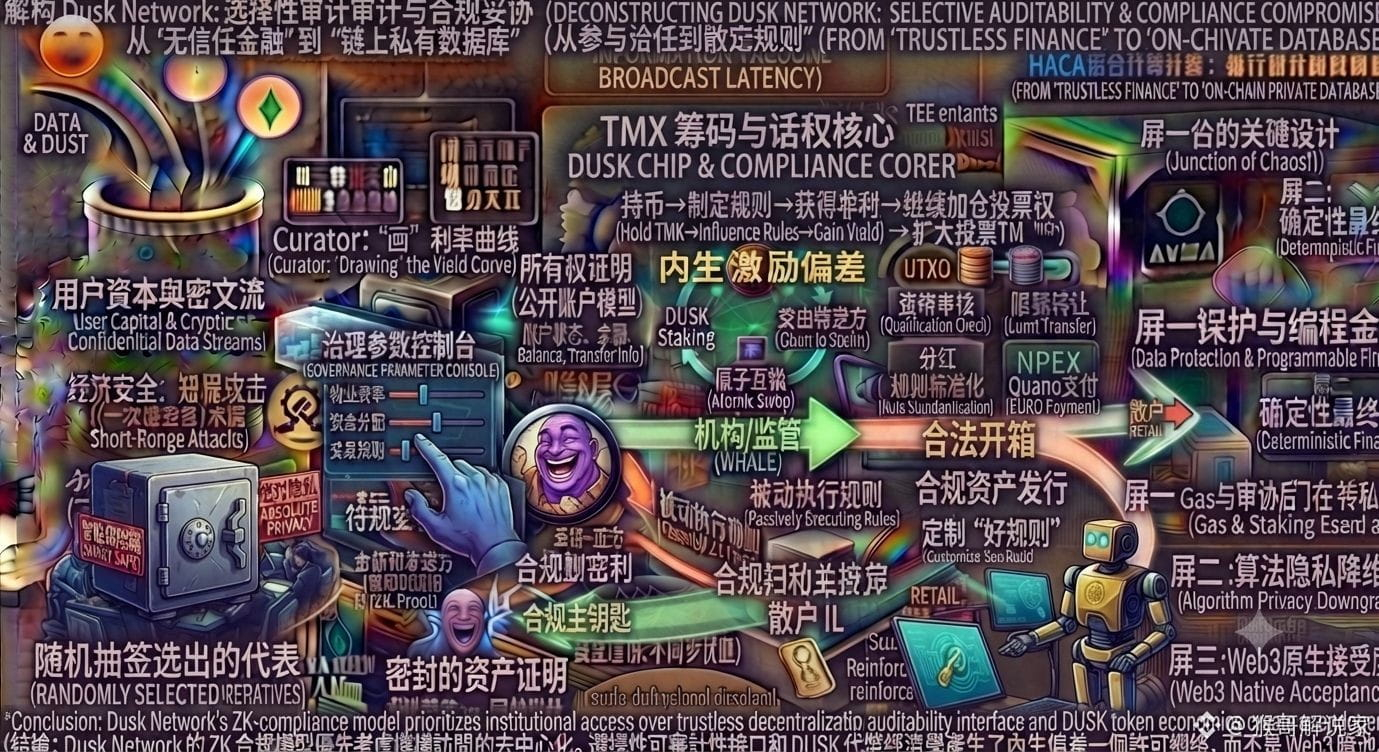
This leads to a central paradox: is this L1, claiming privacy compliance, truly doing trustless Web3-native finance—or is it just giving traditional institutions a shell to build an on-chain private database?
The market’s conventional thinking is “ZK + compliance = the best solution for RWA,” and everyone blindly worships the mathematical beauty of zero-knowledge proofs, while ignoring the biggest blind spot: as long as the compliance audit backdoor/guardianship authority exists, algorithmic privacy can instantly be reduced to a lower dimension in the face of administrative compliance.
It’s like you buy an “absolutely private” smart safe (a ZK circuit) with an exquisitely designed lock mechanism; but the whitepaper, in fine print, says that regulators and certain nodes hold a master key (an audit key). Once specific conditions are triggered, they can legally open it.
At this point, the role of the native token $DUSK is especially worth pondering. On the surface it’s for governance and Gas; in essence, it’s a pricing tool for compliance rules and a game-theoretic stake. When the compliance boundary, the review-node threshold, and Gas fee rates are all decided by votes from large Stakers, it creates a very strong intrinsic incentive bias—whales can use their token advantage to set rule preferences favorable to institutional compliance. After gaining the power to shape the rules, they can then make crazy profits in compliance business, and the profits they earn are restaked to further amplify their voting power.
I’m genuinely impressed by its underlying engineering execution in zkVM and deterministic finality (SA consensus). But my core concern is that the masses mistake it for a dark pool that “protects retail users’ privacy.” In reality, it’s a compliance network that prioritizes institutional compliance—sometimes even sacrificing decentralization. True privacy doesn’t need compliance permission; what usually needs compliance permission is only the chain-ified permission chain.
Do you think this “half-compromised privacy,” which leaves an interface for regulators, can really be accepted by Web3-native funds in the future? Let’s discuss in the comments.
#dusk $DUSK @Dusk
This leads to a central paradox: is this L1, claiming privacy compliance, truly doing trustless Web3-native finance—or is it just giving traditional institutions a shell to build an on-chain private database?
The market’s conventional thinking is “ZK + compliance = the best solution for RWA,” and everyone blindly worships the mathematical beauty of zero-knowledge proofs, while ignoring the biggest blind spot: as long as the compliance audit backdoor/guardianship authority exists, algorithmic privacy can instantly be reduced to a lower dimension in the face of administrative compliance.
It’s like you buy an “absolutely private” smart safe (a ZK circuit) with an exquisitely designed lock mechanism; but the whitepaper, in fine print, says that regulators and certain nodes hold a master key (an audit key). Once specific conditions are triggered, they can legally open it.
At this point, the role of the native token $DUSK is especially worth pondering. On the surface it’s for governance and Gas; in essence, it’s a pricing tool for compliance rules and a game-theoretic stake. When the compliance boundary, the review-node threshold, and Gas fee rates are all decided by votes from large Stakers, it creates a very strong intrinsic incentive bias—whales can use their token advantage to set rule preferences favorable to institutional compliance. After gaining the power to shape the rules, they can then make crazy profits in compliance business, and the profits they earn are restaked to further amplify their voting power.
I’m genuinely impressed by its underlying engineering execution in zkVM and deterministic finality (SA consensus). But my core concern is that the masses mistake it for a dark pool that “protects retail users’ privacy.” In reality, it’s a compliance network that prioritizes institutional compliance—sometimes even sacrificing decentralization. True privacy doesn’t need compliance permission; what usually needs compliance permission is only the chain-ified permission chain.
Do you think this “half-compromised privacy,” which leaves an interface for regulators, can really be accepted by Web3-native funds in the future? Let’s discuss in the comments.
#dusk $DUSK @Dusk