Last night I was browsing the DUSK whitepaper and, in the section on Proof-of-Blind Bid (blind-bid consensus), I kept staring at the threshold ranges (V_RAW_MIN/MAX) for validation nodes when generating ZK zero-knowledge proofs, as well as the logic for calculating auction-ticket weights. I wrestled with it for a long time. When people discuss RWA and regulatory-compliant privacy, they often assume that as long as you combine ZK-SNARKs with institutional KYC, everything will be fine—but most people overlook a blind spot: whether the underlying consensus nodes’ “secret ticket draw” mechanism can end up being reverse-captured by capital concentration.
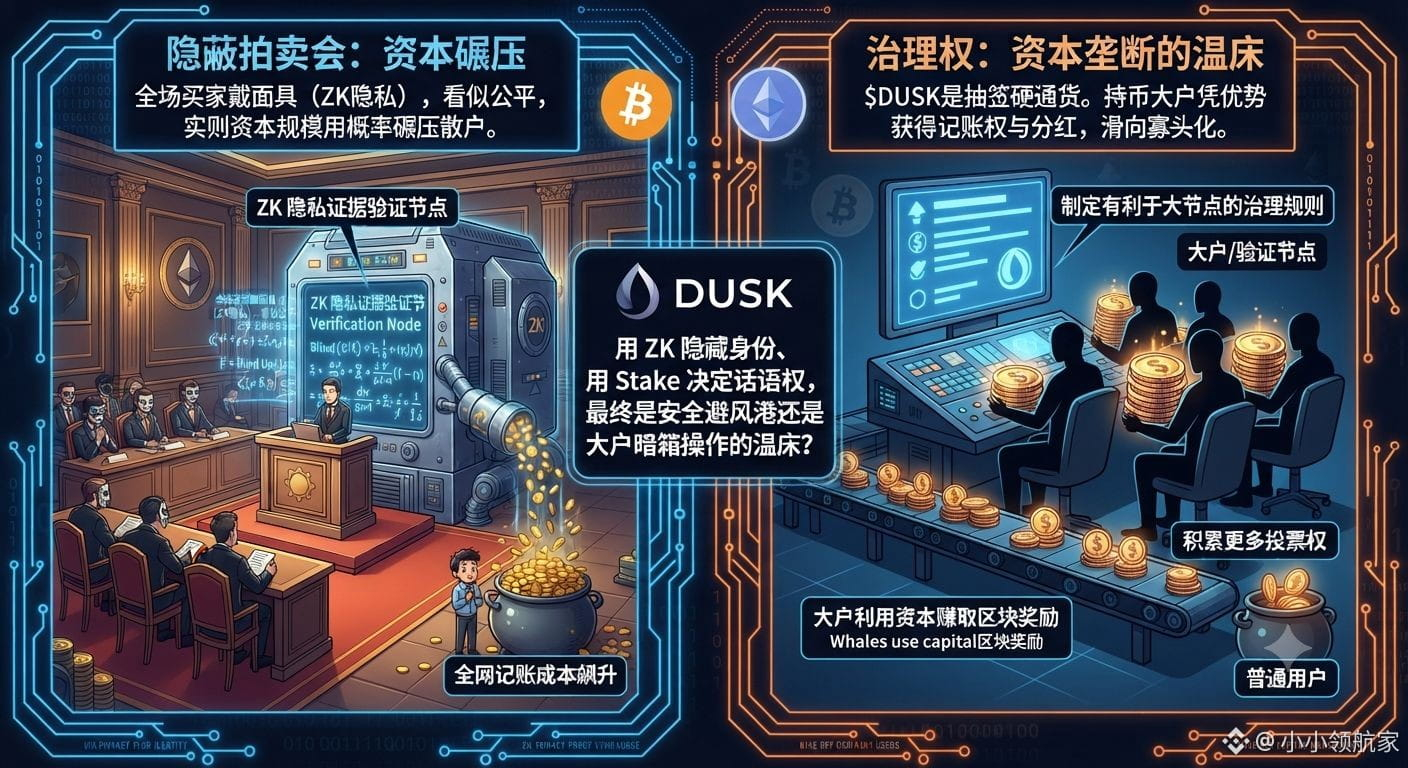
It’s like going to a back-alley sealed-bid auction. The rules say everyone puts their bid in a black box (a ZK proof). On the surface, nobody can see who bid what, guaranteeing privacy and fairness. But in reality, the player with the most chips can buy hundreds or thousands of “entry-number” tickets at once. Even if each individual blind selection probability is balanced, the sheer size of capital can easily overwhelm retail participants with probability alone.
In this mechanism, DUSK tokens are not just Gas and governance credentials—they’re the hard currency for this “sealed-bid ticket draw.” The built-in incentive distortion is glaring: large holders with huge token balances can use their token advantage to more easily obtain the right to produce blocks and earn Gas dividends, thereby accumulating even more voting power to shape governance rules that favor major nodes. What looks like perfect privacy compliance can still slide, within the underlying economic structure, toward capital oligopoly where the rich get richer.
My stance is very clear: DUSK’s design of deeply integrating zero-knowledge proofs into the consensus mechanism is truly impressive—but blindly praising “institution-level privacy compliance” is meaningless. The counterintuitive part is this: the more a blockchain chain pursues extreme privacy, the more difficult its economic model’s oligarchic tendency may be to detect and monitor on-chain.
Do you think this design—“hide identity with ZK, decide voice power with Stake”—will ultimately become an institutional safe harbor, or a hotbed for big players to manipulate everything behind the scenes? Feel free to discuss in the comments.
#dusk $DUSK @Dusk
It’s like going to a back-alley sealed-bid auction. The rules say everyone puts their bid in a black box (a ZK proof). On the surface, nobody can see who bid what, guaranteeing privacy and fairness. But in reality, the player with the most chips can buy hundreds or thousands of “entry-number” tickets at once. Even if each individual blind selection probability is balanced, the sheer size of capital can easily overwhelm retail participants with probability alone.
In this mechanism, DUSK tokens are not just Gas and governance credentials—they’re the hard currency for this “sealed-bid ticket draw.” The built-in incentive distortion is glaring: large holders with huge token balances can use their token advantage to more easily obtain the right to produce blocks and earn Gas dividends, thereby accumulating even more voting power to shape governance rules that favor major nodes. What looks like perfect privacy compliance can still slide, within the underlying economic structure, toward capital oligopoly where the rich get richer.
My stance is very clear: DUSK’s design of deeply integrating zero-knowledge proofs into the consensus mechanism is truly impressive—but blindly praising “institution-level privacy compliance” is meaningless. The counterintuitive part is this: the more a blockchain chain pursues extreme privacy, the more difficult its economic model’s oligarchic tendency may be to detect and monitor on-chain.
Do you think this design—“hide identity with ZK, decide voice power with Stake”—will ultimately become an institutional safe harbor, or a hotbed for big players to manipulate everything behind the scenes? Feel free to discuss in the comments.
#dusk $DUSK @Dusk