#termmax @TermMax
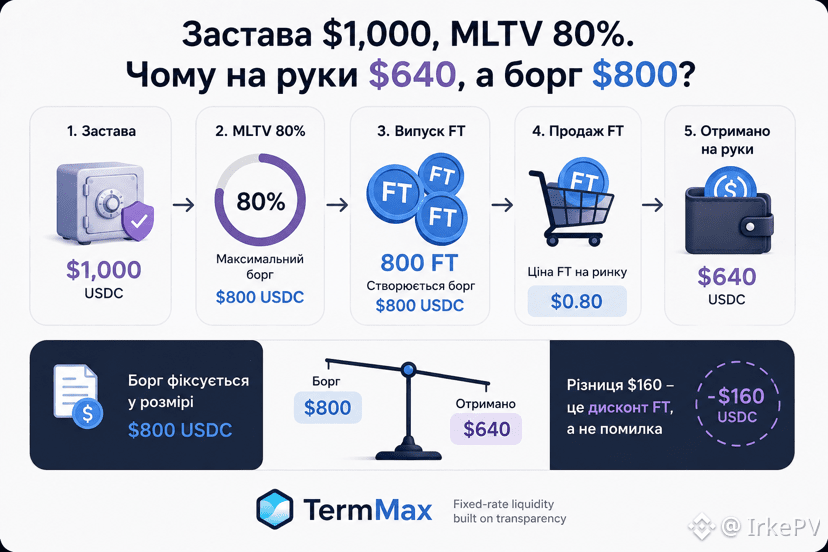
Collateral $1,000, MLTV 80%. Why in @TermMax you can get $640 in hand, while the debt will be $800?
At first the numbers throw you off a bit. But that’s exactly how FT mechanics work in TermMax.
With MLTV at 80%, collateral of $1,000 allows you to create a maximum debt of 800 USDC. For that, 800 FT are minted.
And 1 FT until the maturity date is not necessarily worth $1. It trades at a discount.
If the FT price is $0.80, the math is:
800 FT × $0.80 = $640 USDC
In the end:
$1,000 collateral
$800 debt
$640 received
The $160 difference didn’t “disappear.” It’s built into the FT discount—effectively, it’s reflected in the fixed borrowing price up to the maturity date.
So MLTV 80% in TermMax is not “I receive 80% of the collateral value.” It’s the debt ceiling, and the actual amount of USDC you receive also depends on the market price of FT.
Collateral $1,000, MLTV 80%. Why in @TermMax you can get $640 in hand, while the debt will be $800?
At first the numbers throw you off a bit. But that’s exactly how FT mechanics work in TermMax.
With MLTV at 80%, collateral of $1,000 allows you to create a maximum debt of 800 USDC. For that, 800 FT are minted.
And 1 FT until the maturity date is not necessarily worth $1. It trades at a discount.
If the FT price is $0.80, the math is:
800 FT × $0.80 = $640 USDC
In the end:
$1,000 collateral
$800 debt
$640 received
The $160 difference didn’t “disappear.” It’s built into the FT discount—effectively, it’s reflected in the fixed borrowing price up to the maturity date.
So MLTV 80% in TermMax is not “I receive 80% of the collateral value.” It’s the debt ceiling, and the actual amount of USDC you receive also depends on the market price of FT.