



In Bridgewater’s latest Q2 13F filing, the most obvious change is not a bet on a single new stock, but rather a reshuffling of how risk exposure is expressed. Broad-market index ETFs continue to be increased, while AI hardware and large-cap technology stocks have generally been reduced. Positions related to resources and power have been topped up. Overall, it looks more like a portfolio-level rebalancing than a simple shift to bearishness on technology.
First, look at the portfolio as a whole
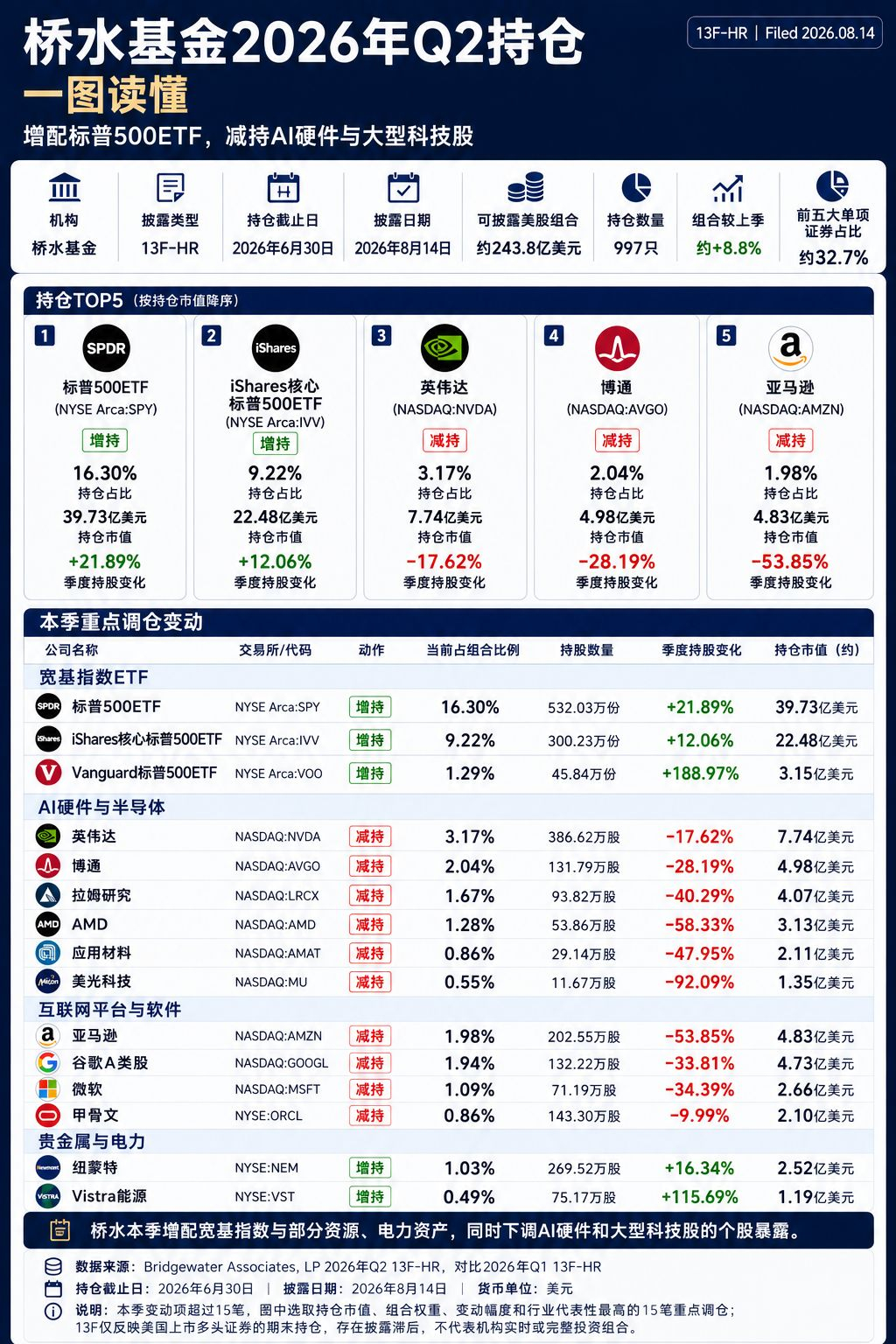
As of June 30, 2026, Bridgewater’s disclosed U.S. stock long portfolio is approximately $24.38 billion, up about 8.8% from the previous quarter. The number of holdings increased from 993 to 997. The top five individual securities account for roughly 32.7% in total, indicating a significantly lower level of concentration than highly concentrated institutions such as Berkshire Hathaway and Pershing Square.
This means Bridgewater’s 13F cannot be read as just “what it bought.” Instead, you should also look at which risk directions it raised or lowered overall through ETFs and a basket of industry stocks.
Broad-based ETFs remain the most important core holding of the portfolio
S&P 500 ETF $SPY increased by 21.89% this quarter. By period end, it held 5.3203 million shares, representing 16.30% of the portfolio—still Bridgewater’s largest single holding. iShares Core S&P 500 ETF also increased by 12.06%, and Vanguard S&P 500 ETF increased even more by 188.97%.
The three S&P 500 ETFs combined account for nearly 27% of the portfolio, indicating that Bridgewater has not exited the U.S. equity market. Instead, while it reduced exposure to some individual stocks, it continued to keep market Beta through broad-based tools. This structure—“increase indexes, reduce individual stocks”—is more explanatory than looking at the trimming of any single tech stock in isolation.
Individual-stock exposure in the AI hardware supply chain clearly declined
Nvidia $NVDA was cut by 17.62% this quarter, but it still accounts for 3.17% of the portfolio at period end, making it Bridgewater’s third-largest single security. Broadcom was reduced by 28.19%, Ram Research by 40.29%, AMD by 58.33%, Applied Materials by 47.95%, and Micron Technology was reduced by 92.09%.
The common thread behind these actions is that Bridgewater broadly reduced its individual-stock positions along the semiconductor, computing power, and equipment supply chain. Since 13F does not provide the institution’s specific explanations, it’s not possible to directly infer that Bridgewater has turned pessimistic on the long-term AI thesis. A more cautious interpretation is that, while maintaining index exposure, Bridgewater reduced the stock concentration in this AI hardware theme.
Major technology platforms are also shrinking in parallel
Amazon $AMZN reduced its stake by 53.85% this quarter, Google Class A by 33.81%, Microsoft by 34.39%, and Oracle by 9.99%. These stocks were not fully exited; rather, they were cut to varying degrees.
Technology platform stocks and the AI hardware supply chain were both reduced at the same time, indicating that the focus this quarter wasn’t rotation within the industry, but rather an overall compression of risk exposure to technology-related individual stocks. But when this action is viewed together with the increase in broad-based ETFs, it looks more like a shift from high-volatility individual stocks toward overall market allocation—not a simple “de-risking.”
Resources and power become the minority of non-index directions that increased
Bridgewater increased its stake in Newmont by 16.34% and increased its stake in Vistra Energy by 115.69%. The former represents gold mining, while the latter belongs to the power and energy infrastructure sector. The driving factors behind these two types of assets are not exactly the same as those for technology stocks.
Note that the absolute weights of Vistra and Newmont are still not high, so you can’t infer from this that Bridgewater has already formed a heavy-conviction thematic position. But they were added this quarter, while multiple technology stocks were cut. At minimum, this suggests that, while keeping equity market exposure, the portfolio also increased some diversification toward resources and power.
How to read Bridgewater’s 13F
Bridgewater’s number of holdings is close to a thousand, and the quarterly changes are substantial. This chart does not list every change; instead, it selects 15 key transactions based on current holding market value, portfolio weight, magnitude of change, and industry representativeness. What’s really worth paying attention to are the three trends appearing at the same time: broad-based ETF increases, widespread declines in technology stocks, and added allocations to resources and power.
13F only reflects long positions in U.S.-listed securities as of June 30. It does not include the full scope of global assets, derivatives, short positions, cash, or non-public investments. Therefore, it’s more suitable for observing changes in risk appetite in publicly traded equity portfolios, and it shouldn’t be taken as Bridgewater’s complete viewpoint or as real-time holdings.
In one sentence: Bridgewater didn’t simply exit U.S. stocks in Q2. Instead, it increased its allocation to the S&P 500 ETF, reduced individual stock exposure to AI hardware and large technology stocks, and added to gold mining and power assets.



Follow me—I'll continue tracking the latest portfolio-rebalancing changes from globally well-known institutions.