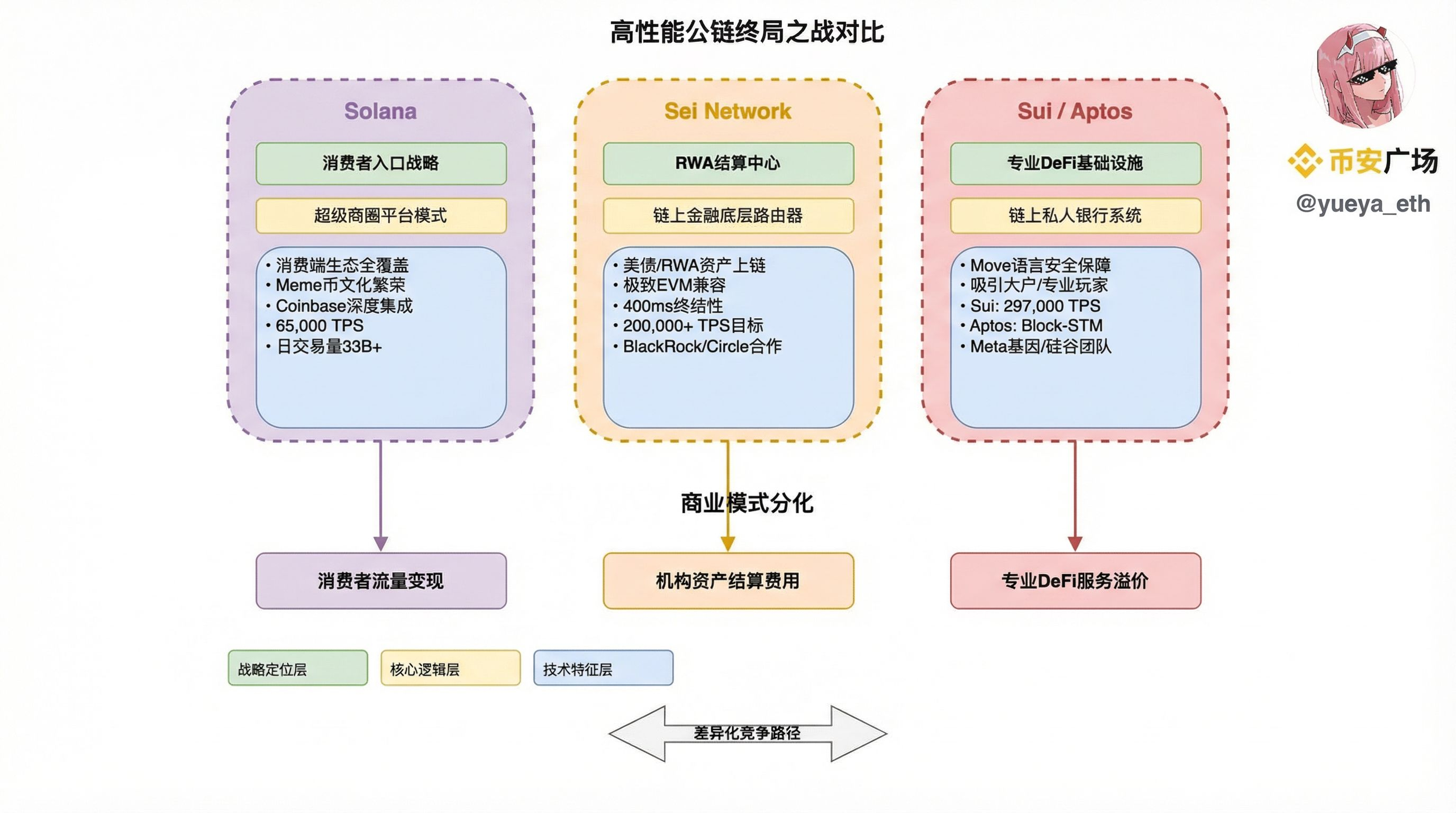

Solana, Sei, Sui, and Aptos are all called high-performance public chains, but what exactly are the differences between them?
First, let's talk about the high-performance pioneer @solana. Its logic is simple and direct, leaning more towards the original 'public chain' model, aiming to serve as a platform to aggregate traffic and users themselves.
Its underlying logic is to convert on-chain activities into high-frequency consumption through a massive number of users and application diversity, thereby monetizing through transaction fees, similar to the 'super business district' in reality. Solana's recent actions have almost completely revolved around the consumer end: mobile, payment, social, gaming, Meme; and the recent deep integration with Coinbase has filled a critical gap in its native liquidity.
Now let's look at @SeiNetwork. Sei takes a completely different path: it does not blindly pursue the number of applications and users, but focuses on attracting issuers and institutions that can bring substantial assets. Its strategy is to migrate 'financial underlying assets' such as U.S. Treasury bonds, stablecoins, and RWA onto the chain, establishing itself as the underlying router of on-chain finance with extreme compatibility (the EVM ecosystem can be seamlessly migrated) and millisecond-level settlement times.
Sei's engineering roadmap fully demonstrates this point:
First is SIP-3: Sei officially describes it as an upgrade 'to clear the path for Sei Giga', aimed at abandoning CosmWasm and the native Cosmos transaction path, moving from a 'dual architecture' to a more pure EVM path.
Storage optimization SeiDB: To support institutional-level concurrency and high-frequency state read/write, SeiDB is positioned to optimize storage for EVM state access patterns, aiming to solve the state I/O and synchronization bottlenecks of traditional storage layers under high throughput.
Consensus acceleration Autobahn: In the Giga context, Sei uses Autobahn as the core of the consensus path to achieve higher throughput and lower finality latency.
All of these layouts are to strengthen its core competitiveness as a 'underlying router'.
On the other hand, the true turning point of RWA lies in the fact that once assets are on-chain, they can be integrated into collateral, lending, payment, and cash management workflows 24/7, and can quickly complete ownership confirmation and risk disposal even during market fluctuations. Ondo Finance's USDY has been launched on Sei, and its official statement emphasizes the asset security supported by short-term U.S. Treasury bonds, bringing it into Sei's high-performance settlement environment.
Finally, it's @SuiNetwork / @Aptos. They are more like the 'on-chain private banking system' created by Silicon Valley elites. Utilizing technological sovereignty and inherent security (Move language), they attract large clients, professional DeFi players, and derivatives teams that have extremely high security requirements, positioning themselves more as professional DeFi infrastructure.
Summary:
When comparing these public chains together, you will find that although they all superficially appear as 'high-performance public chains', in the heated competition stage, their respective positioning and business models have undergone significant differentiation: Solana is vying for 'consumer entry', Sei focuses on 'RWA settlement center', while Sui/Aptos specializes in 'high-performance DeFi paradigm'.