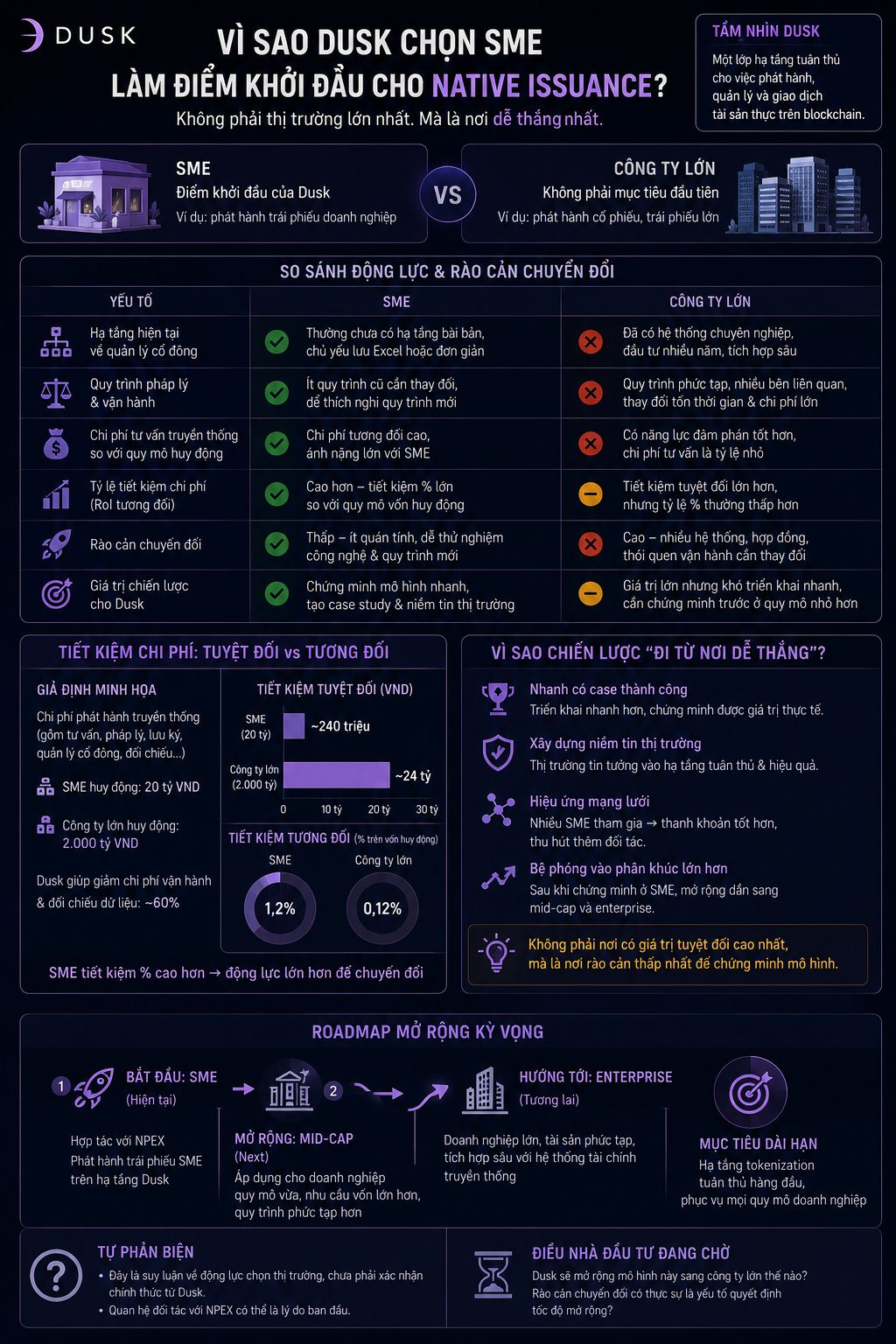
I noticed something when I tried asking the question: why did Dusk choose SME as the starting point for native issuance, instead of targeting large companies that already have tech budgets and stronger incentives to optimize costs.
It’s easy to think that large companies are the ideal customers—larger issuance volumes mean larger data reconciliation costs too, so the absolute savings would be much more impressive than with a small SME. But large companies often already have established shareholder management systems, long-standing relationships with investment banks, and legal processes optimized over decades. The marginal cost to switch to new infrastructure remains high because it requires changing workflows that are currently running smoothly.
On the other hand, SMEs usually don’t have a well-organized shareholder management infrastructure. The cost of hiring traditional advisors for bond issuance is relatively heavy compared with their smaller fundraising scale—meaning SMEs have fewer legacy processes to give up, and the savings ratio relative to capital size is correspondingly higher. Viewed this way, the decision for @Dusk to partner with NPEX for SMEs may not be because this is the biggest market, but because it has the lowest barriers to switching—an “expand from the easiest to win” strategy, rather than going after the place with the highest absolute value.
Counterargument to myself: this is a hypothesis about market selection incentives, and I don’t have direct confirmation that this is truly Dusk’s reason—maybe it’s simply because NPEX is already available as a partner.
I’m waiting to see whether $DUSK will expand this model to larger companies after proving it with SMEs, to check if the switching barrier is truly the deciding factor for how fast they can scale, as the speculation suggests.
#dusk $BTC $ETH
It’s easy to think that large companies are the ideal customers—larger issuance volumes mean larger data reconciliation costs too, so the absolute savings would be much more impressive than with a small SME. But large companies often already have established shareholder management systems, long-standing relationships with investment banks, and legal processes optimized over decades. The marginal cost to switch to new infrastructure remains high because it requires changing workflows that are currently running smoothly.
On the other hand, SMEs usually don’t have a well-organized shareholder management infrastructure. The cost of hiring traditional advisors for bond issuance is relatively heavy compared with their smaller fundraising scale—meaning SMEs have fewer legacy processes to give up, and the savings ratio relative to capital size is correspondingly higher. Viewed this way, the decision for @Dusk to partner with NPEX for SMEs may not be because this is the biggest market, but because it has the lowest barriers to switching—an “expand from the easiest to win” strategy, rather than going after the place with the highest absolute value.
Counterargument to myself: this is a hypothesis about market selection incentives, and I don’t have direct confirmation that this is truly Dusk’s reason—maybe it’s simply because NPEX is already available as a partner.
I’m waiting to see whether $DUSK will expand this model to larger companies after proving it with SMEs, to check if the switching barrier is truly the deciding factor for how fast they can scale, as the speculation suggests.
#dusk $BTC $ETH