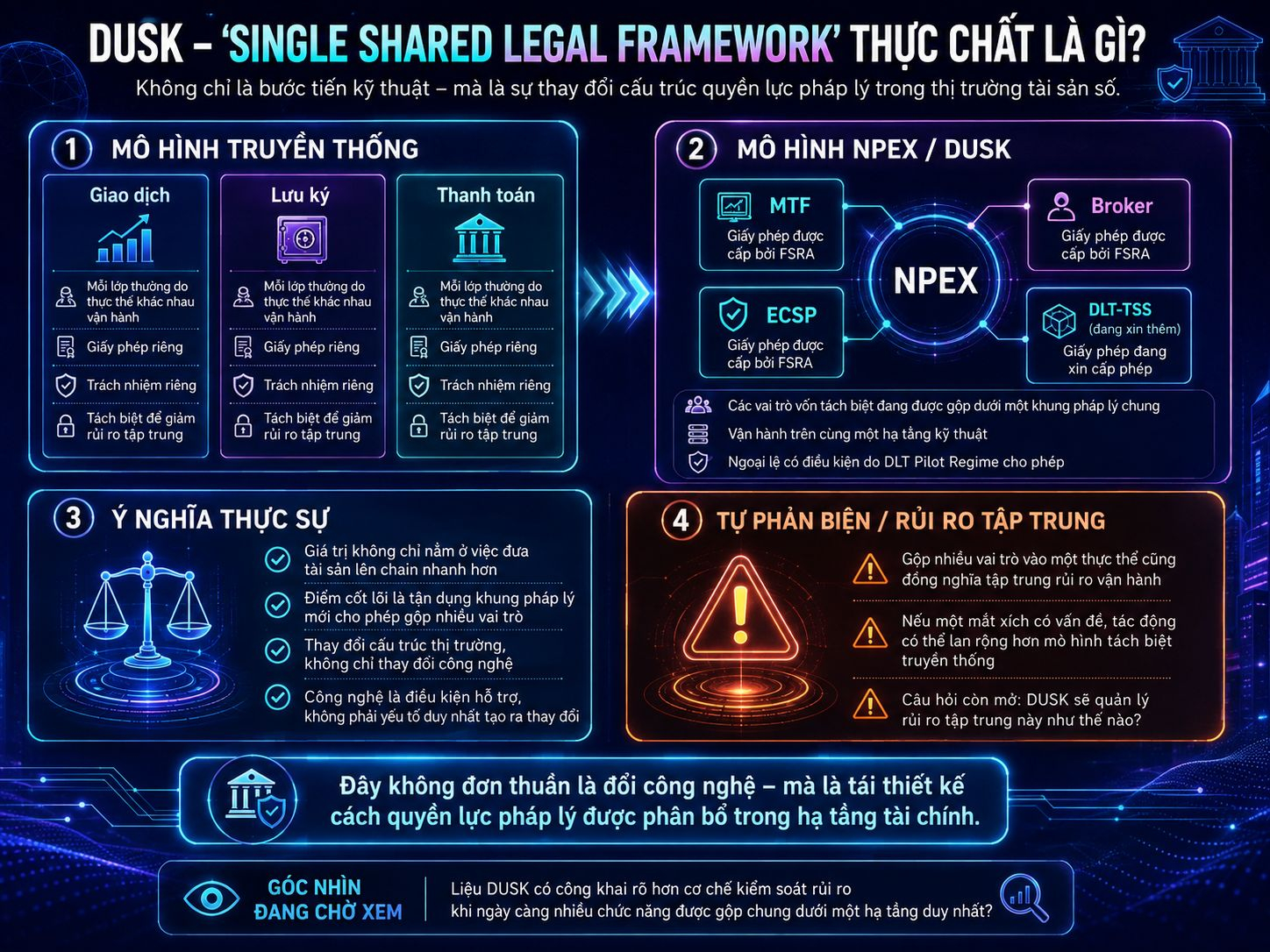
I noticed something notable when reading about the licensing model of @Dusk : the phrase “single shared legal framework” sounds like a technical advancement, but in reality it describes a change in legal power structures more than a technological one.
In traditional finance, each layer where trading happens, where custody happens, where settlement happens is typically handled by separate entities—each with its own license and responsibilities. NPEX simultaneously holds the MTF, Broker, and ECSP licenses, and is also applying for DLT-TSS, meaning roles that used to be distinct are being consolidated under a single legal framework, operating on the same technical infrastructure. This is precisely what the European DLT Pilot Regime enables: permitted non-permitted capital structures within the traditional setup, where separation of roles previously served as a protective measure against centralized risk. An entity that both operates the exchange and also handles custody and settlement payment is a conditional exception, not the default rule—and the accompanying conditions are also why the authorization process is so complex.
With Dusk, the value lies not only in “getting assets onto the chain faster,” but in making proper use of the new legal framework that allows the consolidation of previously distinct roles—changing the market structure, enabled by technology rather than created by technology itself.
Self-critique: consolidating multiple roles into a single entity, even if permitted by law, also means concentrating operational risk into fewer points—if one link fails, the impact could spread more than in the traditional separated model.
I’m waiting to see whether $DUSK will publish more about how this centralized risk is managed, as more and more functions are being combined under a single infrastructure.
#dusk #BTC $BTC