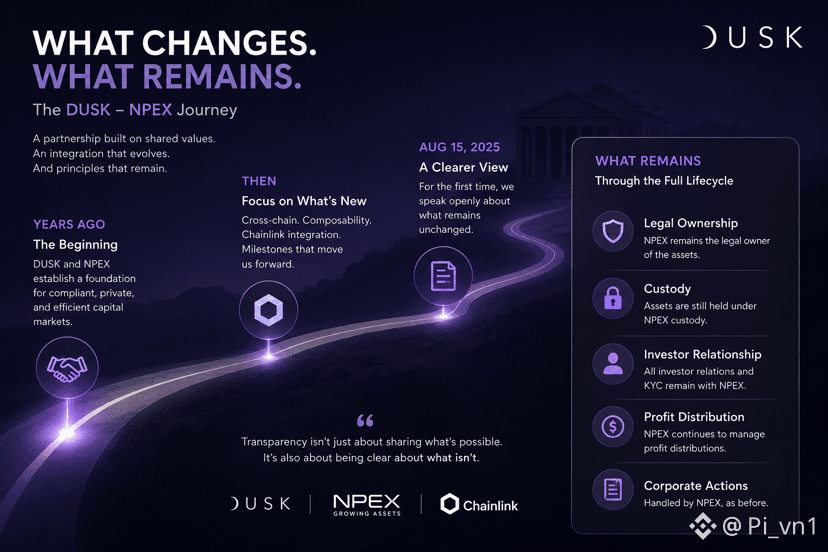
I notice something worth highlighting when thinking about the timeline in the story of @Dusk : the relationship with NPEX has existed for many years, but the article from 15/8 only just publicly stated clearly for the first time the “what remains” — what has not changed across the entire lifecycle of the asset.
This suggests a maturation in communications rather than a product change. In the early stage, most collaboration announcements tend to emphasize what is new — cross-chain, composability, Chainlink integration — because it’s easier to attract attention and easier to measure in terms of technical progress. But frankly listing what still hasn’t changed, instead of only talking about what has changed, is a form of transparency that’s rare in a project’s early phase, when it still needs to draw market attention.
There are two plausible ways to read it. One is a sign of maturity — when the relationship with NPEX has gone far enough that the team is confident to explain the real constraints clearly, rather than letting the market speculate optimistically beyond what’s warranted. The other is a response to inflated expectations — when earlier discussions about “near BlackRock” or tokenizing the entire ownership lifecycle created expectations that went beyond reality, so a piece was needed to restate the boundaries.
Whatever the reason, publicly addressing the limits rather than only pointing to potential is a more notable signal than the technical content itself.
Self-reflection: this could simply be one standalone article within a broader series of routine educational content, not necessarily reflecting an intentional shift in communications strategy.
I’m waiting to see whether $DUSK continues the trend of transparency about these limits in future updates, or whether this is just a one-off exception.
#dusk $BTC #btc
This suggests a maturation in communications rather than a product change. In the early stage, most collaboration announcements tend to emphasize what is new — cross-chain, composability, Chainlink integration — because it’s easier to attract attention and easier to measure in terms of technical progress. But frankly listing what still hasn’t changed, instead of only talking about what has changed, is a form of transparency that’s rare in a project’s early phase, when it still needs to draw market attention.
There are two plausible ways to read it. One is a sign of maturity — when the relationship with NPEX has gone far enough that the team is confident to explain the real constraints clearly, rather than letting the market speculate optimistically beyond what’s warranted. The other is a response to inflated expectations — when earlier discussions about “near BlackRock” or tokenizing the entire ownership lifecycle created expectations that went beyond reality, so a piece was needed to restate the boundaries.
Whatever the reason, publicly addressing the limits rather than only pointing to potential is a more notable signal than the technical content itself.
Self-reflection: this could simply be one standalone article within a broader series of routine educational content, not necessarily reflecting an intentional shift in communications strategy.
I’m waiting to see whether $DUSK continues the trend of transparency about these limits in future updates, or whether this is just a one-off exception.
#dusk $BTC #btc