
Core background: 'Contraction' before departure and moderate game theory
The Federal Reserve decided this month to maintain the benchmark interest rate in the range of 3.50% - 3.75%. This decision aligns with general market expectations, but the details (such as 2 dissenting votes and Powell's departure status) release more complex signals than the mere act of 'keeping rates unchanged.'
Regarding investment decisions, liquidity changes, and issues related to Bitcoin (BTC) practical operations, here is an in-depth analysis:
1. In-depth macro analysis
1. Decision decoding: Why does 'keeping unchanged' actually lean towards being favorable?
Although on the surface the Federal Reserve has paused its rate-cutting pace (after three consecutive rate cuts), this does not signal a shift in monetary policy towards 'tightening,' but rather a form of 'wait-and-see easing.'
• Powell's 'departure state': The chart mentions that Powell refused to answer sensitive questions during the Q&A, entering a 'contraction state before departure'. This is an extremely important signal in financial psychology. A Federal Reserve chairman about to leave usually chooses a 'do no harm' strategy to avoid causing sharp market fluctuations at the end of their term. This certainty of 'not stirring up trouble' serves as a protection for risk markets (Crypto, US stocks).
• Internal divergence (dovish forces rising): Notably, in this decision, two board members voted against it (advocating for a continued rate cut of 25 basis points).
This indicates that the dovish forces within the Federal Reserve are still strong and believe that the economy needs more support.
This divergence effectively blocks the possibility of future 'interest rate hikes', with the market's expected path being only 'maintain' or 'continue rate cuts'.
2. Changes in market liquidity: From 'flooding' to 'targeted penetration'.
You asked about the changes in liquidity, the answer is 'finding new outlets in the ebb and flow'.
• Short-term rebound of the US dollar index: After the decision is announced, the US dollar index (DXY) may experience a short-term knee-jerk reaction rise due to the 'pause in rate cuts'. This will temporarily suppress the valuation of risk assets.
• Substantial liquidity: The interest rate level of 3.50% has significantly decreased from the peak (above 5%), and the financing costs for enterprises have substantially lowered. Although no new 'rate cut water' has been introduced this month, existing liquidity is still seeking high-yield assets.
• The cumulative effect of the 'Spring Festival rally': The Spring Festival in the Asian market usually comes with a return of funds and special consumer sentiment.
Given that the Federal Reserve is not crashing the market, liquidity during the Spring Festival often shows a coexistence of 'holiday hedging' and 'red envelope speculation'. For the crypto market, which operates 24/7, funds are more likely to overflow here during the traditional stock market's holidays.
3. Impact on investor decision-making: Risk appetite increases.
This decision by the Federal Reserve will force investors to shift from 'defensive' to 'offensive'.
• Decreasing appeal of fixed income: With interest rates maintained at 3.5% and expectations of future rate cuts, sticking to US Treasuries or deposits no longer holds absolute attractiveness.
• Seeking Alpha: Funds will more aggressively flow into assets with high volatility and high growth expectations.
Bitcoin (BTC), as a core asset with a fixed total supply, will become the preferred container for this 'escaping capital'.
2. Current practical suggestions for Bitcoin (BTC) at this level.
Based on the current market data around January 29, 2026, Bitcoin is currently in a high-level oscillation range near $89,000 - $90,000 USD.
1. Qualitative analysis of the market: The buildup of a bull market continuation.
The current pattern belongs to the 'consolidation period after the news lands'.
The Federal Reserve has not provided overly hawkish statements, and the biggest shoe has already dropped in the market.
Powell's moderate attitude has effectively cleared obstacles for the 'Spring Festival offensive'.
2. Practical strategies (for different positions).
Strategy A: Those with empty or light positions.
• Entry logic: Since there is no risk of interest rate rebound, each pullback is to digest profit-taking, not a trend reversal.
• Suggested levels: Focus on $88,000 - $88,500 support line. If the market spikes due to a rebound in the dollar, this is an excellent 'entry' opportunity.
• Operation: Build positions in batches, do not miss the Spring Festival rally waiting for 'lower points'.
Strategy B: Heavy holders (Hold & Rotate).
• Holding logic: Powell's 'contraction state' means the probability of a black swan event in policy is extremely low.
• Operation:
• Hold the core chips: Do not easily exit the market. In a context of ample liquidity, Bitcoin is the bottom position for many institutions.
• Monitor exchange rates: Pay attention to the ETH/BTC or altcoin/BTC exchange rates. If Bitcoin consolidates around $90,000, it often rotates to Ethereum or popular sectors (such as AI, MEME, etc. that you are watching).
Consider using a small portion of profits to speculate on high-elasticity Alpha projects.
Strategy C: Contract traders (swing operations).
• Direction: Mainly low long positions, supplemented by high short positions. (Short-term Spring Festival rally, looking bearish in this round in the medium to long term.)
• Key positions:
• Resistance levels: $92,500 - $93,000 (previous high resistance zone).
• Support level: $87,800 (short-term lifeline).
• Suggestion: Since the market expectation is for a 'Spring Festival rally', major funds are likely to leverage the festive atmosphere to drive up prices.
Avoid being overly bearish near support levels.
3. Risk warning.
• Focus on the US dollar index (DXY): If DXY unusually breaks through the strong resistance level of 103/104, it indicates that the market is trading based on 'recession logic' rather than 'soft landing logic'. At that time, Bitcoin may follow a correction in US stocks, so be sure to set stop-loss orders (for example, exit if it falls below $86,500).
Summary.
The Federal Reserve's 'wait and see' approach effectively reassures the market.
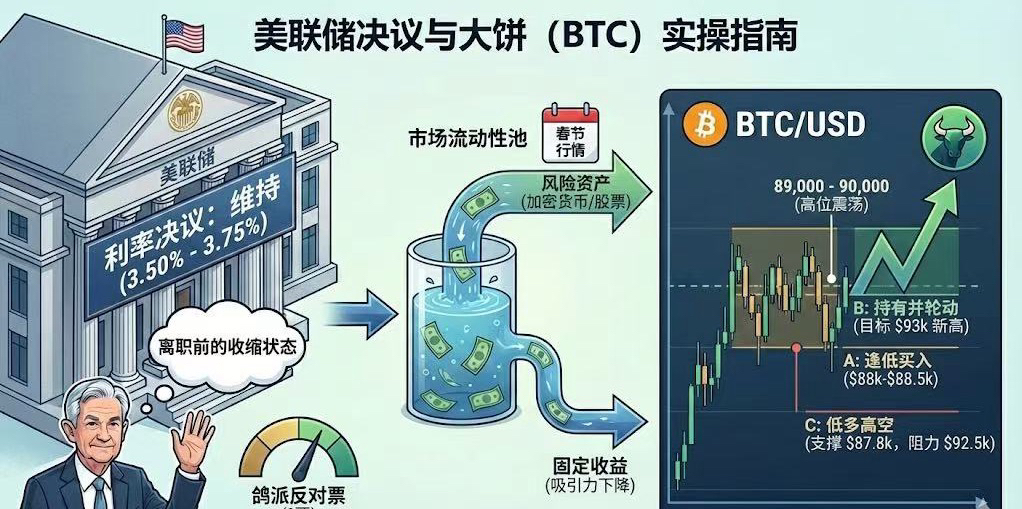
Powell's 'lying flat' is the biggest boon for the bulls.

