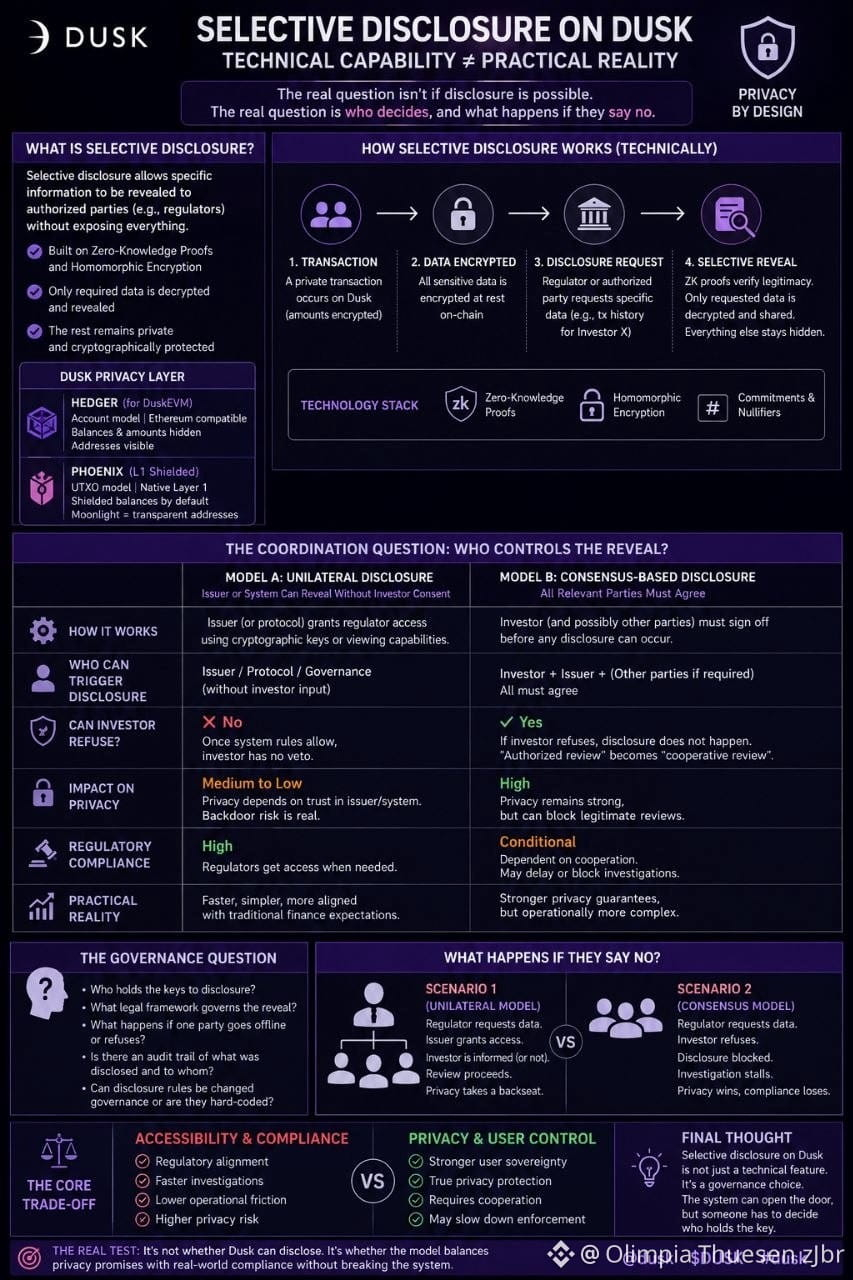
#dusk $DUSK @Dusk I went looking at how selective disclosure actually works on Dusk last night, expecting it to be a clean feature where regulators can see what they need and privacy stays intact. Turns out the mechanics are messier than that.
Because there's a difference between a system that technically can reveal information to regulators, and one where that reveal actually happens in practice without grinding everything to a halt.
What stuck with me is the coordination part. If I'm an issuer and a regulator asks to see transaction history for a specific investor, can I unilaterally grant that access? Or does the investor whose transaction it is have to sign off first? If they can refuse, does "authorized review" just mean "review that requires cooperation"? And if they can't refuse, what does that actually mean for the privacy promise Dusk is making?
Because there's a real difference between "privacy with a backdoor for regulators" and "privacy that only opens if everyone in the transaction agrees it should." One is regulatory compliance. The other is a permission slip everyone has to sign.
I caught myself treating selective disclosure like it was settled, like the system just handles it. But the actual governance question — who controls the reveal, and what happens if they say no — that's still sitting in the background, not solved by the technical layer.
Curious whether Dusk's actual implementation answers this the way I think it should, or whether there's a human layer I'm missing where "authorized" is doing more work than people realize.
@Dusk $DUSK #dusk