

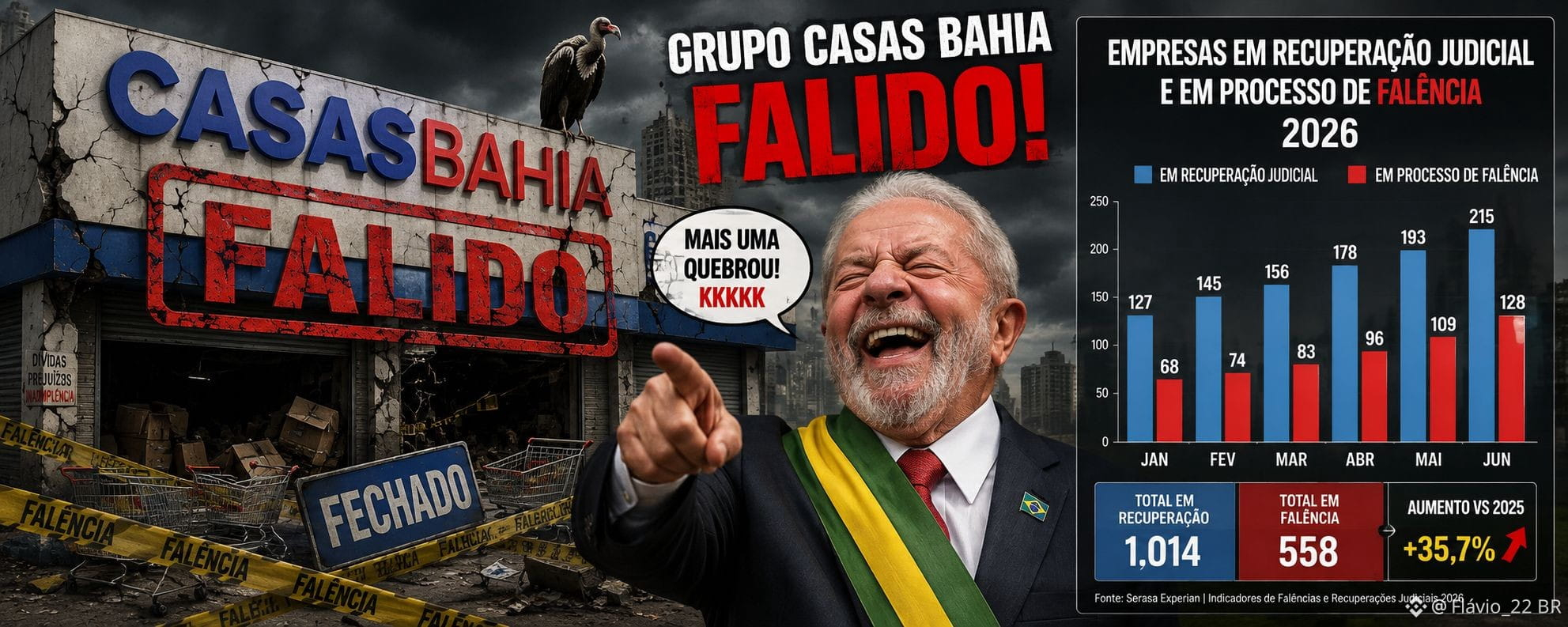

The drop that occurred in the last few weeks is not just a reaction to a bad earnings report: yesterday, August 17, 2026, the company confirmed the filing for judicial reorganization.
🔴 What happened
Casas Bahia released the results for 2T26 and, shortly after, filed for judicial reorganization involving R$ 17.3 billion in liabilities. The case involves Casas Bahia, Ponto Frio, Extra.com and other companies in the group.
The market reacted extremely negatively:
BHIA3 fell 33.33% in only 17/08, closing at R$ 0.44.
By the close of Friday, before the RJ announcement, the stock had already accumulated a decline of approximately 80% in 2026.
With yesterday’s drop, the stock’s deterioration became even more severe.
📉 The 2Q26 balance sheet was very bad
The figure that drew the most attention was the net loss of R$ 10.1 billion.
But there’s an important caveat: approximately R$ 9.1 billion of that loss was non-recurring/non-cash in nature, mainly related to accounting write-downs, restructuring, and tax effects. Therefore, it doesn’t mean that Casas Bahia burned R$ 10 billion in cash during the quarter.
Even removing those extraordinary effects, however, the situation remains quite problematic:
Indicator 2Q26
Result:
Net revenue › R$ 6.97 billion
Revenue growth › +1.6%
Adjusted EBITDA › R$ 518 million
Adjusted EBITDA › -9.4%
Net loss › R$ 10.1 billion
Adjusted loss › R$ 978 million
Shareholders’ equity › -R$ 8.1 billion
Liabilities involved in RJ › R$ 17.3 billion
⚠️ The main problem isn’t simply "the debt"
This is a very important point.
The most worrying issue right now is liquidity.
The company needs money and credit to buy inventory, maintain stock levels, pay suppliers, and keep operating. The EY audit report also flagged a significant uncertainty related to going concern.
Judicial recovery (recuperação judicial) works exactly as a form of protection to prevent creditors from individually seizing the company and to allow for collective negotiations.
In other words:
RJ doesn’t mean bankruptcy.
But it means that the financial situation has reached a point where management understands it cannot meet its obligations using only normal operations.
🏪 And the company is cutting stores
Another very relevant fact is the announcement to close 298 stores.
At the end of the second quarter, Casas Bahia had 1,033 stores. Therefore, we’re talking about approximately 29% of the network being closed.
About 1,900 to 3,000 layoffs were also announced, depending on the stage/estimate considered in recent news.
This shows that management is trying to turn the company into a much smaller, more efficient operation.
The logic is:
fewer stores → less rent → fewer employees → less need for capital → less cash burn.
The problem is that there’s a side effect:
Fewer stores also means lower potential revenue.
💰 Why did BHIA3 fall so much?
I see five major reasons.
1. High leverage
R$ 17.3 billion in liabilities is a staggering figure for a company whose operations are generating adjusted EBITDA of only R$ 518 million in the quarter.
2. Negative shareholders’ equity
Net equity ended the quarter at approximately -R$ 8.1 billion.
This is especially worrying for the shareholder.
3. Judicial recovery (recuperação judicial)
This may be the biggest turning point.
Creditors begin negotiating within a court process, and shareholders end up behind creditors in the capital structure.
In a restructuring, for example, this can happen:
• extending/rolling over debts
• discounts
• conversion of debt into shares
• issuance of new shares
• dilution of current shareholders
This last point is especially important for anyone thinking of buying BHIA3 simply because “it’s cheap.”
4. High interest rates
Casas Bahia itself argues that the increase in the Selic rate had a particularly strong impact because its business is historically dependent on installment credit (crediário).
The installment credit (crediário) portfolio was approximately R$ 6.3 billion in 2Q26.
In addition, high interest rates make inventory financing and financial operations involving suppliers more expensive.
5. Competition
The company also faces very strong competition from digital platforms, especially Mercado Livre and Amazon, in addition to the structural transformation of retail.