

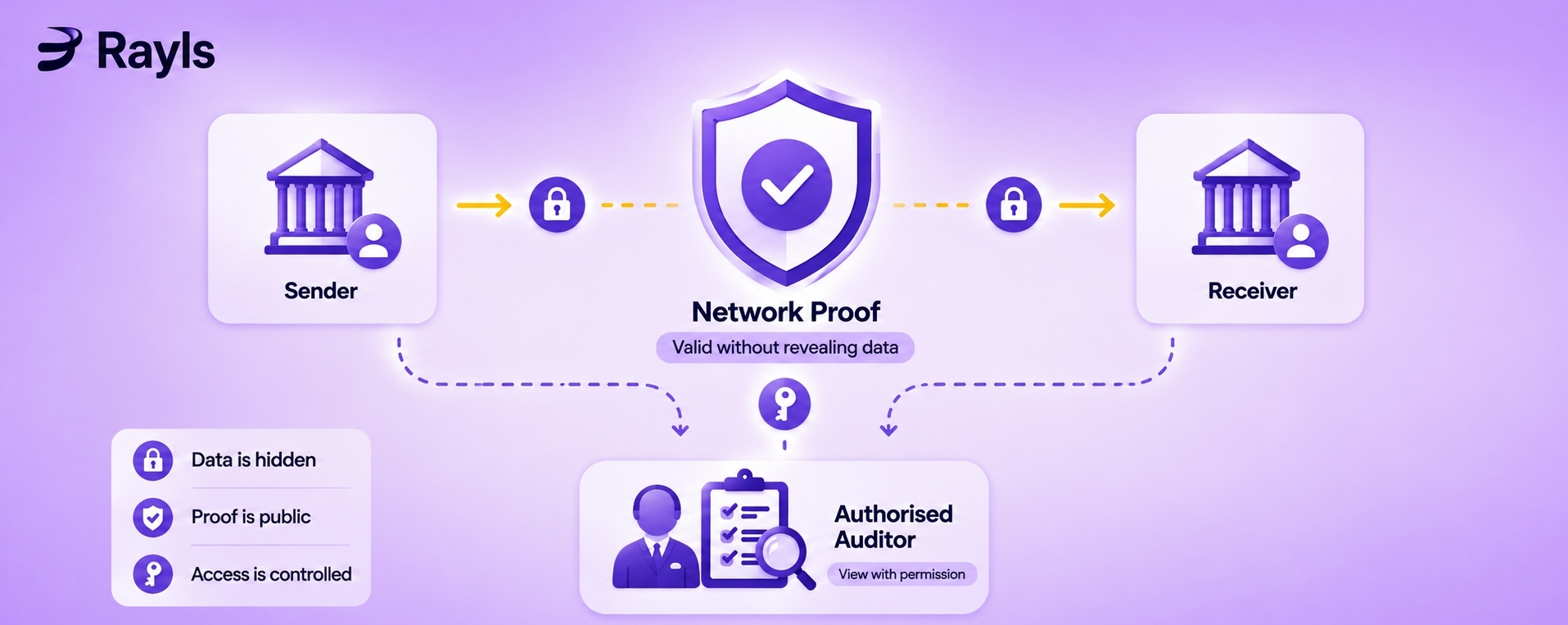

One thing I wanted to understand better while going through the Rayls docs was Enygma.
The simple question was:
If a transaction is private, how can an institution still prove that it was valid or let an auditor check it?
The answer is more interesting than simply hiding the transaction.
The transaction data stays private
With Enygma, the sender, receiver and amount can be hidden from normal network participants.
But the network still needs to know that the transaction is valid.
This is where the cryptography comes in.
Rayls uses things such as ZK-SNARKs and Pedersen commitments to prove that the transaction is correct without exposing the private information behind it.
So an outside observer can see that a valid transaction happened, without seeing the actual contents.
The proof is visible.
The sensitive data is not.
Then what about auditors?
This was the part I found most interesting.
Rayls separates the ability to spend from the ability to view.
Enygma uses separate spending and viewing keys. An authorised auditor can receive a viewing key and inspect the transactions they are authorised to see, without getting the ability to move the funds.
So privacy doesn't mean:
"Nobody can ever see anything."
It means:
"Only the right people can see the right information."
That is much more useful for financial institutions.
A simple example
Imagine Bank A sends 10 private tokens to Bank B.
A normal public observer shouldn't be able to see:
who sent it
who received it
how much was sent
But Enygma can still generate the cryptographic proof needed to verify that the transfer is valid.
If an authorised auditor needs to inspect the transaction, the appropriate viewing access can be provided without giving that auditor spending authority.
There is another interesting use case in the docs: Delivery-versus-Payment, or DvP.
For example, one party can deposit a tokenised asset while another deposits the payment token. The Enygma DvP contract checks the conditions and settles the exchange atomically.
So the privacy layer isn't just about hiding balances.
It can also support actual financial settlement logic.
What clicked for me
Before reading the docs, I thought "private blockchain" mainly meant restricting who can access the network.
Enygma is different.
The privacy is enforced through cryptography, while authorised visibility is handled separately.
That gives Rayls three useful properties at the same time:
Private data
Verifiable transactions
Controlled audit access
For institutional finance, that combination makes a lot more sense to me than simply putting sensitive transactions on a permissioned chain and calling them private.
That was probably the most interesting thing I learned while exploring Enygma.