#dusk $DUSK @Dusk
Before I head into the hills, I like transfers finished. Not “almost finished.”
So this tiny detail in Dusk’s migration docs would have confused me.
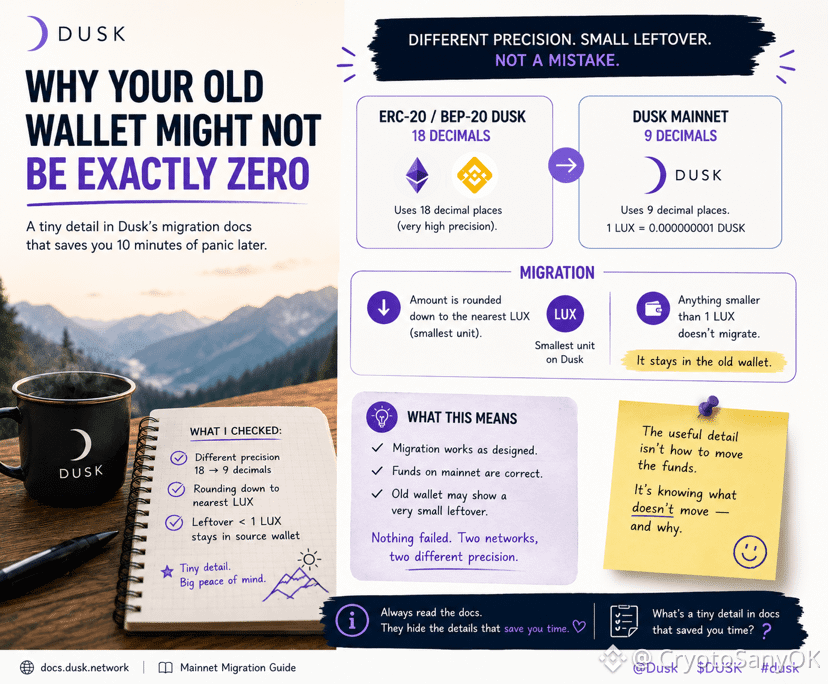
ERC-20 and BEP-20 DUSK use 18 decimal places. Native DUSK uses 9.
During migration, the amount is rounded down to the nearest LUX, the smallest unit on Dusk mainnet.
And that creates a slightly weird result:
your old wallet might not end up exactly at zero.
Any fraction smaller than 1 LUX — 0.000000001 DUSK — stays in the source wallet instead of migrating.
If I saw that tiny leftover without knowing why, I’d probably spend ten minutes checking whether something had failed.
But it’s just a precision difference between the networks.
So now I know what I’d check first:
18 decimals → 9 decimals → tiny remainder possible.
Sometimes the useful detail isn’t how to move the funds.
It’s knowing what doesn’t move — and why.
Before I head into the hills, I like transfers finished. Not “almost finished.”
So this tiny detail in Dusk’s migration docs would have confused me.
ERC-20 and BEP-20 DUSK use 18 decimal places. Native DUSK uses 9.
During migration, the amount is rounded down to the nearest LUX, the smallest unit on Dusk mainnet.
And that creates a slightly weird result:
your old wallet might not end up exactly at zero.
Any fraction smaller than 1 LUX — 0.000000001 DUSK — stays in the source wallet instead of migrating.
If I saw that tiny leftover without knowing why, I’d probably spend ten minutes checking whether something had failed.
But it’s just a precision difference between the networks.
So now I know what I’d check first:
18 decimals → 9 decimals → tiny remainder possible.
Sometimes the useful detail isn’t how to move the funds.
It’s knowing what doesn’t move — and why.