Recently, the AI sector has heated up again, and VVV (Venice) has once again returned to the market spotlight.
Many people treat VVV as a mere ordinary AI concept coin, but if you truly study Venice, you’ll find that it has multiple layers of real logic: a real product, real revenue, Token value capture, and privacy AI.
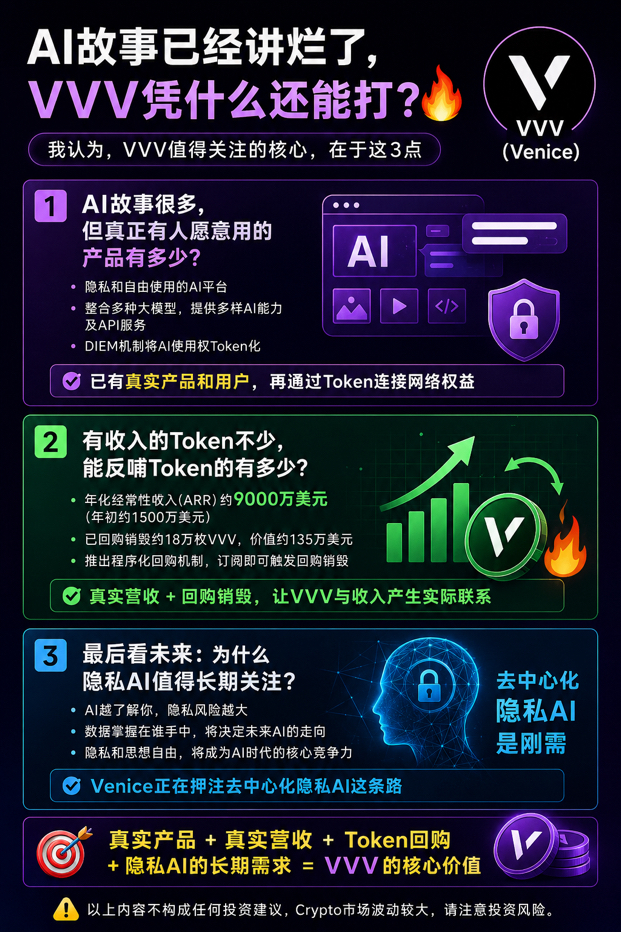
I think the core reasons VVV is worth paying attention to come down to the following three questions.
1) There are many AI stories, but how many products are there that real people are actually willing to use? 💡
Venice can be simply understood as an AI platform that emphasizes privacy and free usage.
It integrates different large language models to provide AI capabilities like text, images, and video for users, while also offering API services to developers. Compared with traditional AI products, Venice places greater emphasis on user privacy, aiming to reduce the risk that users’ AI interactions become a centralization platform’s long-term data asset.
Users can stake VVV to obtain Venice API usage rights. Venice’s DIEM mechanism further tokenizes these AI usage rights.
The biggest difference between VVV and many AI concept tokens: it doesn’t first issue a token and then look for what the product should do. Instead, it already has AI products and users, and then connects the network’s rights through the token.
So the first layer of VVV’s value comes from the fact that Venice provides real business demand.
2. There are plenty of tokens with revenue—but how many can actually feed back into tokens? 📈
The second question is whether Venice actually makes money.
According to data recently released by the Venice project team, its annualized recurring revenue (ARR) has already reached approximately $90 million, up significantly from about $15 million at the beginning of the year.
For an AI project, this scale of revenue is already quite substantial—especially in the current bear market environment, where there aren’t many Crypto projects that can truly generate ongoing business revenue.
But having income isn’t enough.
Traditional stocks can use PE valuation because shareholders own equity in the company and can share in the company’s profits and assets. But VVV isn’t the stock of the Venice company, so the money Venice earns won’t directly translate into dividends for VVV holders.
What’s truly worth paying attention to is that Venice is proactively using part of its revenue to repurchase and destroy VVV.
As of April this year, Venice has officially disclosed that it has already independently repurchased and destroyed about 180,000 VVV, worth about $1.35 million. It then introduced a programmatic repurchase mechanism: the newly added Pro, Pro+, and Max subscriptions correspond to $2, $5, and $10 worth of VVV repurchase and destruction, respectively.
This creates a real connection between VVV and Venice’s business revenue.
The more profitable the Venice business is, the more opportunities there are to take out additional funds to repurchase VVV; after the repurchase, it gets destroyed.
VVV’s most important underlying fundamentals right now aren’t the “AI” story, but the fact that there is already real revenue behind it—and the revenue is already trying to empower the token.
3. Finally, let’s look to the future: why privacy AI is worth long-term attention?🔐
This is, in my view, the place where Venice has the most room for imagination, and why AI privacy is a necessity.
The better AI is to use, the more it needs to understand you.
At the beginning, we only asked AI to write articles and look up information; slowly, it would help us work, invest, plan our lives, and even discuss emotions, family, life goals, and all kinds of personal thoughts.
Once this kind of habit continues for years, what AI knows may be not just search history, but a person’s interests, preferences, and even thoughts. This brings huge convenience, but it also involves significant privacy risks.
Once this capability is abused, AI could turn from a tool for improving efficiency into a tool for large-scale surveillance, behavior prediction, and even thought intervention.
As AI capabilities become stronger and stronger, who holds the data, who can access that data, and whether users can truly control their own information will become increasingly important issues.
So future AI competition may not just be “whose model is smarter.” It may become another question: who can truly protect users’ privacy and freedom of thought while providing powerful AI capabilities?
And Venice is betting on decentralized privacy AI.
So when I look at VVV, it’s not just because of the AI narrative. Real products, real revenue, token buybacks, and—on top of that—the long-term demand for privacy AI give VVV a value logic that’s different from ordinary AI tokens.
What do you think about VVV? Do you believe privacy AI will become an important direction for future AI development? Feel free to discuss your views in the comments.
⚠️ The above content does not constitute any investment advice. The Crypto market is highly volatile; please be mindful of investment risks.$VVV