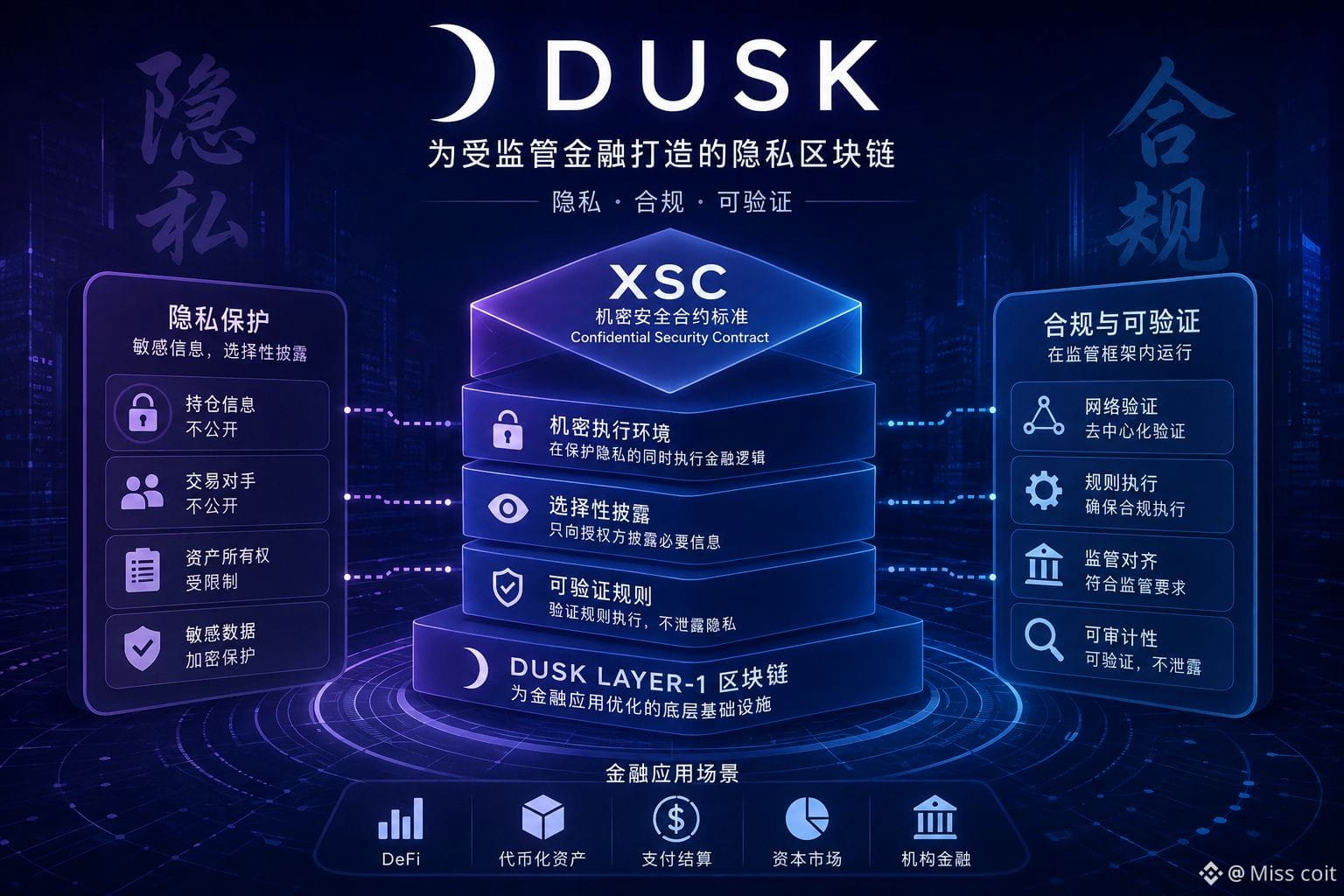
The deeper I study Dusk, the more I realize that its real challenges aren’t just about making financial transactions more private.
The harder part is: how to make privacy truly matter in a financial system that still needs to verify what’s happening.
That sounds simple, but in practice it creates a very complex design problem.
Financial applications can’t always disclose every detail of each transaction. Positions, counterparties, asset ownership, and other sensitive information may need to be restricted.
But going to the opposite extreme also won’t work.
If nobody can verify what actually happened, then so-called confidentiality eventually becomes just another form of information opacity.
That’s exactly what I find truly interesting about the Dusk architecture.
Its Layer-1 is designed for financial applications, and the Confidential Security Contract (XSC) standard provides developers with a framework for building confidential smart contracts. The core idea is to let financial logic execute without requiring every piece of information inside it to be publicly exposed.
In other words, it’s not just about hiding data.
It’s about controlling who needs to know what, while keeping enough information for the network to execute and verify the truly important rules.
That’s why I think Dusk’s understanding of blockchain privacy is more practical.
But this design also comes with clear trade-offs.
Confidential execution may increase technical complexity. Developers need the right tools, applications must run under more complex security assumptions, and institutions still need regulatory clarity before migrating real financial activities onto this kind of infrastructure.
Then there are issues that technology itself can’t solve: adoption.
Dusk can build an architecture that supports confidential financial applications, but developers and institutions still need a sufficiently compelling reason to use it.
So now, I’m less concerned with whether Dusk can provide privacy.
What matters more to me is whether the future of regulated finance will really need this level of privacy.
If privacy and verifiability eventually become equally important requirements for on-chain financial markets, then Dusk’s architectural choices could become extremely meaningful.
But if the market doesn’t develop enough demand, it may end up being just a technically interesting idea without real use cases
#dusk $DUSK @Dusk