

(Source: official WeChat account of PV Industry)
Over the past year, photovoltaics has quietly found a different way to live.
Fewer and fewer new projects are being built, but more and more technological upgrades are being carried out. In April, Aisai announced that it would spend RMB 1.665 billion to fully back ABC; in July, Longi invested RMB 1.8 billion to advance the HPBC 2.0 upgrade on a massive scale; not long ago, TCL Zhonghuan just completed the acquisition of a new energy company, and is already eager to take on the six major bases, with an expected total investment of RMB 2.6 billion…
According to incomplete statistics, the total investment in photovoltaic technology upgrade projects that have been publicly disclosed has now nearly reached RMB 13 billion, involving production capacity of more than 100 GW.
Behind all this, policy constraints are also tightening in step. In early July, three mandatory national standards for photovoltaics—including (the minimum efficiency threshold and efficiency grades for crystalline silicon photovoltaic modules and inverters)—were officially released, effectively keeping low-efficiency capacity out of the market.
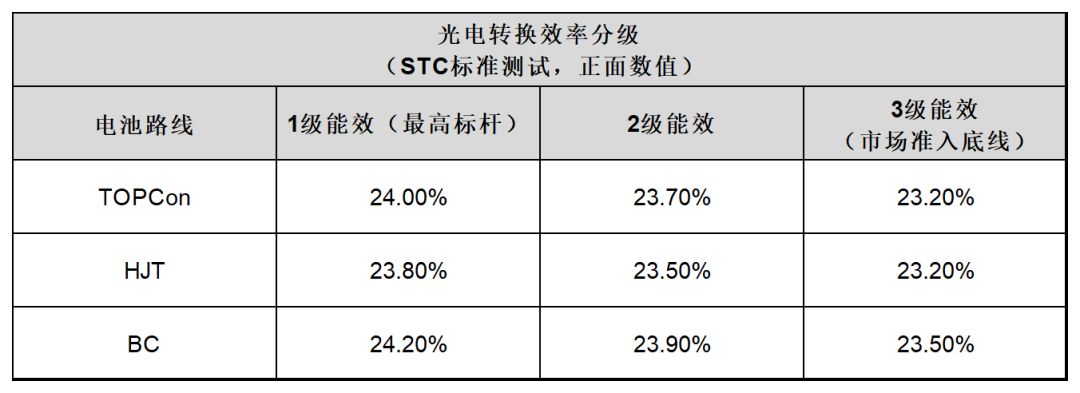
Technology upgrades are not just about choosing a lineup anymore—they also determine whether a company still has the qualification to survive.
Now the elimination race has started. In this contest over positioning for efficiency, who has already gained the lead?
August’s latest module ranking
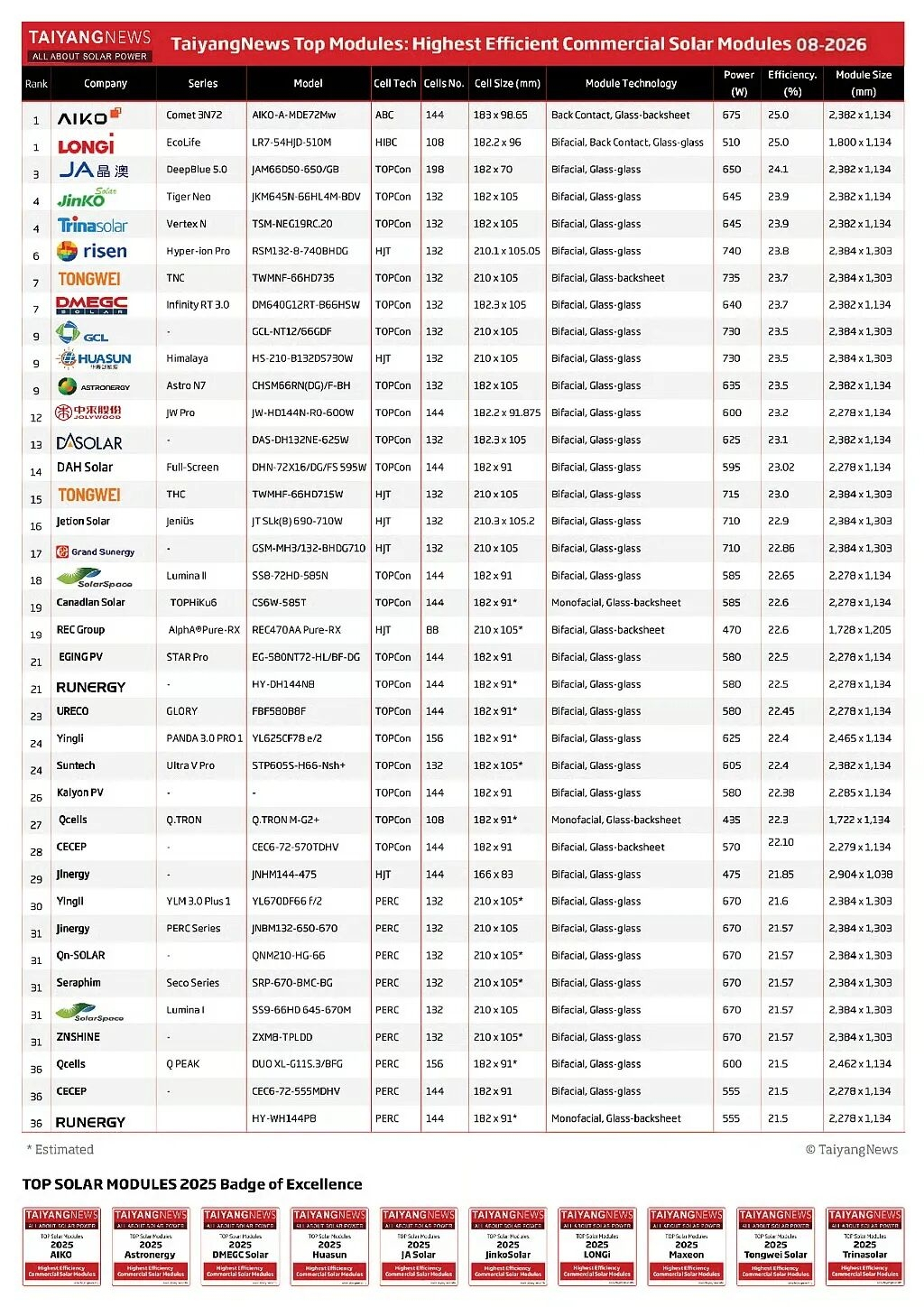
Recently, the international photovoltaic authority media TaiyangNews released its August 2026 edition (the global ranking of the highest-efficiency photovoltaic modules in mass production) (TOP SOLAR MODULES, Issue 56). This edition includes 38 high-efficiency commercial modules from 31 PV companies including Longi, JA Solar, JinkoSolar, Trina, Jinko, Sungrow, Tongwei, GCL, Huasong, and Gintech.
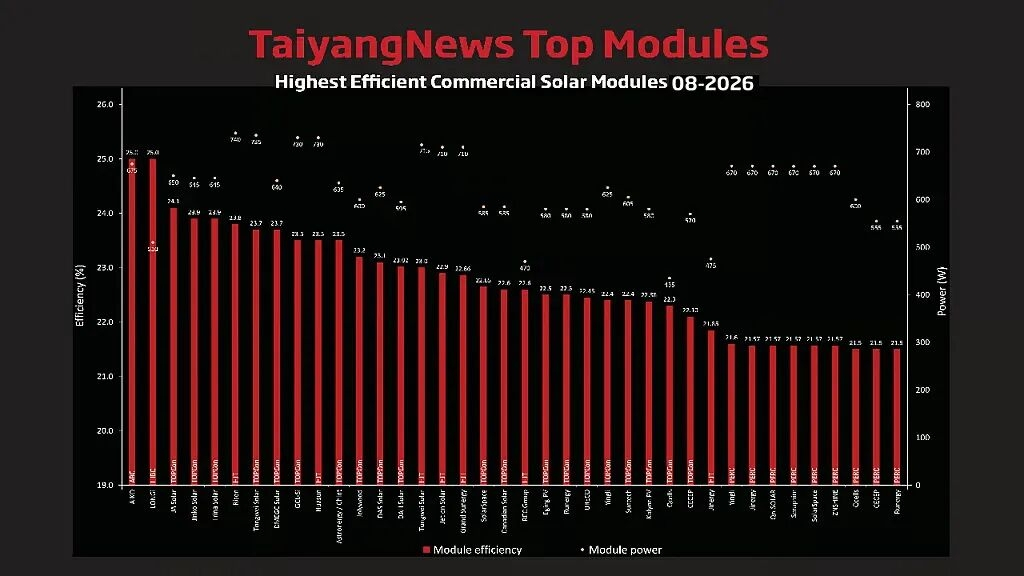
The rankings show that BC technology continues to lead. Longi and JA Solar are tied for first place with 25% efficiency modules. TOPCon follows closely: JA Solar reaches 24.1%, Trina and Jinko are 23.9%, while the HJT route maintains a high-power advantage. For example, Eastern Sun’s Hyper-ion Pro delivers 740W output power with an efficiency of 23.8%.
Longi and JA Solar are tied for first place. The listed product is EcoLife LR7-54HJD-510M. It uses Longi’s HIBC technology, integrating the characteristics of the TOPCon passivation contact structure and HJT-related technology. This is an important outcome of Longi’s high-efficiency crystalline silicon technology route. Previously, Longi’s most efficient product, Hi-MO 9, was 24.2%. EcoLife further increased efficiency to 25%, achieving a key breakthrough.
JA Solar, with its ABC technology, was the first to achieve commercialized module efficiency reaching 25%. It is the first commercial BC module product on the list to reach this efficiency level. The listed product is Comet 3N72 (AIKO-A-MDE72Mw), with power of 675W. The module uses an all-back-contact design, with no grid-line shading on the front. While keeping the appearance simple, it achieves higher optoelectronic conversion efficiency. Thanks to its ABC series products, JA Solar has maintained a leading position since entering the ranking in 2023. Comet 3N72 replaces the earlier Comet 2U modules with 24.8% efficiency.
JA Solar ranks third overall. It is the first company in the list to cross the 24% efficiency threshold with its commercialized TOPCon modules, indicating that TOPCon efficiency is moving closer to the BC route. The listed product DeepBlue 5.0 JAM66D50-650/GB uses 182mm rectangular wafers and a three-split design, with a total of 198 cells, a dual-glass structure, and a bifaciality of about 85%.
Trina and Jinko are tied for fourth. Trina’s Vertex N series was upgraded to 23.9% this May. The product uses 210R wafer technology and a 132-cell half-cell design, balancing large-format module output capability with high efficiency.
In April, JinkoSolar upgraded its Tiger Neo series. Module efficiency increased from 23.69% to 23.9%, and its ranking rose from 7th previously to 4th. This series adopts n-type TOPCon half-cell technology, with 132 cells, a dual-glass structure, and is one of the representative products in the current TOPCon lineup.
Eastern Sun ranks sixth. The listed product Hyper-ion Pro RSM132-8-740BHDG represents the high-power advantage of the HJT route. With 740W power, this module is among the highest output-power products on the list. It uses 210×105mm half-cell wafers and achieves a bifacial power generation rate of 90±5%.
Trina relies on its TNC 2.0 technology to enter the first tier of high-efficiency modules. In August, it ranked seventh on the list. By optimizing the battery and module structure, this module improves performance and uses 210mm wafers with a 132-cell dual-sided half-cut battery design, enabling strong power output. Notably, in mid-July, Trina announced its TNC 3.0-G12 modules have officially entered mass production. This product has the industry’s highest mass-production power of 750W and a dual crown of 24.14%+ mass-production efficiency data, making it the first global mass-producing company for this high-efficiency module type.
Dongfang Yijiu (Yongxiang), represented by its Infinity RT series module DM640G12RT-B66HSW, has a module efficiency of 23.7% and power of 640W. After an upgrade in April this year, it ranked 7th on the list. The module uses a rectangular wafer design and a dual-glass structure, with bifaciality reaching 80±5%. Power degradation is 1% in the first year, then decreases by 0.4% each year from the second year onward. After 30 years, it still retains 87.4% of its power.
The next efficiency level is 23.5%. In the ranking, it is ninth, with a three-way tie among GCL, Huasong, and Gintech New Energy.
At the end of last year, GCL increased module efficiency from 22.53% to 23.5% through product upgrades, resulting in a significant rise in ranking. However, at the time the company did not disclose the technology improvements behind the notable efficiency gains. The GCL-N12/66GDF featured in this ranking is a bifacial dual-glass TOPCon module. It uses 210mm wafers and a 132-cell half-cell design. Its 730W power performance makes it one of the representative high-power TOPCon products.
Huasong’s representative product is the Himalaya series HS-210-B132DS730W. It ranks second among the HJT camp in the overall ranking. This module has an output power of 730W, uses 132 dual-sided shingled (split) cells, and 210mm wafers. It is assembled with 2mm-thick dual-glass, with a dual-sided rate of 90±5%, making it especially suitable for large-scale applications.
Gintech New Energy, thanks to its ASTRO N7 series, has entered the 23.5% efficiency tier. This is a bifacial dual-glass module with a rated power of 635W. It uses 182mm rectangular wafer TOPCon technology and a 132-cell half-cell design. Dimensions are 2382×1134×30mm, with a bifaciality of 80±5%.
Compared with the ranking, who is the most at risk?
For leading companies, things are basically safe. Longi and JA Solar’s BC module efficiency has reached 25%. For TOPCon, the core products from JA Solar, Trina, and Jinko are concentrated in the 23.9% to 24.1% range. Eastern Sun’s HJT flagship has an efficiency of 23.8%. These companies have nearly a 2-percentage-point safety buffer from the forced threshold, and are hardly affected in the short term.
What is truly under pressure is that group of products at the end of the leaderboard.
For example, in the August ranking, there are as many as 10 products with efficiency below 22%. Of those, 9 come from the PERC technology route, and one comes from the HJT camp—the JNHM144-475 by Jineng Technology. This product has a maximum efficiency of 21.85% and power of 475W, ranking 29th on the leaderboard.
Previously, at the 22% efficiency level, there was also one HJT product from Meyer Burger, but the product was discontinued and taken off the market in March this year.
Further reduction in the number of PERC products
In the past, the low-efficiency range was still the main stronghold of PERC modules. But with the rapid iteration of technologies such as TOPCon and BC, PERC modules are stepping out of the historical stage. The rankings show that over the past year, multiple PERC module products have been removed from the list, including those related to companies such as Hanwha Qcells, Trunsun, Jinko, Aiko, Sungrow, EGing, JA Solar, GCL, and Astron. As of now, the number of PERC products has dropped significantly, with only a small number remaining on the list.
Industry signal: Global competition for commercial modules is about to enter the 24%+ efficiency era
Judging from the changes in the rankings over the past half year, BC modules have broken through 25%, some TOPCon modules have surpassed 24%, and HJT modules continue competing toward higher-power directions. Products with efficiencies of 22% or even below 23% are gradually being phased out.
Proofread by: Pineapple Bao
Reviewed by: Lao Zhang