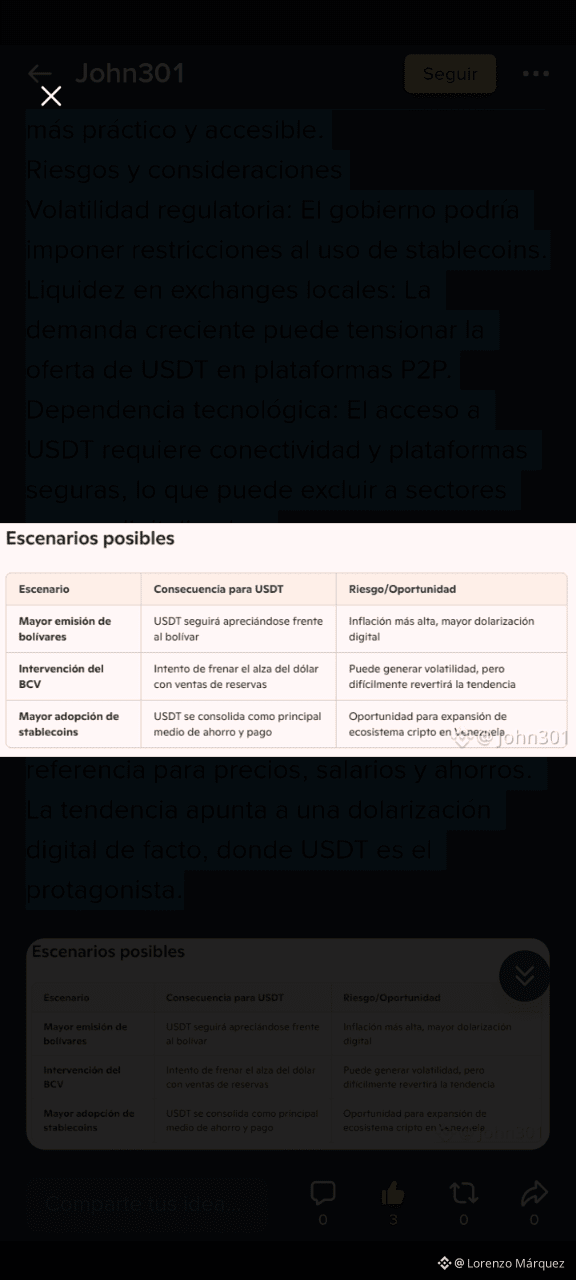
The increase in the money supply in Venezuela🇻🇪💵 is driving the devaluation of the bolívar and, as a direct consequence, the price of $USDT against the bolívar has already risen by around 15% in just one week. This means that Venezuelans will increasingly turn to USDT as a refuge against inflation and the loss of purchasing power.
Immediate impact on USDT 🇻🇪💵
Money supply: The Central Bank of Venezuela (BCV) raised liquidity to nearly 950,000 million bolívares.
Exchange rate: The excess issuance puts upward pressure on the parallel dollar and, by extension, the price of USDT.
Effect on USDT: In just one week, USDT rose 15% against the bolívar, reflecting the loss of confidence in the local currency.
Trends in USDT usage in Venezuela
Everyday payment method: Trade, remittances, and savings are increasingly done in USDT, which has become a “common currency” for the population.
Protection against inflation: In light of the acceleration of bolívar issuance, citizens seek refuge in stablecoins like USDT and USDC.
Alternative to physical dollars: Restrictions and shortages of banknotes make USDT more practical and accessible.
Risks and considerations
Regulatory volatility: The government could impose restrictions on the use of stablecoins.
Liquidity in local exchanges: Growing demand may strain the supply of USDT on P2P platforms.
Technological dependence: Accessing USDT requires connectivity and secure platforms, which can exclude less digitalized sectors.
Conclusion
The increase in the money supply in Venezuela strengthens the position of USDT as a financial refuge. While the bolívar loses value, USDT becomes the reference for prices, salaries, and savings. The trend points to a de facto digital dollarization, where USDT is the protagonist.