I used to think that if a Finance L1 wanted its own capabilities, it would have to pay a price: the developer would have to leave the familiar EVM stack.
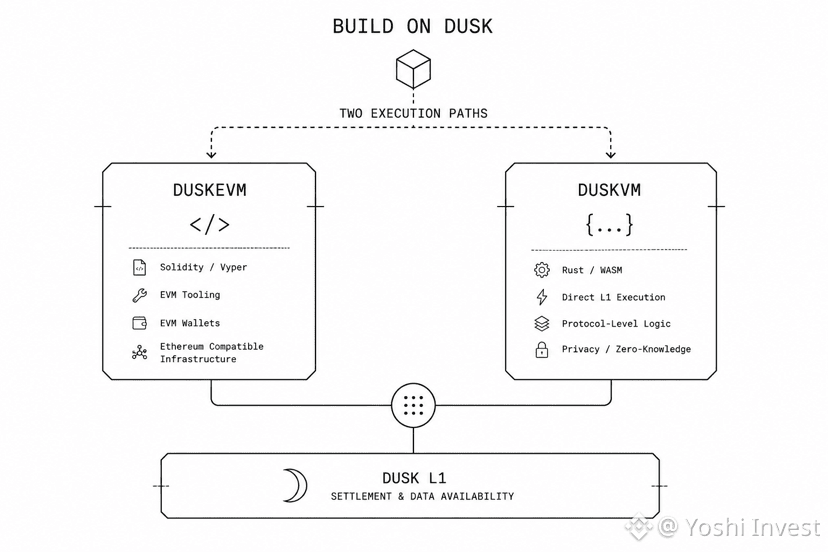
When I was researching how to build on @Dusk , I kept thinking that if I wanted to touch the specific traits of a Finance L1, I’d have to get used to a whole new stack. But the more I read, the more it felt familiar: Solidity, Vyper, and the EVM tooling I already knew were all there on DuskEVM. I even wondered: so where exactly does Dusk differ?
I kept reading and came across the DuskVM. Rust/WASM, running directly on L1. At that point, I thought: if you really want to go deep into Dusk’s native layer, you’d still have to learn yet another stack.
That’s when it clicked: maybe I had equated specialization with having to start from scratch.
Not necessarily.
I can start with what I’m already comfortable with. And when the application needs native execution, privacy, or zero-knowledge at the L1 level, there’s still another path.
Now I’m starting to see EVM + native privacy differently.
EVM preserves what I already know. Specialization gives me an additional option when an application needs to go deeper into L1.
Maybe a Finance L1 doesn’t need to make developers pay the UX price just to become specialized.
@Dusk #dusk $DUSK
When I was researching how to build on @Dusk , I kept thinking that if I wanted to touch the specific traits of a Finance L1, I’d have to get used to a whole new stack. But the more I read, the more it felt familiar: Solidity, Vyper, and the EVM tooling I already knew were all there on DuskEVM. I even wondered: so where exactly does Dusk differ?
I kept reading and came across the DuskVM. Rust/WASM, running directly on L1. At that point, I thought: if you really want to go deep into Dusk’s native layer, you’d still have to learn yet another stack.
That’s when it clicked: maybe I had equated specialization with having to start from scratch.
Not necessarily.
I can start with what I’m already comfortable with. And when the application needs native execution, privacy, or zero-knowledge at the L1 level, there’s still another path.
Now I’m starting to see EVM + native privacy differently.
EVM preserves what I already know. Specialization gives me an additional option when an application needs to go deeper into L1.
Maybe a Finance L1 doesn’t need to make developers pay the UX price just to become specialized.
@Dusk #dusk $DUSK