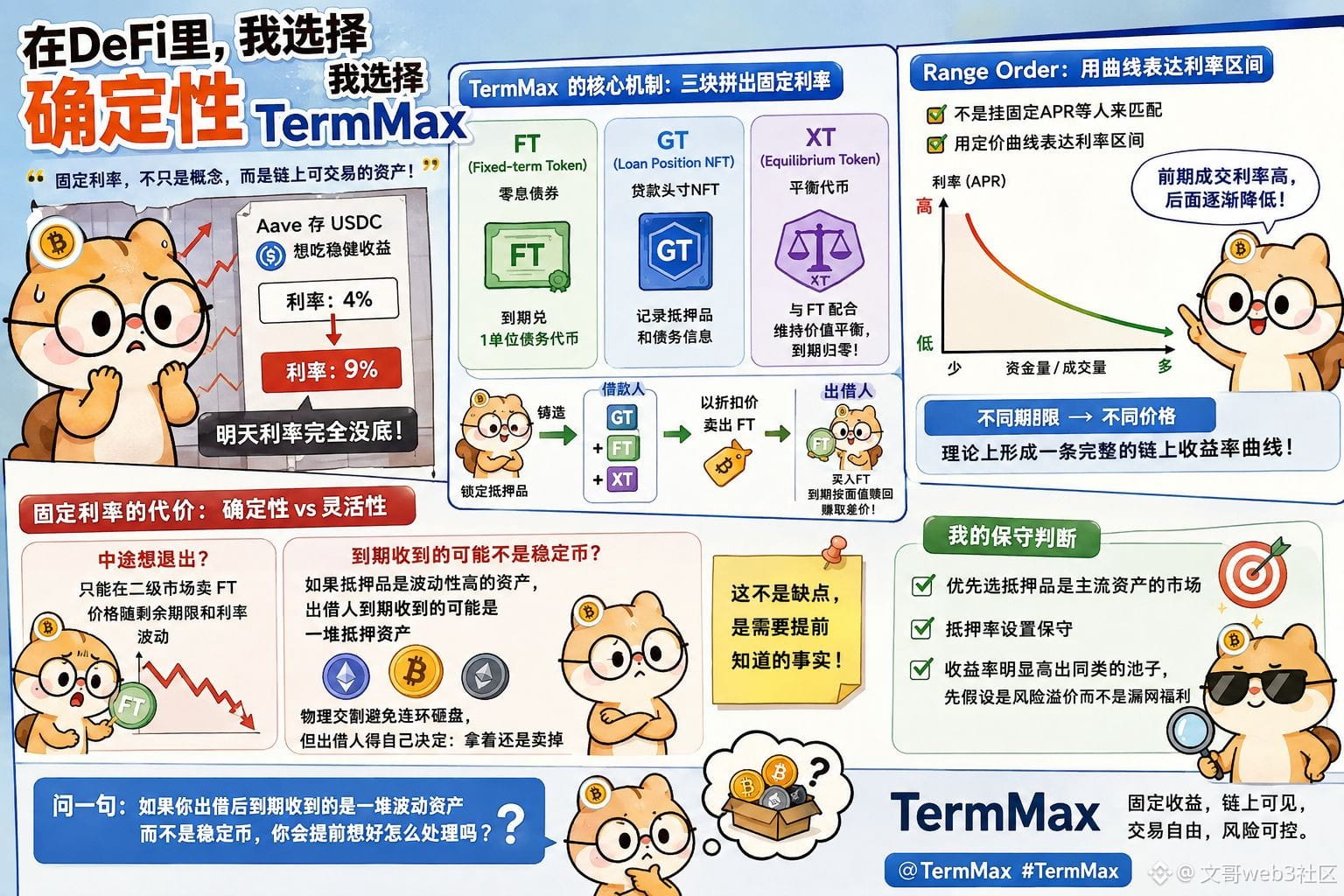
I’ve suffered from the downsides of floating-rate loans in DeFi. Last year I deposited some USDC on Aave, thinking I’d get a steady return. But when the market moved, borrowing demand suddenly spiked and the interest rate jumped from 4% to nearly 9%. I didn’t lose money, but that feeling of having absolutely no idea what the rate will be tomorrow is really unsettling. So when I looked at @TermMax , what mattered most to me was whether it can truly solve the problem of “certainty,” and what price I’d have to pay for that certainty.
What I find interesting about TermMax is that it isn’t just tweaking interest rates—it splits the entire debt into three parts: FT, GT, and XT. FT is similar to a zero-coupon bond: at maturity, it redeems for 1 unit of the debt token. GT is a loan position in NFT form, recording the collateral and the debt. XT, working alongside FT, helps maintain value balance, and it goes to zero at maturity. Borrowers lock collateral to mint GT and FT, then sell FT at a discount to generate liquidity. Lenders buy FT and redeem it at face value at maturity—the profit is the difference. This design turns “fixed income” from a concept into an on-chain asset that can be traded and priced independently.
What also catches my attention is the Range Order. It doesn’t just match by having a fixed APR posted; instead, it uses a pricing curve to express an interest-rate range: higher rates in the early phase, gradually decreasing afterward. It’s essentially encoding how “liquidity depth” corresponds to “interest rate” directly into the mechanism. Different maturities map to different prices, and in theory this can form a complete on-chain yield curve.
Of course, the downside is there too. The cost of fixed interest is sacrificing flexibility. If you want to exit mid-way, you can only sell FT in the secondary market, and the price will move with the remaining term and interest-rate fluctuations. Also, if the collateral is a high-volatility asset, what lenders receive at maturity might not be stablecoins but a pile of collateral assets. Even though physical delivery avoids a cascading liquidation stampede, lenders still have to decide whether to hold or sell. This isn’t a flaw—it’s a fact you need to know in advance.
My view is fairly conservative: I’d prioritize markets where the collateral is mainly mainstream assets and the collateralization ratio is set conservatively. If the yield is clearly higher than similar pools, I’d first assume it’s a risk premium rather than an out-of-band free lunch.
One question: if you lend and at maturity you receive a bundle of volatile assets rather than stablecoins, have you thought ahead about how you’d handle it?
#termmax
What I find interesting about TermMax is that it isn’t just tweaking interest rates—it splits the entire debt into three parts: FT, GT, and XT. FT is similar to a zero-coupon bond: at maturity, it redeems for 1 unit of the debt token. GT is a loan position in NFT form, recording the collateral and the debt. XT, working alongside FT, helps maintain value balance, and it goes to zero at maturity. Borrowers lock collateral to mint GT and FT, then sell FT at a discount to generate liquidity. Lenders buy FT and redeem it at face value at maturity—the profit is the difference. This design turns “fixed income” from a concept into an on-chain asset that can be traded and priced independently.
What also catches my attention is the Range Order. It doesn’t just match by having a fixed APR posted; instead, it uses a pricing curve to express an interest-rate range: higher rates in the early phase, gradually decreasing afterward. It’s essentially encoding how “liquidity depth” corresponds to “interest rate” directly into the mechanism. Different maturities map to different prices, and in theory this can form a complete on-chain yield curve.
Of course, the downside is there too. The cost of fixed interest is sacrificing flexibility. If you want to exit mid-way, you can only sell FT in the secondary market, and the price will move with the remaining term and interest-rate fluctuations. Also, if the collateral is a high-volatility asset, what lenders receive at maturity might not be stablecoins but a pile of collateral assets. Even though physical delivery avoids a cascading liquidation stampede, lenders still have to decide whether to hold or sell. This isn’t a flaw—it’s a fact you need to know in advance.
My view is fairly conservative: I’d prioritize markets where the collateral is mainly mainstream assets and the collateralization ratio is set conservatively. If the yield is clearly higher than similar pools, I’d first assume it’s a risk premium rather than an out-of-band free lunch.
One question: if you lend and at maturity you receive a bundle of volatile assets rather than stablecoins, have you thought ahead about how you’d handle it?
#termmax