


Source: Xinhua Finance
Xinhua Finance, Beijing, August 18 (Hu Yuting): On August 18, the People’s Bank of China conducted no operations for the 7-day reverse repo, while it carried out 469.7 billion yuan in overnight reverse repo operations. As 565.5 billion yuan of overnight reverse repo matured that day, there was a net withdrawal of 95.8 billion yuan in the open market.
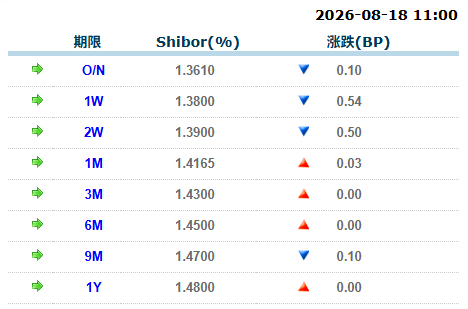
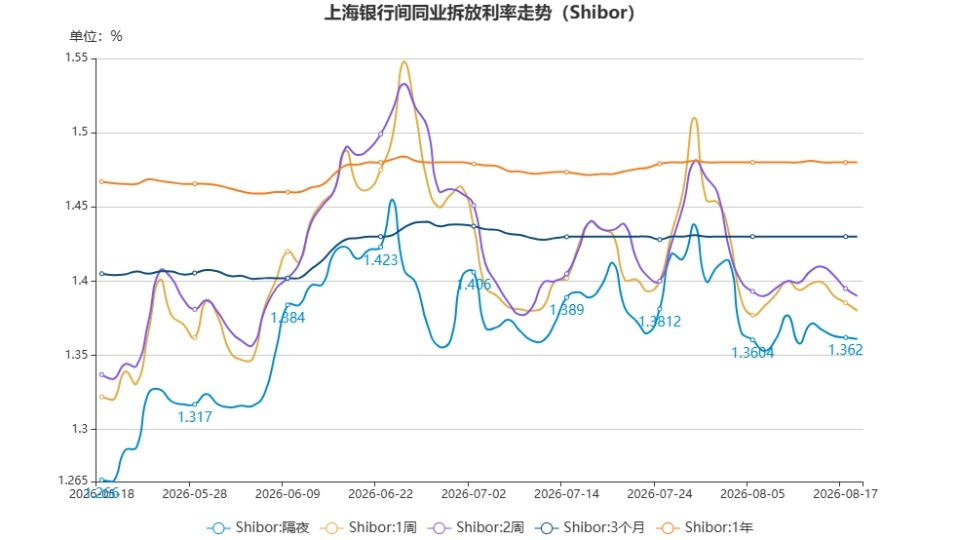
Shanghai Interbank Offered Rate (Shibor) sees mixed movements, with overall stability. Specifically, the overnight Shibor fell by 0.10 BP to 1.3610%; the 7-day Shibor fell by 0.54 BP to 1.3800%; and the 14-day Shibor fell by 0.50 BP to 1.3900%.
Shanghai Interbank Offered Rate (August 18)
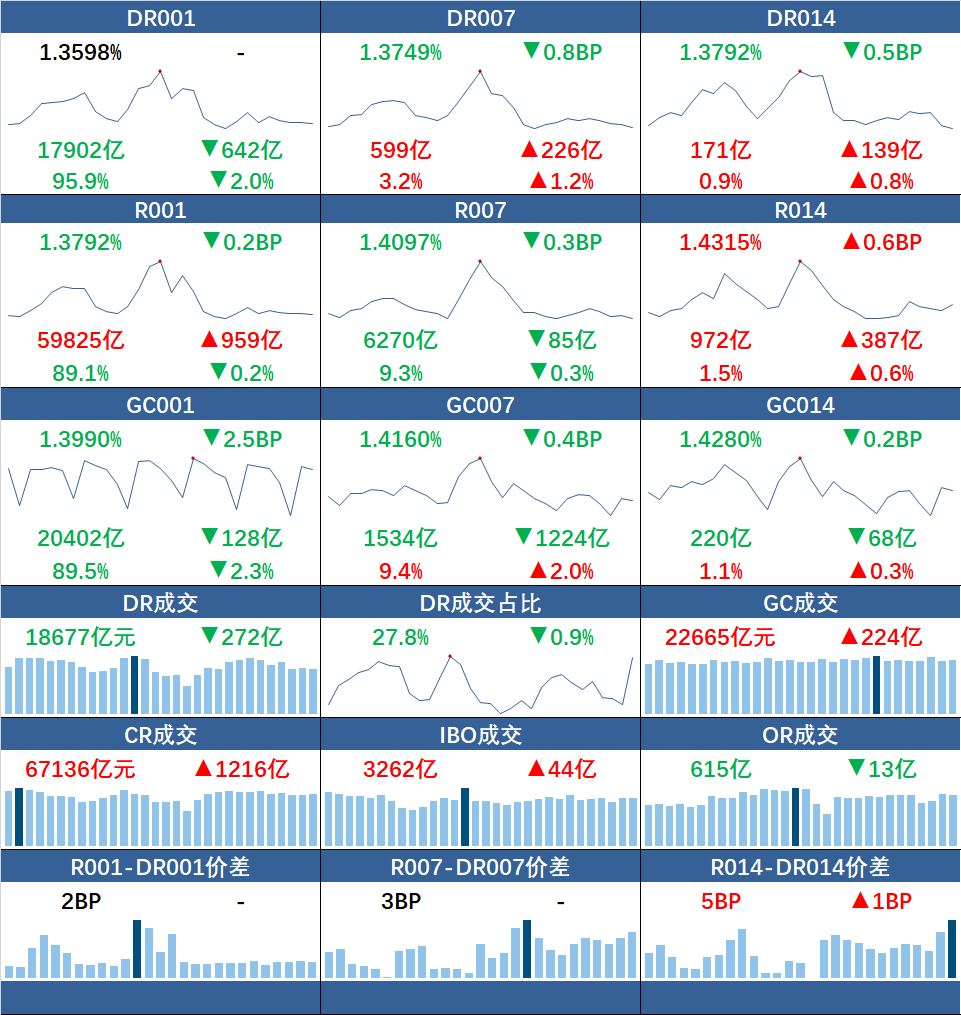
In the interbank pledged repo market, short-term rates edged down overall. Trading volume for R001 continued to rise, nearing 600 billion yuan, while the weighted yield trends for DR014 and R014 diverged. Specifically, the weighted average rates for DR001 and R001 were basically unchanged, with a decline of 0.2 BP, reported at 1.3598% and 1.3792% respectively. Trading amounts decreased by 64.2 billion yuan for DR001 and increased by 95.9 billion yuan for R001. The weighted average rates for DR007 and R007 fell by 0.8 BP and 0.3 BP respectively, reported at 1.3749% and 1.4097%. Trading amounts increased by 22.6 billion yuan for DR007 and decreased by 8.5 billion yuan for R007. The weighted average rates for DR014 and R014 fell by 0.5 BP and rose by 0.6 BP respectively, reported at 1.3792% and 1.4315%. Trading amounts increased by 13.9 billion yuan for DR014 and 38.7 billion yuan for R014.
Money market interest rates (August 18)
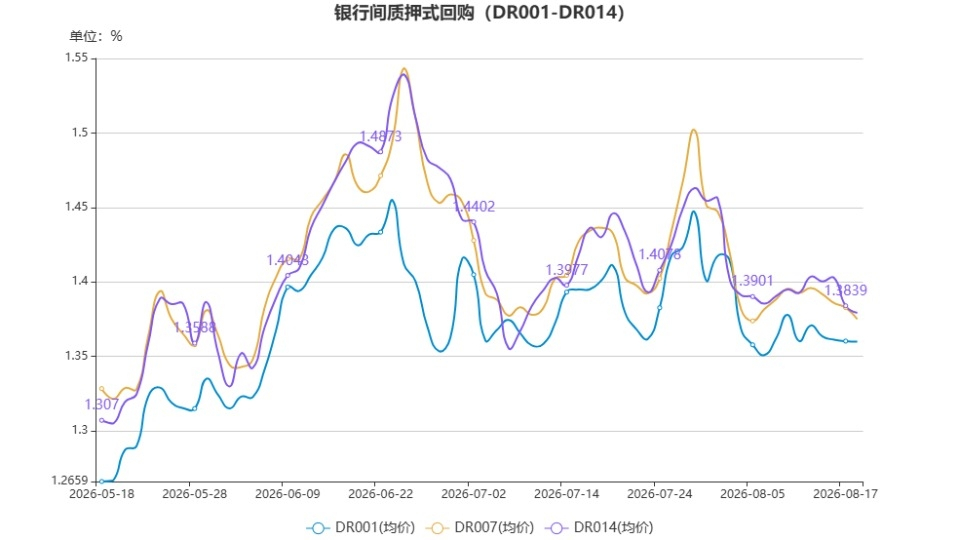
According to messages from a trader at Shanghai International Money Brokerage Co., Ltd., on the 18th the funding market continued to be in a relatively loose state. In the early session, funding supply across tenors was abundant. For overnight pledged rate CDs, deals were done at around 1.39%; for pledged credit O/F/R supply, deals were in the 1.42%–1.43% range. For 7-day non-bank pledged rate CDs, deals were in the 1.40%–1.41% range, and pledged credit O/F/R was in the 1.415%–1.42% range. For cross-month tenors, 14-day pledged rate CD deals were around 1.43%, and non-bank pledged credit O/F/R was around 1.45%–1.46%. Subsequently, more funds were lent out and the deal rates edged down. Near midday, overnight pledged rate CD deals fell to the 1.37%–1.38% range; for cross-month tenors, a small number of pledged rate CD deals were in the 1.425%–1.43% range. Overall, liquidity remained loose through the morning close. In the afternoon, the funding market stayed loose at the open: overnight pledged rate CD deals were in the 1.37%–1.38% range, and 7-day non-bank pledged CDs were around 1.40%. Near the close, the lowest overnight pledged rate deal reached 1.36%, and the lowest pledged CD deal reached 1.37%. Liquidity remained loose until the close.
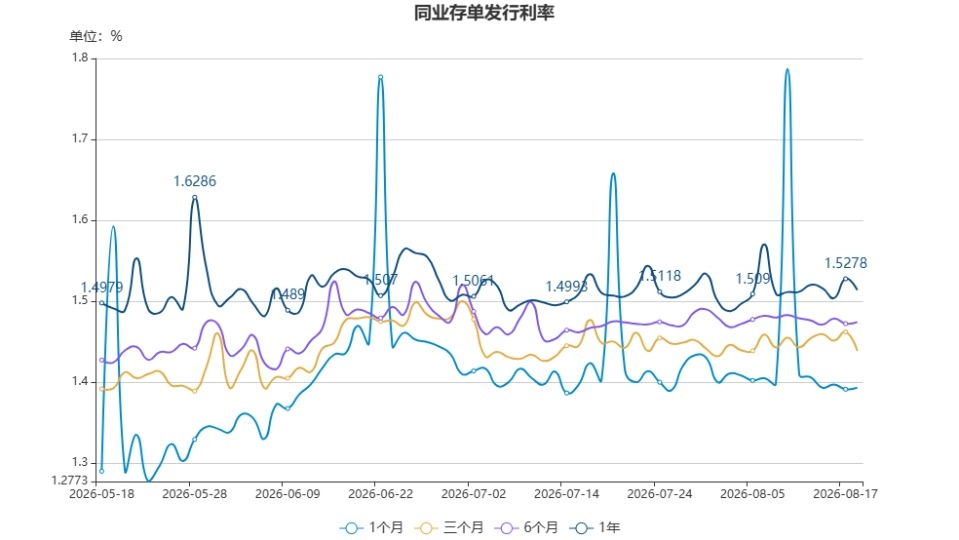
On the interbank negotiable certificates of deposit front, short-end yields in the secondary market were broadly flat with yesterday, while yields on the long end fluctuated and trended lower. Specifically, the 1M China-guaranteed bank CD closed at around 1.38% at end of day, unchanged from yesterday; the 3M China-guaranteed bank CD closed at around 1.43%, unchanged; the 6M China-guaranteed bank CD closed at around 1.46%, unchanged; the 9M China-guaranteed bank CD closed at around 1.475%, down by about 0.25 bp from yesterday. The 1Y China-guaranteed bank CD closed at around 1.4775%, down by about 0.25 bp from yesterday. The spread between 1Y and 9M was 0.25 bp, narrowing by 0.1 bp from yesterday; the spread between 9M and 6M was 1.5 bp, narrowing by 0.25 bp; the spread between 6M and 3M was 3 bp, unchanged; the spread between 3M and 1M was 5 bp, unchanged. The 1Y–1M curve spread was 9.75 bp, narrowing by 0.25 bp from yesterday. The 1Y–3M curve spread was 4.75 bp, also narrowing by 0.25 bp from yesterday.
【Today’s Focus】
? On August 18, Xiao Yuanqi, a member of the Party Committee and vice minister of the National Financial Regulatory Administration, met with Jonathan Choi, the Secretary for Financial Services and the Treasury of the Hong Kong Special Administrative Region Government, and his delegation. The two sides exchanged views on the latest developments in the financial industry in both places, as well as supporting Hong Kong to consolidate and enhance its status as an international financial centre. Xiao Yuanqi said that the Financial Regulatory Administration supports Mainland insurance funds in participating in mutual financial market access between the Mainland and Hong Kong, and supports Mainland insurance institutions to invest in exchange-traded funds (ETFs) listed on The Stock Exchange of Hong Kong through the Shanghai–Hong Kong and Shenzhen–Hong Kong Stock Connect.
? Recently, Guangdong’s first “token economy” special financial product, “Token Loan,” was launched in Guangzhou’s Haizhu District. China Bank, CITIC Bank, and Guangzhou Bank were the first three banks to participate in the initial rollout. Among them, China Bank has already implemented the credit line quota. Interviewed experts believe that the “technical ledger” formed based on token consumption data is becoming a new basis for banks to build their credit assessment framework. In essence, it is a digital extension of corporate credit evaluation in a computing-power scenario. The financing pain points addressed by “Token Loan” are real, and the data-driven credit logic it constructs is valuable too. However, the data infrastructure, risk-control methodology, and regulatory framework supporting that logic are still under development.
? According to incomplete statistics from the YinDeng Center, the number of debt packages released for listing announcements this year increased by 10% compared with the same period last year, but the total outstanding principal amount declined by nearly one quarter. The average size per single package “shrunk” by more than 30%. In terms of asset quality, the transferred asset packages show characteristics of “shorter aging, smaller average number of borrowers per account, and a lower litigation rate.” The median of the weighted average overdue days shortened by about 10 months, and the trend of banks “selling earlier and exiting faster” is evident. Meanwhile, in package solicitation for assets, Platinum Card holders, higher-education groups, and younger customer segments are becoming key “selling points” in banks’ solicitation announcements. Industry consensus is that the ongoing expansion in the supply of credit card non-performing assets is the concentrated clearance of risks left behind by historically extensive growth, rather than a sudden worsening of risk. With the policy window period and the combined impact of existing stock liabilities, it is likely that full-year supply will remain at a high level. However, prices of high-quality assets with short holding periods and non-litigated assets are expected to stay relatively stable.
Edited by Gao Ershan