I keep coming back to the same thing with DUSK:
the interesting part isn’t really the privacy narrative.
It’s what happens when you open the developer docs and ask, “okay… how do I actually build this?”
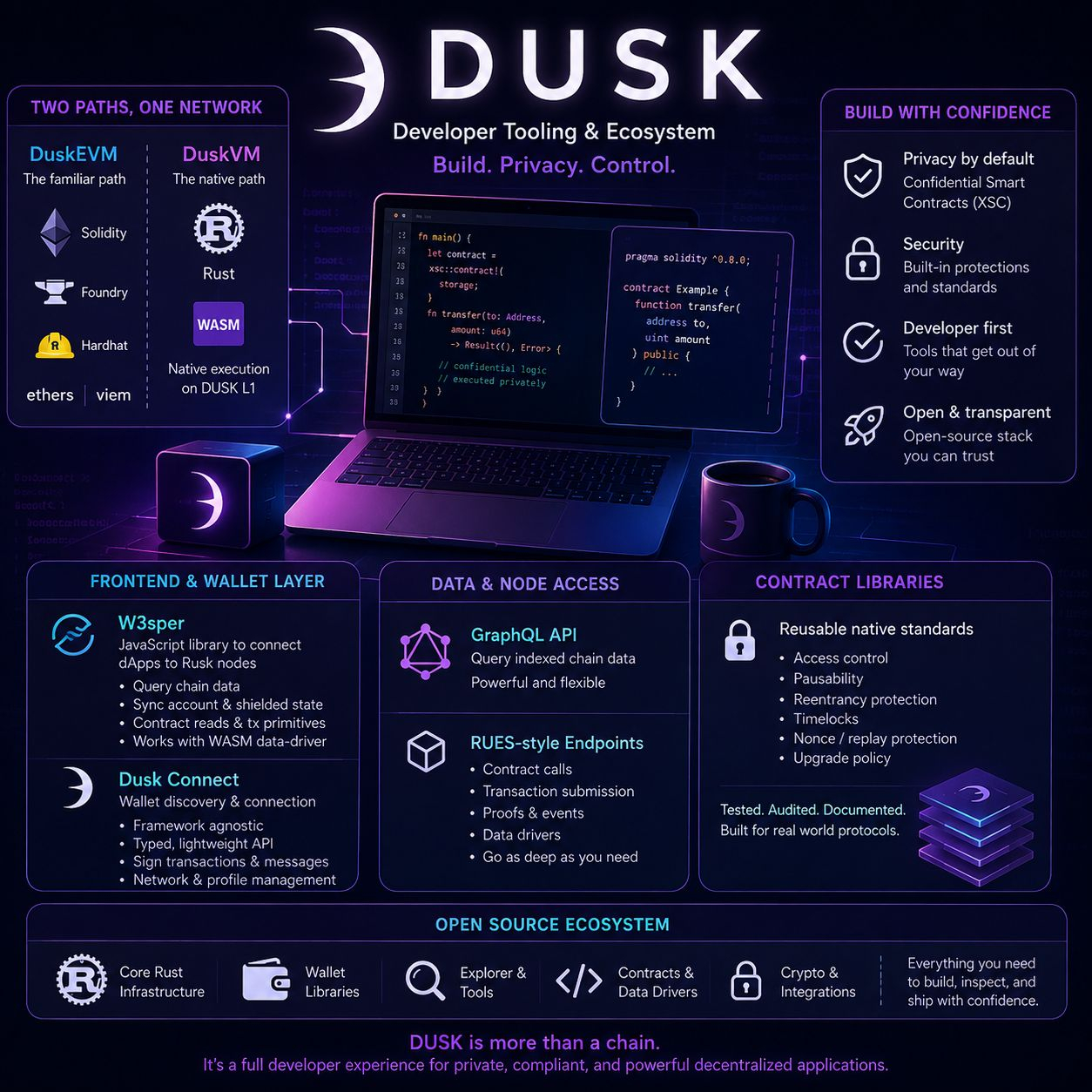
You get two paths.
DuskEVM is the comfortable one.
Solidity, Foundry, Hardhat, ethers, viem — tools most Ethereum developers already know.
Then there’s DuskVM.
Rust, WASM, and a much more native way of talking to the chain.
That second route feels different.
You’re not just deploying to a familiar EVM with a privacy label attached.
You’re learning how DUSK itself works.
And that matters.
W3sper lets apps talk to Rusk nodes, query chain data, handle account state, interact with contracts and work with WASM data drivers.
Dusk Connect handles wallets without forcing developers around one wallet.
And when the abstractions stop being enough, you can go lower.
GraphQL.
Node APIs.
Rawer transaction and contract flows.
That’s usually a good sign.
Because every serious developer eventually hits the edge of the nice wrapper.
Even the contract libraries caught my attention: access control, pausability, reentrancy protection, timelocks, replay protection.
Boring stuff.
Until you actually need it.
That’s what I like about DUSK’s developer stack.
It doesn’t feel built only to look easy from the outside.
There’s a deeper layer for people willing to learn the machine.
And maybe that’s the quiet bet here:
the developers who stay long enough to understand the stack may build things that are difficult to express elsewhere.
Sometimes the best developer feature is the one you only notice after the tutorials stop helping.
#dusk $DUSK @Dusk