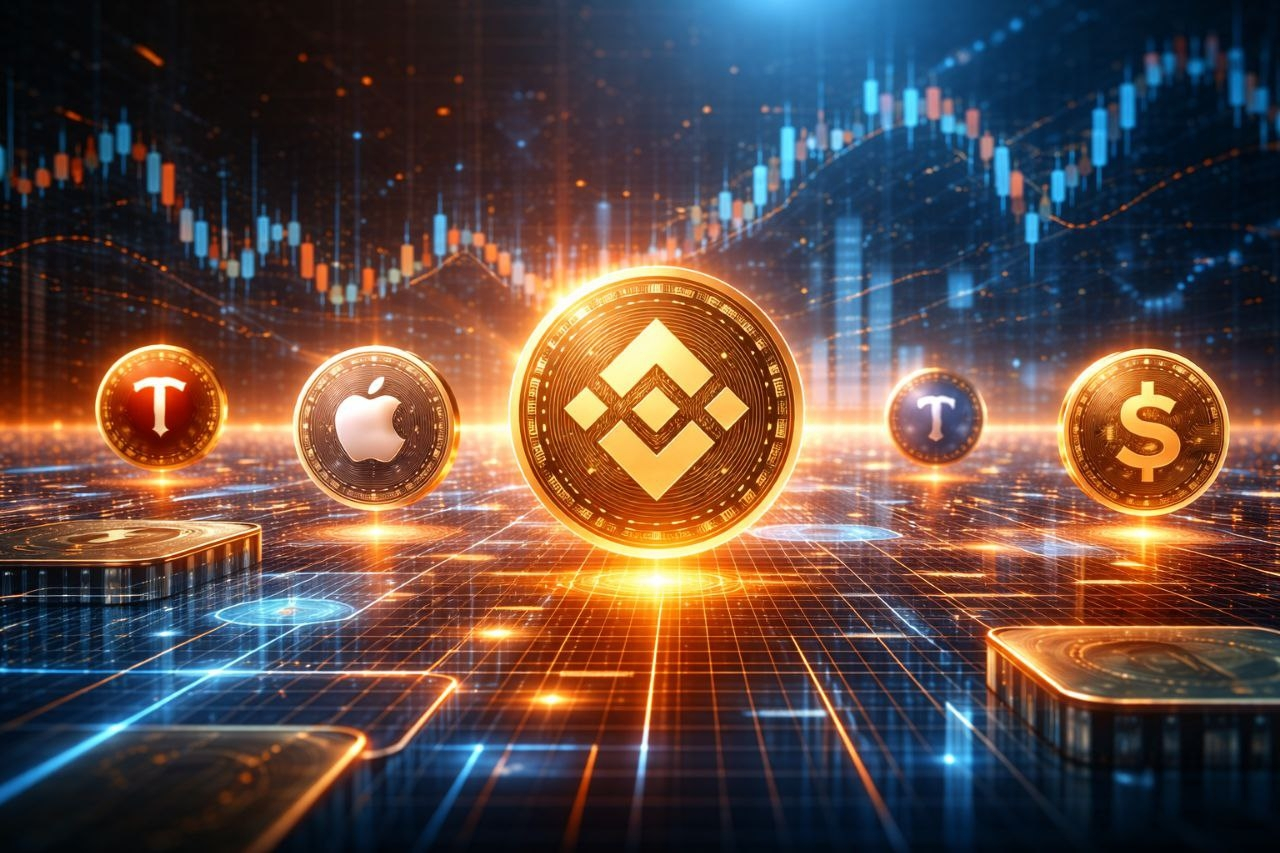
In a world where the integration of traditional finance (TradFi) with the blockchain economy accelerates, the phenomenon of tokenizing real-world assets (RWA) stands out as one of the deepest structural shifts in the modern financial system.
At the heart of this transformation, Binance stands not just as a trading platform, but as a player reshaping the concept of financial ownership from its roots.
Talking about tokenized stocks is not an exhibition of a new product, but a strategic reading of a future where geographical boundaries are broken, and the relationship between the investor and the asset is redefined.
🔹 Core idea: When ownership becomes fairer
What are tokenized stocks?
Tokenized stocks are a digital representation of a real stock listed in traditional markets (like Tesla or Apple), traded via blockchain with a direct price correlation of 1:1 to the real asset.
It is not speculative derivatives, but a new model of digital ownership that combines:
Blockchain transparency
Liquidity of global markets
Modern trading flexibility
🔹 Why is it a true revolution?
1️⃣ Fractional Ownership
Owning a high-priced share is no longer exclusive to large capitals.
Any investor can own a small part of the share, which:
Expands the investor base
Increases liquidity
Achieves unprecedented access fairness
2️⃣ Trading without time limits
✔️ 24/7 Trading
✔️ No waiting for market opening
✔️ Settlement without delay (T+2)
Stocks move with the same flexibility as digital currencies, but with real asset values.
🔹 From suspension to smart return: Binance's story with tokenized stocks
In 2021, Binance launched tokenized stocks for the first time, but faced strong regulatory challenges from entities such as:
UK FCA
German BaFin
The reason?
Legal ambiguity surrounding the classification of these assets:
Are they securities? Or digital assets?
🔻 Result: Service temporarily suspended.
But in 2026, everything changed:
Maturity of the crypto market
Evolution of regulatory frameworks
Binance's transition to a more compliant model
Rising institutional demand for RWA
➡️ This return is not an experiment… but a carefully calculated step.
🔹 Why now? The rise of the RWA era
Asset tokenization is no longer a futuristic idea but a reality driven by:
Binance
Coinbase
OKX
Traditional institutions like Nasdaq and NYSE
Everyone agrees on one point:
Tokenized assets are the next bridge between traditional finance and the digital economy.
🔹 Quick comparison: Traditional stocks vs Tokenized stocks
The standard
Tokenized stocks
Traditional stocks
Trading
24/7
Specific hours
Minimum
Parts of the share
Full share
Access
Global
Local
Settlement
Instant
T+2
Fees
Lower
Higher
🔹 Challenges… but
Despite the significant advantages, challenges still remain:
Differences in regulatory frameworks
Geographical restrictions
Legal classification of assets
But financial history tells us one thing:
Every technology that solves a real problem… finds its way to success.
With the increasing need for: ✔️ Higher liquidity
✔️ Greater transparency
✔️ Global access
Tokenization of stocks is not an option, but a necessary phase.
Summary: Redefining ownership
Tokenized stocks are not just a trading tool,
But a philosophical shift in the concept of financial ownership.
It is a transfer of power from: 🏦 Closed institutions
➡️ To individuals around the world
And in this transformation…
The question is no longer:
Will tokenized stocks succeed?
But it has become: When will it become the norm?