A couple of days ago, while checking the on-chain records on the chain, I noticed something strange. I had a lending order posted on TermMax at a certain price that never got filled. The order sat there for almost two weeks, yet during that period, I actually received daily interest. The money was just waiting for someone to take the order slot, but it didn’t sit idle—it was still working.
This experience was quite new to me. After playing with limit orders for so many years, I’ve always thought of posted order capital as dead money. In an exchange, placing a low-priced order and waiting for it to get matched—if it doesn’t fill within half a month, that’s very common. Meanwhile, that money just lies in the margin account and earns zero interest. On-chain lending is the same: you post a lending order, and if it can’t be matched, you simply wait. Only people who can afford to wait have the right to earn from limit-price funding—almost like an implicit cost.
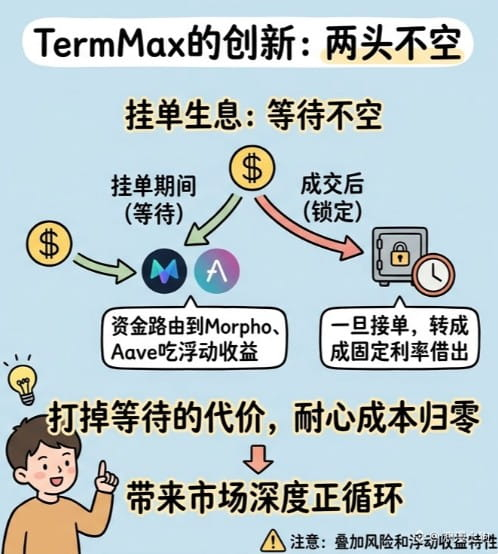
The mechanism itself isn’t complicated. Before the deposit order gets matched, the protocol automatically routes the funds to established lending platforms like Morpho and Aave to capture floating yield. As soon as someone takes the order, the capital is pulled back and converted into a fixed-rate loan. While you wait you earn floating yield; once matched you earn fixed yield—so neither side is left empty.
The really impressive part of this design is that it eliminates the cost of waiting. The biggest weakness of the order-book model is liquidity cold-start. No one wants to use real money to sit in the book as a standing order, because being idle means losing money. Now the posted orders themselves also generate yield, so the opportunity cost of patience effectively becomes zero. That naturally encourages more capital to stay in the order book. For the whole market depth, it creates a positive feedback loop. Honestly, this makes me more optimistic about the model than even the yield itself.
That said, there are two layers of risk you have to unpack. First, the routed funds mean the risk exposure increases by another layer. You might think you’re only taking the risk of TermMax, but in reality you’re bearing the compounded risk of TermMax plus the underlying lending platforms. If a contract at any layer fails, you’re pulled into the consequences. Second, during the posting period you’re earning floating yield. That portion isn’t locked. “What you see is what you get”—the yield is only accounted from the moment matching succeeds. Don’t assume the entire cycle’s yield is guaranteed as fixed return. Also, when funds are withdrawn from the underlying platform and then matched, there’s an execution timing in between. In extreme market conditions, whether there will be friction depends on real on-chain testing.
When you have funds posted and waiting to be filled, how do you usually handle them—do you just wait, or do you find another route?
#termmax @TermMax
This experience was quite new to me. After playing with limit orders for so many years, I’ve always thought of posted order capital as dead money. In an exchange, placing a low-priced order and waiting for it to get matched—if it doesn’t fill within half a month, that’s very common. Meanwhile, that money just lies in the margin account and earns zero interest. On-chain lending is the same: you post a lending order, and if it can’t be matched, you simply wait. Only people who can afford to wait have the right to earn from limit-price funding—almost like an implicit cost.
The mechanism itself isn’t complicated. Before the deposit order gets matched, the protocol automatically routes the funds to established lending platforms like Morpho and Aave to capture floating yield. As soon as someone takes the order, the capital is pulled back and converted into a fixed-rate loan. While you wait you earn floating yield; once matched you earn fixed yield—so neither side is left empty.
The really impressive part of this design is that it eliminates the cost of waiting. The biggest weakness of the order-book model is liquidity cold-start. No one wants to use real money to sit in the book as a standing order, because being idle means losing money. Now the posted orders themselves also generate yield, so the opportunity cost of patience effectively becomes zero. That naturally encourages more capital to stay in the order book. For the whole market depth, it creates a positive feedback loop. Honestly, this makes me more optimistic about the model than even the yield itself.
That said, there are two layers of risk you have to unpack. First, the routed funds mean the risk exposure increases by another layer. You might think you’re only taking the risk of TermMax, but in reality you’re bearing the compounded risk of TermMax plus the underlying lending platforms. If a contract at any layer fails, you’re pulled into the consequences. Second, during the posting period you’re earning floating yield. That portion isn’t locked. “What you see is what you get”—the yield is only accounted from the moment matching succeeds. Don’t assume the entire cycle’s yield is guaranteed as fixed return. Also, when funds are withdrawn from the underlying platform and then matched, there’s an execution timing in between. In extreme market conditions, whether there will be friction depends on real on-chain testing.
When you have funds posted and waiting to be filled, how do you usually handle them—do you just wait, or do you find another route?
#termmax @TermMax