
Stock trading—just look at the analysis reports by financial analyst team of Golden Qilin: authoritative, professional, timely, and comprehensive. Help you uncover potential theme opportunities!
Source: Securities Market Weekly, Market No.
Text | Waterside
On August 17, the market rebounded strongly. On August 18, it quickly shifted again toward differentiation, but this did not stop some individual stocks from continuing an accelerated rally, nor did it break the market’s offensive posture established since August.
The breakout of a “bull” phenomenon (the arrival of a bull) sparked consecutive limit-up gains for multiple stocks related to “bulls,” such as Luoniushan and Tianshan Biology. On August 18, Yiming Food again sealed a limit-up; from the end of July to now, it has surged by nearly 200%. Among tech stocks, PCB player Jinlu Electronics not only regained its July losses but has also accelerated to set a new historical high in recent days. Optical communication leaders like Tianfu Communications and Shijia Photon have all achieved a V-shaped reversal. Zhongshi Technology has also logged three straight 20CM limit-up moves...
Recently, market concept stocks and theme sector stocks have kept heating up, which to a certain extent indicates that investors’ risk appetite is rising. But there’s one issue that can’t be avoided: after this round of rebound, the market has entered a critical window—many stocks have already accumulated relatively large gains. Is it time to leave, or is it still worth staying? Can this rebound continue? Among the leaders this time, such as optical communications and storage chips, which ones still have upside opportunities beyond expectations? Today’s discussion focuses on this.
The rally is expanding into a wider market area
Tianfu Communication has gained 70% since August
@With the Light, Hello. I saw your August 16 back-end comment: “It will definitely skyrocket, recover what was lost, and make new history!” There are many thoughts behind that. In this round of repair rally since August, many people may have experienced a shift in mindset—from not believing at the beginning, to believing a bit, and then to believing relatively strongly. Market optimism is also increasing in parallel as the rally in both indices and individual stocks gradually spreads.
Based on market feedback, the structural “money-making effect” has been continuously amplified in some individual stocks. If we separately count the number of stocks with gains of over 50% since August—up to August 18, August 17, August 14, and August 13—the numbers are 91, 86, 49, and 39 respectively (see Table 1).
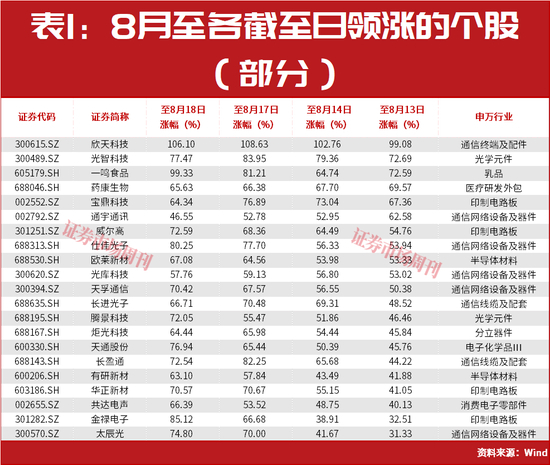
Among them, sector leaders led the charge with strength, with tracks led by compute power and optical communications. For instance, Tianfu Communication has gained 70% since August. For a recent stock incentive plan, it has set performance appraisal targets for net profit growth from 2027 to 2029 versus 2025 of no less than 120%, 320%, and 560% respectively.
Looking further, many stocks have moved from a decline under an “A-type” pattern into a “V-shaped” rebound. Market confidence is being repaired even more. For instance, Taichen Optical, which fell more than 50% in late July, has risen more than 70% since August. According to the financial report, its revenue in Q2 2026 reached a historic high on a single-quarter basis. In addition, looking at holdings, “smart money” northbound capital significantly increased its position in the second quarter, adding 5.07 million shares to reach 6.519 million shares.
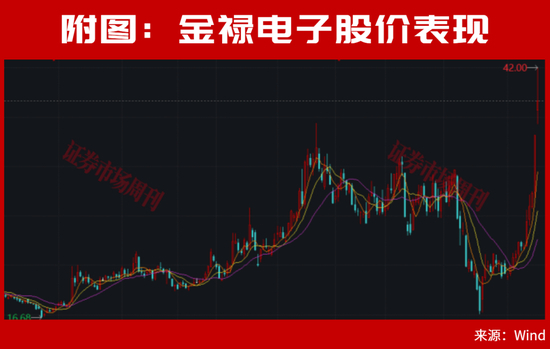
Some individual stocks not only recovered the losses from July but also set new highs. For example, in the PCB segment, Jinline Electronics. After it sent out a signal for a strong rebound early from the bottom, it then continued to rebound. On July 21, it closed with a “20cm” limit-up at a low level, successfully engulfing the prior long bearish candle. After that, it continued rising. On August 17, it closed with another “20cm” limit-up, and on August 18 it rose further and hit a new historical high (see the attached figure). Jinline Electronics is a typical case, but the more important question is: where is the next “Jinline Electronics” to come from?
In addition to the underlying assets in (Table 1) above, there is another very typical single stock: Changxin Technology. On August 17, it surged 12%, and its market value surpassed 4 trillion yuan. Previously, many people were concerned that Changxin Technology would trigger a “siphon” effect and intensify internal differentiation. But judging from what’s happening now, the market isn’t following that script. Instead, it has connected a chain reaction: Changxin Technology’s stock price rally → boosted sentiment in the storage sector → a coordinated rise among stocks across the industry chain.
Just from the market perspective, this rebound in A-share AI compute power, optical communications, and storage stocks is clearly linked with the U.S. market. For example, SanDisk and Micron Technology have surged one after another recently, and they have almost recovered their losses from July. Lumentum’s gain is also close to its historical high set in May this year.
Regarding the current market, some people feel anxious about missing the move; some worry about chasing high and getting stuck on the sidelines. Others believe that the start of a right-side market has given everyone yet another opportunity to “buy on pullbacks.”
Duanyongping adjusts his NVIDIA holdings
Highyi significantly increased its holdings of SanDisk and Micron Technology
Behind this round of rebound in AI optical communications, compute power, and storage chip stocks are multiple driving logics, including performance realization from leading companies and optimistic expectations for the long-cycle industry.
For example, Anthropic (believed to have the potential to challenge the biggest U.S. IPO in history). Its preliminary revenue in the second quarter exceeded $11.5 billion, up at least 14 times year over year. The significance behind this is reflected in the realization of performance at the AI application layer—validating the industry’s business cycle momentum and sustainability for the compute infrastructure and optical communications sectors.
In addition, on August 14, NVIDIA announced that its Spectrum-X Ethernet silicon-optical switches have entered full-scale mass production. It should be noted that this is the world’s first 200G/lane CPO Ethernet switch system to enter mass production. This event is an important catalyst for accelerating order fulfillment and expanding commercial space across the CPO and optical interconnect industry chain. It also helps heat up hard-tech areas in A-share AI optical communications, storage chips, and related fields.
Against the backdrop of the overall positive cycle for the AI industry, recent 13F filings released by some well-known investors and heavyweight institutions show that in Q2 2026, different institutions hold somewhat different views on the AI industry chain, while sharing some similarities. For example, Duanyongping, Highyi, and others.
First, let’s look at Duanyongping. The second-quarter U.S. stock holdings filing submitted by H&H International Investment (hereinafter “H&H”) shows that its total holdings market value is about $19.1 billion, or roughly RMB 138 billion. With such a huge scale, it only allocated to fewer than 20 underlying assets. Its top holding is still Apple (APPLE), with a holdings market value of $7.8 billion. Further analysis shows that in the second quarter, H&H reduced positions in seven individual stocks (such as NVIDIA, Apple, Google, and Microsoft), fully exited two stocks (TSMC and CrowdStrike). Meanwhile, it increased holdings of PDD Holdings, Berkshire Hathaway Class B shares, and Disney, and it also initiated a new position in Alibaba (see Table 2).
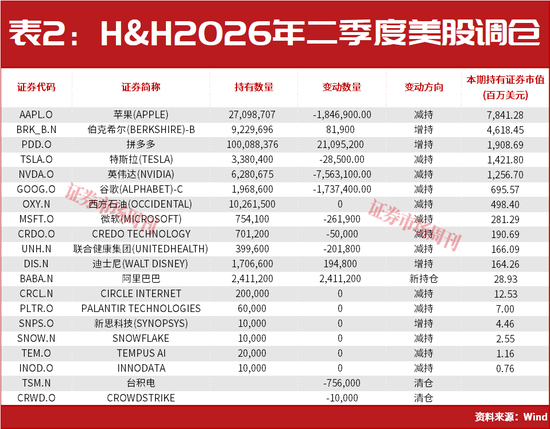
H&H reduced its holdings in NVIDIA by a relatively large amount. In the second quarter, it cut 7.56 million shares to 6.28 million shares, and the market value of its holdings fell to $1.256 billion. Worth noting is that during the second quarter, NVIDIA’s share price hit a record high. Looking back, H&H built its position in NVIDIA in Q1 2025, and in both Q4 2025 and Q1 2026 it continued to add large amounts. The share counts at the end of those quarters were 7.2371 million and 13.8438 million respectively.
In H&H’s case, its reduction of NVIDIA holdings in this year’s second quarter exceeded 50%. Some believe this is more like a “take profit at a high level” approach under a value-investing mindset. In addition, judging from H&H’s overall portfolio reshuffling in the second quarter, there are clear signs of actively optimizing the holding structure and not concentrating excessive weight in a single track—AI computing power.
Similar to H&H’s pace, in the second quarter Highyi also reduced its holdings of NVIDIA. The number of shares held fell by more than 70% to 80,000 shares. At the same time, it also initiated a new position in Alibaba.
Overall, according to Highyi’s overall U.S. stock holdings in the second quarter, the total market value of holdings was close to $1 billion, and it held fewer than 20 stocks as well. In this list of holdings, relative to H&H, Highyi increased its holdings of TSMC in the second quarter. Highyi’s stake in TSMC increased by more than 10% in Q2, and the market value at the end of the quarter was $230 million. Worth noting is that TSMC is Highyi’s number-one overweight stock in its U.S. portfolio.
Highyi’s preference for the AI industry chain is also reflected in its significant additional bets on the storage leaders Micron Technology and SanDisk. In the second quarter, Highyi increased its Micron holdings by 25,000 shares (an increase of over 280%) to 34,000 shares, with a market value of approximately $39.73 million. It also added 10,000 SanDisk shares (an increase of over 190%) to 16,000 shares, with a market value of about $36.38 million. Worth noting is that both Micron Technology and SanDisk are new positions added by Highyi in the first quarter of this year.
(The individual stocks mentioned in the article are only used as examples for analysis and do not constitute buy/sell recommendations.)