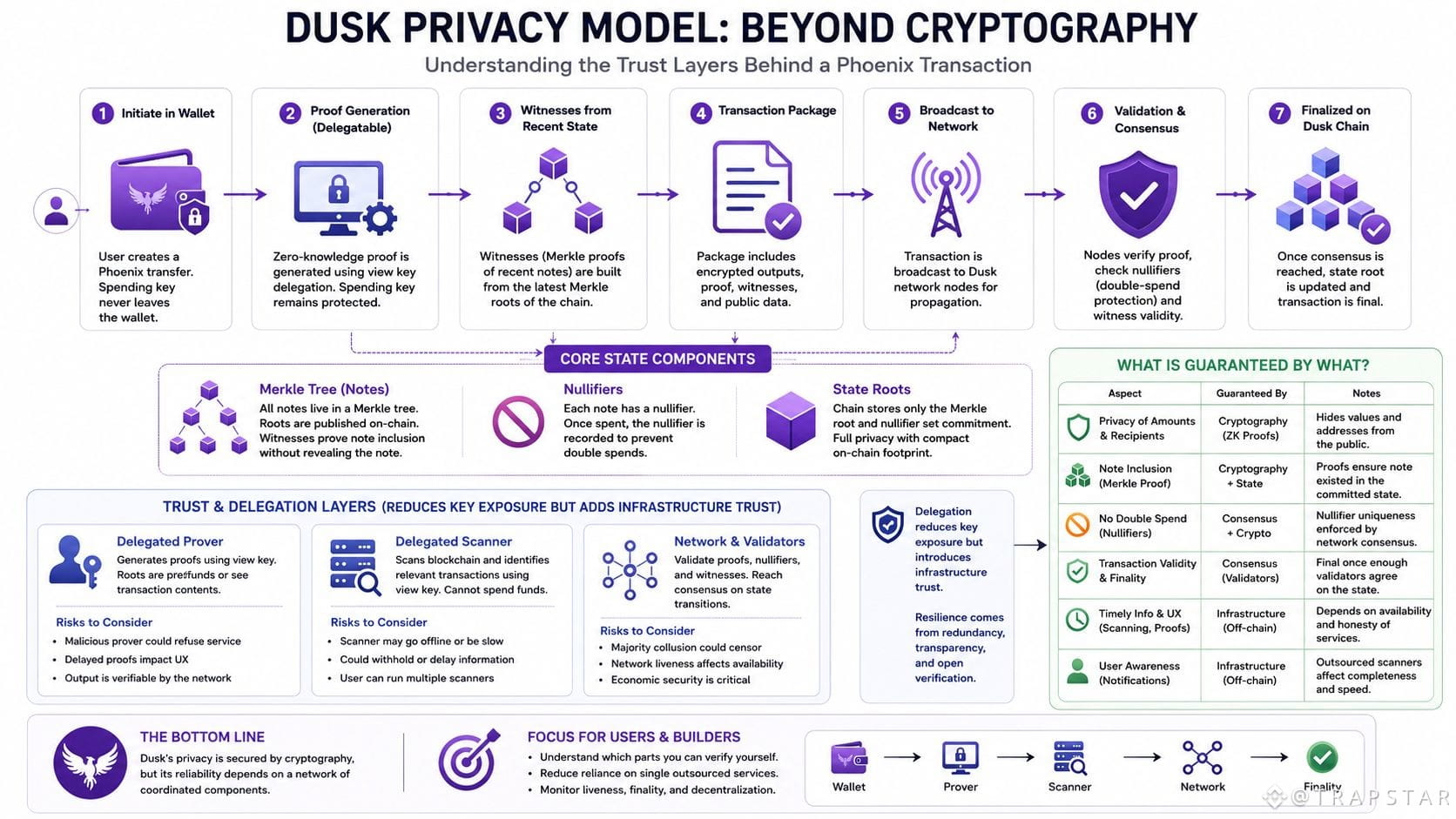
I thought I understood Dusk's privacy model until I started tracing what actually has to be trusted once a transaction leaves the wallet. That's where the architecture becomes far more interesting than the cryptography itself.
The more I mapped the transaction flow, the more the focus shifted away from encryption and toward coordination. A Phoenix transfer is not just about creating a valid proof. It depends on witnesses built from recent Merkle roots, nullifiers preventing double spends, and the network agreeing on a consistent state before anything is finalized. Every layer protects a different assumption, and that makes the trust model worth examining in detail.
The documentation explains that proof generation and blockchain scanning can be delegated without exposing spending keys, thanks to view keys and separated authorization. That design reduces key exposure, but it also raises practical questions. How are outsourced proving services verified? What happens if a delegated scanner becomes unavailable, delayed, or selectively withholds information? Which guarantees come from cryptography itself, and which still rely on honest infrastructure operating around it?
That distinction matters because the strongest privacy systems are not defined only by what they hide. They are defined by how resilient they remain when parts of the surrounding ecosystem behave unpredictably. For Dusk, understanding those boundaries may ultimately matter more than understanding the zero-knowledge proofs themselves.
@Dusk $DUSK #dusk
The more I mapped the transaction flow, the more the focus shifted away from encryption and toward coordination. A Phoenix transfer is not just about creating a valid proof. It depends on witnesses built from recent Merkle roots, nullifiers preventing double spends, and the network agreeing on a consistent state before anything is finalized. Every layer protects a different assumption, and that makes the trust model worth examining in detail.
The documentation explains that proof generation and blockchain scanning can be delegated without exposing spending keys, thanks to view keys and separated authorization. That design reduces key exposure, but it also raises practical questions. How are outsourced proving services verified? What happens if a delegated scanner becomes unavailable, delayed, or selectively withholds information? Which guarantees come from cryptography itself, and which still rely on honest infrastructure operating around it?
That distinction matters because the strongest privacy systems are not defined only by what they hide. They are defined by how resilient they remain when parts of the surrounding ecosystem behave unpredictably. For Dusk, understanding those boundaries may ultimately matter more than understanding the zero-knowledge proofs themselves.
@Dusk $DUSK #dusk