#dusk $DUSK @Dusk
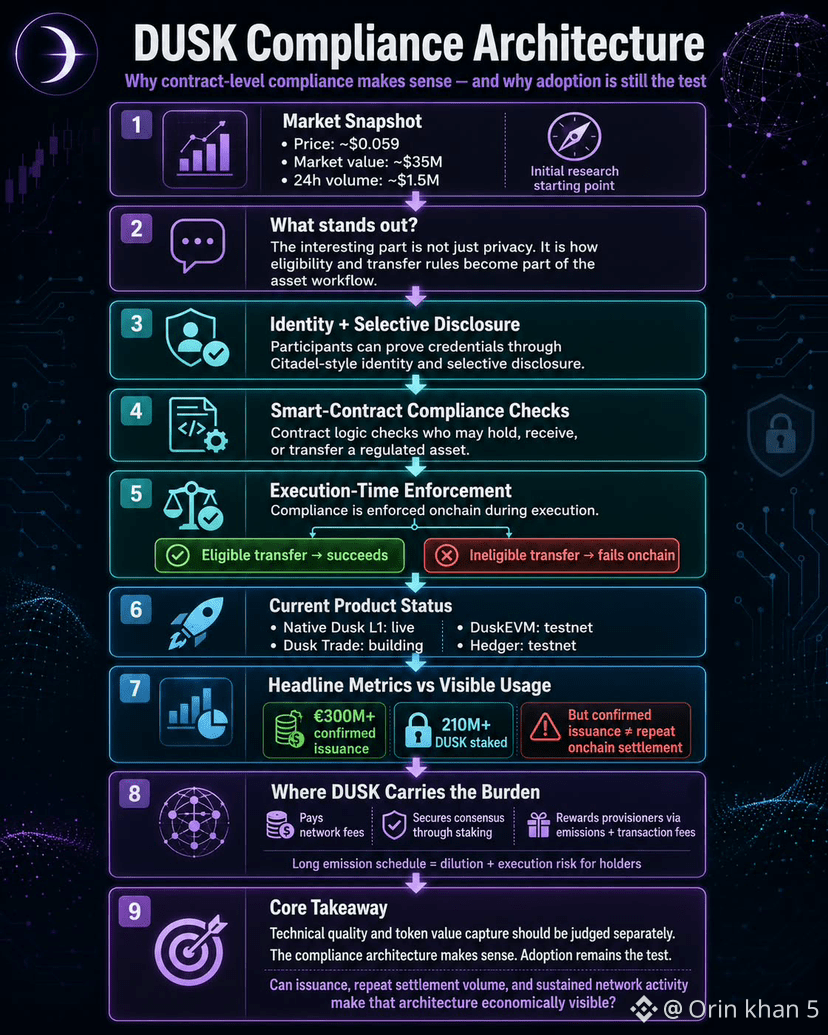
I was checking DUSK around $0.059, with roughly $35 million in market value and about $1.5 million in daily volume, when I returned to Dusk’s compliance architecture. The interesting part is not privacy. It is making eligibility and transfer rules part of the asset workflow.
For a regulated asset, a participant can prove credentials through Citadel-style identity and selective disclosure, while smart-contract logic checks who may hold, receive, or transfer the asset. That matters because compliance is enforced at execution time: an ineligible transfer can fail onchain instead of depending entirely on a venue or manual review.
The harder question is whether that design is producing visible usage yet. Dusk’s native L1 is live, but Dusk Trade is still building, while DuskEVM and Hedger remain testnets. Dusk reports €300M+ in confirmed issuance and 210M+ DUSK staked, yet confirmed issuance is not the same as repeat onchain settlement.
DUSK carries the economic burden. It pays network fees, secures consensus through staking, and rewards provisioners through emissions plus transaction fees. The emission schedule continues over decades, so holders face dilution and execution risk while institutions may use compliant infrastructure without needing recurring DUSK balances.
That is why technical quality and token value capture should be judged separately. The contract-level compliance model makes sense; adoption remains the test. Can verifiable issuance, repeat settlement volume, and sustained network activity make that architecture economically visible?