


Nanfang Finance reporter Zhu Zixuan
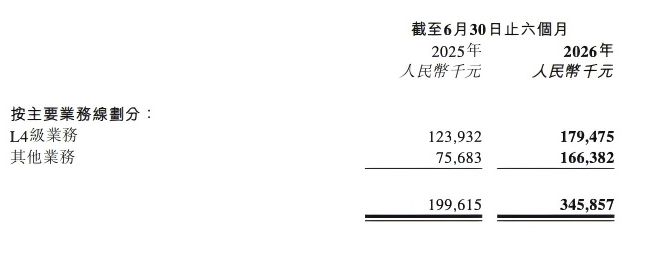
Recently, Guangzhou autonomous driving company Wenyao Zhixing released its interim performance results for the first half of 2026. The financial report shows that Wenyao Zhixing’s total revenue for the first half was RMB 346 million, up 73.3% year over year; gross margin increased from 30.6% in the same period last year to 36.6%. Notably, over the past six months, its L4-level business performed remarkably well, with revenue of RMB 179 million, accounting for roughly half of its core business.
However, although revenue has grown rapidly, the loss-making situation has not improved. When will Wenyao Zhixing turn to profitability—that remains one of the questions the market is most concerned about.
Revenue of RMB 346 million and a loss of RMB 790 million
The domestic market is the foundation of Waymo's business, and the performance in the first half of 2026 is also impressive.
In the second quarter of 2026, the daily average number of orders per Robotaxi vehicle in China exceeded 21, up 24% quarter over quarter, with a daily peak of 28 orders. The number of registered users increased 35% quarter over quarter, and taxi-hailing revenue increased by about 140% quarter over quarter in the single quarter. In Guangzhou—the core city—the scope of pure unmanned services has already expanded to three times the level at the end of 2025, covering the three core districts of Huangpu, Tianhe, and Haizhu, enabling uninterrupted commercial operations 24/7.
Han Xu, founder and CEO of Waymo, said, “In the second quarter of 2026, Waymo made notable progress in overseas acceleration, light-asset expansion, and building self-sustaining capabilities. On the technology front, both the scaled commercial deployment of the 3,400-vehicle L4 fleet represented by Robotaxi and the roughly 30,000-unit per-quarter delivery of the one-piece end-to-end L2++ solution have already been achieved.”
By business line, the L4 business is still the “anchor” supporting revenue. In the second quarter, it achieved revenue of RMB 125 million, up 47% year over year and up 131% quarter over quarter. More noteworthy is the explosive growth of the high-level assisted driving solution business: in the second quarter, revenue surged 25.94 times year over year and increased 219% quarter over quarter. Behind this data change is the company’s end-to-end ADAS solution WRD 3.0 entering the stage of large-scale production.
Starting from the mass-production smart-driving market by leveraging the L4 technology “dimension reduction” approach, the company not only reduces R&D costs, but also opens up a broader market space than Robotaxi. This has become one of the core supports for the increase in gross margin in the first half of the year.
As of now, WRD 3.0 has secured production lock-ins for more than 30 vehicle models. In the second quarter, quarterly shipments reached 30,000 sets. The rapid ramp-up of the L2++ business means that Waymo’s strategy to enable mass-produced vehicles using L4 technology in a “dimension-reduction” way is starting to deliver financial returns. This forms a dual-engine structure: “L4 builds the technology barrier” and “L2++ releases scale dividends.”
In a research report, Dongwu Securities judged that the domestic fleet size and the number of commercial cities continue to increase, directly improving per-vehicle economics. Bidirectional growth in order density and user scale is gradually validating the network effects of city-level operations.
Behind the impressive operational data, the profitability turning point has not yet arrived.
According to the financial report, in the first half of the year, the net loss was RMB 790 million, narrowing by only 0.2% year over year, which is more than twice the revenue of RMB 346 million. Operating loss was RMB 853 million, narrowing by 4.2% year over year. If non-cash items such as share-based payments are excluded, the adjusted net loss reached RMB 665 million, which actually expanded by 11.7% year over year.
The main reason is the continued ramp-up of R&D investment. Most of the huge spending goes toward iterations of the autonomous driving technology foundation and large models.
To enable an autonomous driving system to handle rare long-tail scenarios, the underlying compute cost, GPU spending, and data costs are all substantial investments. Data from a research report by Guolian Minsheng shows that in the second quarter, R&D expenditures reached RMB 434 million, up 36.2% year over year. Investment in areas such as personnel outsourcing, cloud services, and hardware iterations is still being further increased. In the entire first half of the year, the company’s total R&D expenses were RMB 798 million, which is 2.3 times the total revenue for the period.
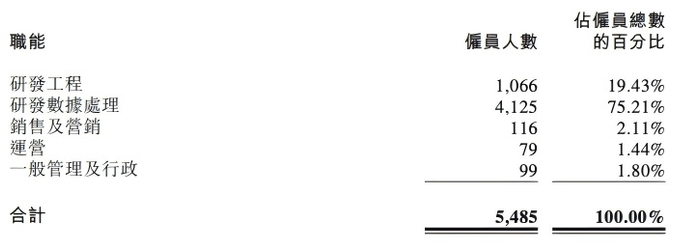
The staffing structure also reflects the high-intensity R&D investment. As of the end of June, the company had 5,485 employees globally, including 1,066 in the R&D engineering team and 4,125 in the R&D data processing team. Employees related to R&D account for more than 94.6%.
As of the release of the interim report, Waymo has not officially announced that any city in China has achieved operational profitability at the per-vehicle level.
The speed of revenue growth still cannot keep up with the growth rate of R&D and operational investment. By the end of June, the company’s cash and cash equivalents plus time deposits totaled approximately RMB 5.4 billion, down RMB 1.7 billion from the beginning of the year. In just half a year, it consumed nearly one quarter of its cash reserves.
Ai Media Consulting CEO Zhang Yi said to Southern Finance reporters that 73% of revenue growth rates are already at a high-speed development stage, and losses are an objective result under the dual constraints of policies and road-right allocation.
Zhang Yi said that in domestic all-unmanned Robotaxi operations, operations are still mainly based on pilot programs within specific zones, and cross-regional operations have not yet been fully opened up. The rapid expansion of order size faces clear bottlenecks. Pressures on the cost side come from multiple aspects: R&D investment, vehicle depreciation, and safety operations and maintenance are all rigid expenditures. Meanwhile, R&D investment for a safety bottom line is necessary both now and in the future.
Up sharply by 154.4%, overseas business gains momentum
While the domestic core business remains steady and solid, the overseas market is becoming Waymo’s most prominent differentiating advantage.
In the first half of the year, overseas revenue grew 154.4% year over year, while domestic revenue grew 48.4% year over year in the same period. Overseas growth was 3.2 times that of domestic. The share of overseas revenue in total revenue also increased from 23.5% in the same period of 2025 to 34.5%.
Completely different from the domestic heavy-operations model, the overseas market follows a light-asset operational technology output route.
By partnering with local leading mobility platforms such as Uber and Grab, collaboration partners cover heavy-asset areas such as vehicle procurement, localized operations, and customer acquisition. Waymo only provides autonomous driving technology solutions and charges technology authorization fees and a share of operational revenue streams. According to the interim report disclosures, the company’s overseas L4 business is a high-gross-margin business and is one of the core drivers behind the company’s overall gross margin improvement during the reporting period.
“Although global autonomous driving commercialization is still in an early stage, the market space is broad and growth certainty is high. The marginal economic benefit of this model is prominent. It is expected to continue to contribute stable cash flow and has become an important profit center and cash-flow business for the company.” Li Xuan, CFO and international负责人 of Waymo, said that Waymo’s revenue is maintaining rapid growth and the company is steadily on the path toward self-sustaining cash generation.
As of now, Waymo has covered 13 countries and more than 60 cities for its Waymo business. Based on its overseas deployment, the company is continuously expanding in the Middle East market. In Abu Dhabi and Dubai, it has achieved pure unmanned commercial operations, covering more than 70% of core urban areas, with a local fleet of approximately 400 vehicles. In Europe, the company, through its collaboration with Uber, plans to roll out in Madrid and the Greater Zurich area in Spain and the region around Zurich consecutively. It has also partnered with GreenMobility, planning to expand its business in Denmark in the first half of 2027. In Asia, it has teamed up with Grab to launch public operations in Singapore.
In a research report, Dongwu Securities pointed out that the company’s light-asset overseas model of “software self-owned + vehicle fleet partners funding” has entered a phase of rapid growth. The profitability of the technology output model is significantly better than that of domestic self-operated operations.
The reusability of the technology foundation is the underlying support for multi-scenario deployment.
The company’s self-developed GENESIS general-purpose simulation platform can compress millions of kilometers of road testing data into just a few days, reducing data labeling costs by more than 75%. The newly released physical AI cognition large model WITT improves data processing efficiency by up to 200 times and reduces token costs by 98%. This set of general technical stack can be reused across all product lines. The long-term advantage in R&D efficiency will continue to be amplified.
However, from technological leadership to scale profitability, there is still a long commercial race ahead.
When discussing the direction of autonomous driving development, Zhang Yi told reporters from Southern Finance that risk-controlled scenarios such as cultural tourism, industrial parks, and transportation hubs can be prioritized for expansion. In addition, fixed shuttle routes through B2B government and enterprise partnerships can ensure stable passenger flow and cash flow. At the same time, the Robotaxi service can be used as a supplement to urban public transportation capacity to cover commuting and shopping district travel demand, forming complementarity with the existing C-end operational core. He also believes that by continuously refining the safety performance of L2+/L3 smart driving solutions and deepening the overseas light-asset authorization rollout model, the company can open up a broader market space.