#termmax @TermMax TermMax is not just a fixed-rate protocol. It’s a redesigned “DeFi LEGO” built from the ground up.
I used to think fixed-rate is only for big funds or institutions. But after sitting down and reading through TermMax’s components carefully, I realized: they’re breaking things down into small pieces so retail users can use it too, while still preserving the precision of fixed interest rates.
The simplest way to understand it:
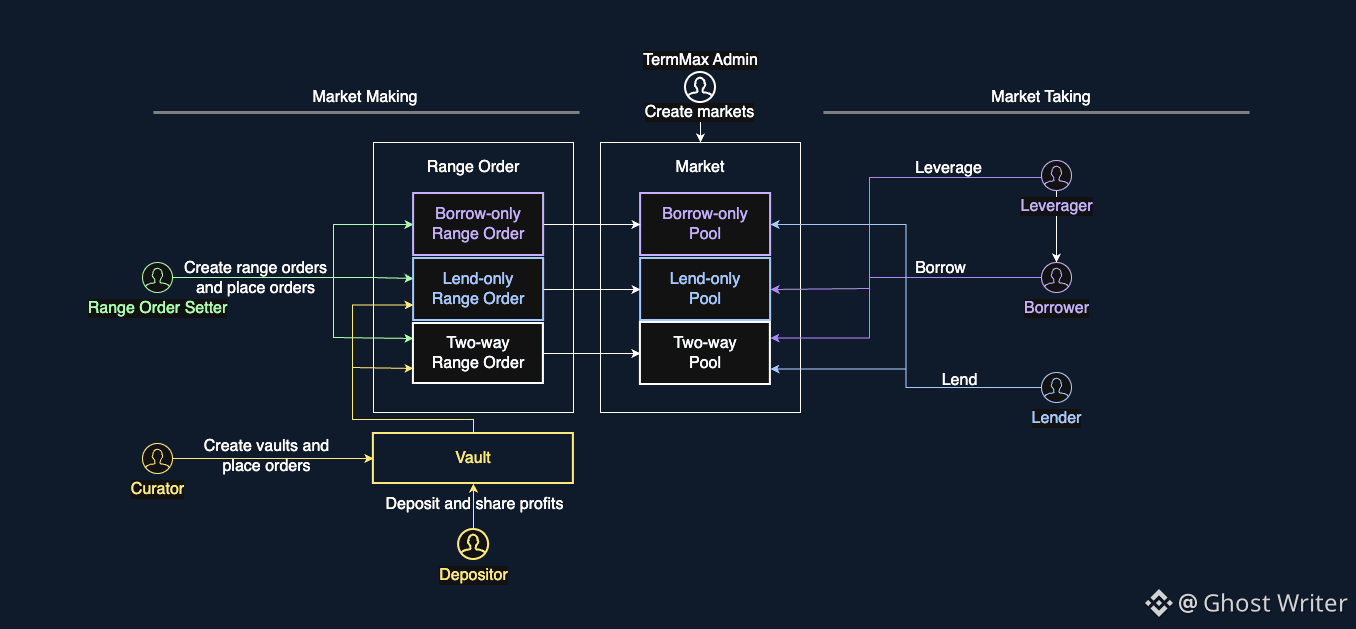
👉 Market is the “playground.” Each Market comes with a pre-defined debt token (usually stablecoin), collateral, maturity date, and liquidation threshold. All borrowing, lending, and leverage happen here.
👉 Range Order is the interest-rate curve that a market maker or curator draws in advance. There are 3 types: borrow-only, lend-only, or two-way. Users don’t need to place complicated orders—they just need to choose the interest-rate segment that fits and match. This is the part I find most interesting—rates are “quoted” clearly instead of jumping according to supply-demand every second.
👉 Vault is like an investment fund managed by the curator. You deposit money, they allocate it across multiple Range Orders, and profits are shared by ratio. It has a timelock and a guardian to protect depositors. It’s very close to how traditional funds operate, but on-chain.
And there are three main tokens:
- FT: fixed-rate interest token. Bought at a discount to face value; at maturity you receive the full amount—the interest is known in advance.
- XT: the portion of interest that must be paid.
- GT: an NFT representing the entire leverage position (collateral + debt).
The whole system is designed so that floating rate only remains as the “waiting-to-match” part, while the matched portion always has a fixed interest rate.
On August 25th, TMX will officially TGE, and TermMax will also run the Binance Wallet Booster program. This is a great time for newcomers to explore before liquidity and incentives increase dramatically.
#binancewallet #tge
I used to think fixed-rate is only for big funds or institutions. But after sitting down and reading through TermMax’s components carefully, I realized: they’re breaking things down into small pieces so retail users can use it too, while still preserving the precision of fixed interest rates.
The simplest way to understand it:
👉 Market is the “playground.” Each Market comes with a pre-defined debt token (usually stablecoin), collateral, maturity date, and liquidation threshold. All borrowing, lending, and leverage happen here.
👉 Range Order is the interest-rate curve that a market maker or curator draws in advance. There are 3 types: borrow-only, lend-only, or two-way. Users don’t need to place complicated orders—they just need to choose the interest-rate segment that fits and match. This is the part I find most interesting—rates are “quoted” clearly instead of jumping according to supply-demand every second.
👉 Vault is like an investment fund managed by the curator. You deposit money, they allocate it across multiple Range Orders, and profits are shared by ratio. It has a timelock and a guardian to protect depositors. It’s very close to how traditional funds operate, but on-chain.
And there are three main tokens:
- FT: fixed-rate interest token. Bought at a discount to face value; at maturity you receive the full amount—the interest is known in advance.
- XT: the portion of interest that must be paid.
- GT: an NFT representing the entire leverage position (collateral + debt).
The whole system is designed so that floating rate only remains as the “waiting-to-match” part, while the matched portion always has a fixed interest rate.
On August 25th, TMX will officially TGE, and TermMax will also run the Binance Wallet Booster program. This is a great time for newcomers to explore before liquidity and incentives increase dramatically.
#binancewallet #tge