#termmax @TermMax
Brothers, the plaza has already dissected TermMax’s FT/XT identity, the Range Order curve, and flash-loan leverage. Over the past two days, I’ve been watching another piece: V2 Vaults’ Curator mode. The protocol itself doesn’t decide which maturity a given amount of money goes to—it hands that off to the curator. This design reminds me of a paper from 1945.
That year, Hayek wrote “The Use of Knowledge in Society.” He was answering the hottest debate back then: whether a planned economy can actually calculate better than a market.
His conclusion: “As for knowledge of particular times and places, it can never be fully communicated to any central authority.”
It’s not that the computing power isn’t enough—the point is that such knowledge simply can’t be taken away from the people who possess it.
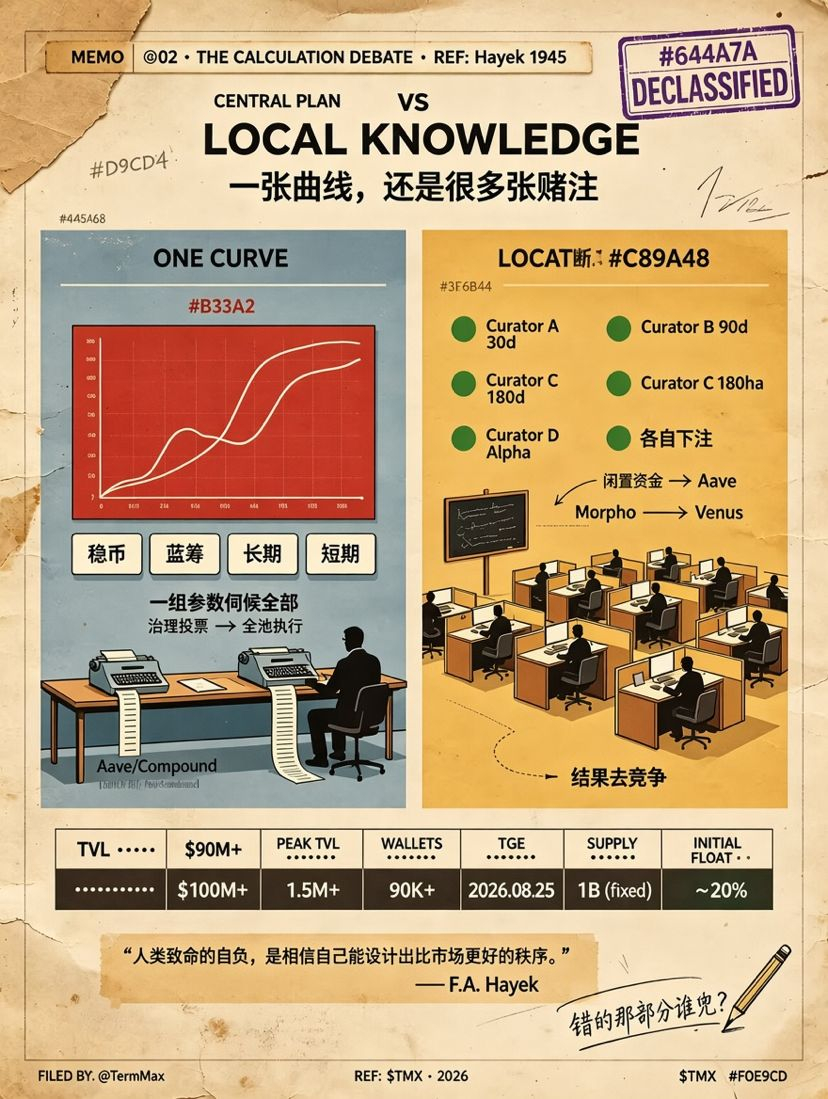
Aave and Compound take the opposite approach: interest-rate curve parameters are set by governance votes, and the entire pool executes them uniformly. The cost is that a set of global parameters has to serve all assets, all maturities, and all risk preferences at the same time.
TermMax breaks decision-making authority into pieces: Curators manage their own Vaults, do cross-maturity allocation—so judgments are distributed; idle funds automatically go to earn on Aave, Morpho, and Venus—so local opportunities aren’t wasted; Alpha Zone builds markets permissionlessly—so you don’t have to wait for governance approval.
This isn’t about creating a smarter curve. It’s about letting many people place bets, and letting the outcome compete.
When Hayek accepted the Nobel Prize, he put it more coldly: “Man’s fatal conceit is to believe that he can design a better order than the market.”
Spread out the soft underbelly and say it plainly: with curator authority centralized, if you pick the wrong person, the Vault takes the hit; TVL is a little over ninety million, and the peak has once broken 100 million—nothing on the same scale as Aave; 1.5 million registered wallets, around 90,000 daily actives—the retention still depends on what happens after TGE. TMX was generated on August 25th, with a fixed supply of one billion and initial circulating amount of 20%.
The interest rates determined by voting are design. The allocations produced through curator competition are discovery. But discovery requires trial and error—so who covers the part where mistakes happen?
Brothers, the plaza has already dissected TermMax’s FT/XT identity, the Range Order curve, and flash-loan leverage. Over the past two days, I’ve been watching another piece: V2 Vaults’ Curator mode. The protocol itself doesn’t decide which maturity a given amount of money goes to—it hands that off to the curator. This design reminds me of a paper from 1945.
That year, Hayek wrote “The Use of Knowledge in Society.” He was answering the hottest debate back then: whether a planned economy can actually calculate better than a market.
His conclusion: “As for knowledge of particular times and places, it can never be fully communicated to any central authority.”
It’s not that the computing power isn’t enough—the point is that such knowledge simply can’t be taken away from the people who possess it.
Aave and Compound take the opposite approach: interest-rate curve parameters are set by governance votes, and the entire pool executes them uniformly. The cost is that a set of global parameters has to serve all assets, all maturities, and all risk preferences at the same time.
TermMax breaks decision-making authority into pieces: Curators manage their own Vaults, do cross-maturity allocation—so judgments are distributed; idle funds automatically go to earn on Aave, Morpho, and Venus—so local opportunities aren’t wasted; Alpha Zone builds markets permissionlessly—so you don’t have to wait for governance approval.
This isn’t about creating a smarter curve. It’s about letting many people place bets, and letting the outcome compete.
When Hayek accepted the Nobel Prize, he put it more coldly: “Man’s fatal conceit is to believe that he can design a better order than the market.”
Spread out the soft underbelly and say it plainly: with curator authority centralized, if you pick the wrong person, the Vault takes the hit; TVL is a little over ninety million, and the peak has once broken 100 million—nothing on the same scale as Aave; 1.5 million registered wallets, around 90,000 daily actives—the retention still depends on what happens after TGE. TMX was generated on August 25th, with a fixed supply of one billion and initial circulating amount of 20%.
The interest rates determined by voting are design. The allocations produced through curator competition are discovery. But discovery requires trial and error—so who covers the part where mistakes happen?