



By | Zhou Miao
Editor-in-chief | Zhao Yan
Source | Starfire Ember
A cross-industry merger and acquisition pushed a storage testing equipment supplier that was once not particularly notable onto the spotlight.
Airlian Home (603221.SH), which mainly produces PVC elastic flooring, reported a pre-loss of more than RMB 34 million in the first half of the year. However, it has recently announced that it plans to acquire no less than 77.08% of the equity of a storage testing equipment provider called Wuhan Oukangnuo Electronic Technology Co., Ltd. (hereinafter “Oukangnuo”) for no more than RMB 650 million.
This acquisition also constitutes a related-party transaction. After the news broke, Airlian Home’s stock price chalked up 11 consecutive limit-up moves over 12 trading days, with a cumulative gain of 185.56%, during which it was suspended twice. The Shanghai Stock Exchange also issued a regulatory letter, asking questions regarding the underlying substance of the cross-industry acquisition, the source of funds, business synergy, and the arrangements for equity transfer, among other issues.
For Aili Home, which has no semiconductor testing business foundation, the acquisition of Oconno seems like a critical step for transformation. But what the market cares about more is whether, under the arrangement of the related-party transaction, this high-premium acquisition is really worth the money.
A 475% premium—why?
According to the announcement, the above 650 million yuan valuation implies a premium of about 475% over Oconno’s book net assets. Accordingly, actual controller Zhao Ming made a performance commitment: from 2026 to 2029, non-recurring profit and loss adjusted net profits will be no less than 50 million yuan, 50 million yuan, 60 million yuan, and 70 million yuan, respectively, for a total of 230 million yuan over four years.
So, is this company really worth that price? Oconno’s business is mainly SLT (system-level testing) technology-driven storage testing equipment and related testing services. Its products cover scenarios such as SSD module testing, DDR module testing, and storage device/testing of memory chips, and it mainly serves storage original manufacturers and module factory customers.
SLT (system-level testing) comes after CP wafer testing and FT finished-product testing. If ATE (automated test equipment, the core tool used to execute CP and FT testing) is like checking whether the “parts” are intact, then SLT is more like a “finished-goods inspector.”
Judging from performance: from 2023 to 2025, Oconno’s revenue increased from 17.6915 million yuan to 70.6782 million yuan. After suffering losses for two consecutive years, it turned profitable in 2025 with a net profit of 6.1068 million yuan. In the first half of 2026, the company’s revenue reached 79.8798 million yuan and net profit was 37.1967 million yuan, several times the full-year figure for 2025.
In response, Aili Home explains that, on one hand, it was driven by a surge in downstream demand, which expanded Oconno’s business scale and gradually diluted R&D expenses; on the other hand, it sold more BIST testing equipment with relatively low hardware costs and a high reuse rate of software development, thereby lifting the overall gross margin.
This rationale sounds reasonable, but just look at the customer structure. In the first half of 2025 to 2026, the top five customers’ revenue shares for Oconno were 96.16% and 93.48%, respectively. Based on each party’s revenue share and gross margin rate, the company’s overall gross margin increased from about 45% to about 66%.
What truly lifted the gross margin rates was actually the first-largest customer A (whose main products are SSD testers). In the first half of 2026, this customer’s revenue share rose from 36.99% to 84.08%, and the corresponding gross margin increased from 54.37% to 72.75%.
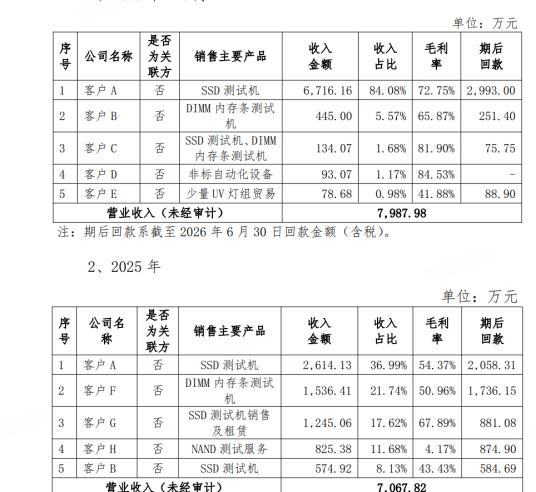
Now let’s look at the overseas giants. The announcement lists comparable companies—Japan’s Advantest and the U.S.’s Teradyne—with gross margins of 69.5% and 59.8% for Q2 2026, respectively. Judging by that, Oconno’s overall gross margin has already caught up with international leaders.
Not to mention that the third-largest customer C (mainly selling SSD tester systems and DIMM memory tester systems) and the fourth-largest customer D (mainly selling non-standard automation equipment) have gross margins as high as 81.9% and 84.53%, respectively. Even Advantest would have to go silent after looking at that.
How big is the market cake? Don’t rush to draw it on paper.
Additionally, Oconno’s revenue growth potential also doesn’t hold up under closer scrutiny. Aili Home cites data from the DATAINTELO report: using SLT’s 20.7% share of total testing equipment and referencing Advantest’s overall forecast for the tester market, it calculates that the market size for SLT equipment in 2026 will be between $440 million and $540 million.
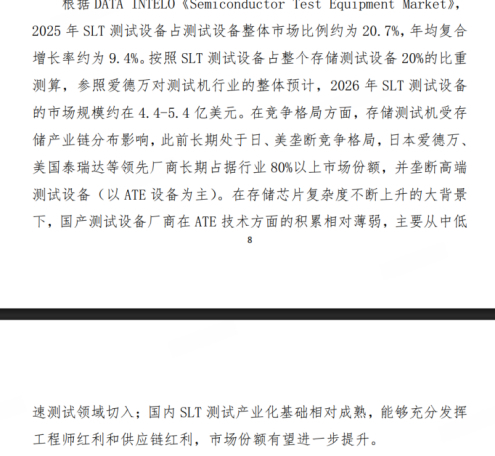
But the problem is that the announcement uses SLT’s share of overall testing equipment (20.7%) directly as its penetration rate in the SLT segment of storage testing equipment. Yet SLT is divided into multiple types based on the test target, such as SoC, power, and storage, among others. Is it really hard to justify using a big-disk coefficient and applying it to a specific niche segment?
And this doesn’t even count the monopoly of overseas giants. In its announcement, Aili Home admits that storage testing machines have long been in a duopoly pattern dominated by China and Japan/U.S. markets: overseas giants—Japan’s Advantest and the United States’ Teradyne—together hold more than 80% of the market share. However, in the company’s view, these overseas manufacturers monopolize mainly high-end testing equipment centered on ATE systems;
In other words, there may be room for domestic substitution in this niche sector of SLT. However, both industry reports and SEMI data show that globally, the SLT equipment market is dominated by a highly concentrated oligopoly: SEMI’s early data indicates that around 2020, just two companies—Advantest and Teradyne—together accounted for more than 90% of the memory SLT equipment market.
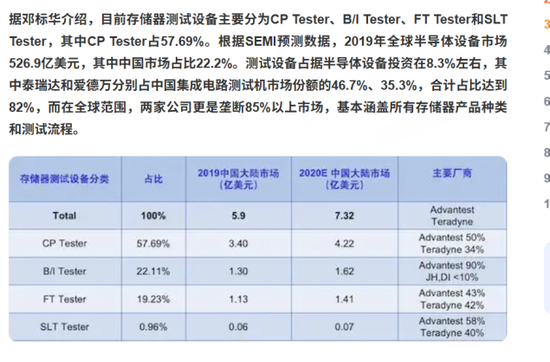
A report published in recent years, titled (The importance of system-level testing (SLT) in complex SoC chips and the equipment market), also mentions that the global SLT equipment market likewise has a highly concentrated oligopolistic structure, with CR5 at about 82% and CR3 at about 65%. The main players are still overseas giants such as Advantest and Teradyne.
What’s even more concerning is that competition in this track is intensifying. The explosion of AI computing power and 5G is making chips increasingly complex. Traditional ATE testing can hardly fully cover functional verification in real system environments anymore, and SLT has become a key link to intercept defects—meaning more and more players will be eyeing this “cake.”
Domestic ATE leaders such as Huafeng Testing & Control and Changchuan Technology (rights protection) have already extended their business into the SLT track. Even more subtly, Oconno’s former top customer, Shenzhen Yilian (a storage manufacturer; disclosed in the company’s 2020 interim report, and the company no longer discloses the name of major customers thereafter), has recently also announced the launch of its own developed M.2 SLT system.
In response, Aili Home also acknowledged in the announcement that the market space and engineering barriers in the SLT testing equipment segment where Oconno operates are relatively small. With the entry of Japanese and U.S. oligopolists and domestic competitors, it may face fiercer market competition.
To translate it: the issue for Oconno right now is not whether it can “grow into a big fish,” but that the pond itself may not be big or deep—Japanese and U.S. giants can step in at any time, and domestic peers and old customers have already jumped into the water.
“Gray memories” behind the rise
Oconno’s growth path is inseparable from two original manufacturers that were listed in promotional materials in the past: Seagate and Yangtze Memory.
In fact, when Oconno was founded in 2005, it focused on PCB testing equipment and automated fixtures, which had nothing to do with semiconductor storage. Starting in 2011, after it teamed up with Seagate (Seagate Technology, Nasdaq: STX), it began to work on HDD and SSD testing equipment—this is what officially brought it into the storage testing arena.
Seagate was founded in 1979 and is headquartered in California, the United States. Along with Western Digital and Toshiba, it is known as one of the three global HDD giants. Together, they control the vast majority of the mechanical hard disk market. Its main businesses include HDDs and enterprise-class SSDs. In China, Seagate has Seagate International Technology (Wuxi) Co., Ltd., which has been pointed to as an important production base for the company.
Later, the company supplied products to Lenovo, Huawei, and Inspur in sequence. But the truly “critical leap” was in 2021: it entered the Yangtze Memory supply chain, moving from a hard-disk factory fixture supplier to a domestic NAND original equipment manufacturer of complete SLT systems, officially stepping into the core circle of domestic storage. However, behind this “leap” lies a legal dispute that cannot be avoided.
In a second-instance judgment document ((2024) Su 02 Min Zhong 1327), this kind of past incident was recorded. Between 2018 and 2021, the former senior engineering manager at Seagate Wuxi Company, Xie, oversaw 9 Non-MS and 2 frontline MS engineers, responsible for Drive Failure analysis, stability testing, and customer rework.
On paper, all the core technical documents of Seagate were running through his work email. But over the three-year period, Xie gradually sent 68 documents from Seagate Wuxi Company to his own personal email, and many of the emails contained a large number of items marked with Seagate confidential information. Xie explained that he forwarded the relevant emails to work from home.
Things started to get subtle from 2021. In that year, Xie frequently used a new email address with the suffix @cnokn.com.cn—the official domain of Oconno. Later in court, Xie admitted that he had “heard of a certain company in Suzhou (affiliated with Oconno) that is a supplier of analysis equipment,” and he also said, “in the past two years, we haven’t purchased anything from this supplier.”
But in the same witness testimony, he also confirmed another fact: in May and June 2021, Oconno personnel emailed him asking him to “check whether the experimental results meet a certain company in Wuxi’s project upgrade requirements.” For this purpose, Oconno specifically applied for a company-domain email account for him, with the password provided by the other party—he used it himself.
What happened afterward, Xie said very calmly—he forwarded the emails sent by Oconno to his subordinate Wang. After Wang finished the analysis, he sent the results back. Then Xie forwarded the results back to Oconno’s email, telling them to “log into Oconno themselves to see the specific content.”
An international first-tier original manufacturer with an extremely strict confidential system—why would the former senior leadership in its engineering department take such a risk? During their tenure, they used a supplier-domain email account to send project emails and provided the testing results to the supplier, reporting “test results that meet the project upgrade requirements.”
And during Oconno’s customer expansion, it also set up company email accounts for customer executives and asked them to evaluate the results of the experiments—such private contact that bypasses the customer’s normal procurement process may also reveal shortcomings in this company’s compliance management and business ethics, doesn’t it?
Up to here is the Seagate thread. But the story isn’t over. The circulation of project emails related to Seagate is one thing. Xie also did another matter: he arranged for his subordinate, Wang, to edit and process Seagate’s important testing scripts and results for Yangtze Memory—Seagate’s then major competitor—and sent files containing information about these competitors to Oconno’s email. The timing here happens to coincide with the time when Oconno pushed into the Yangtze Memory supply chain.
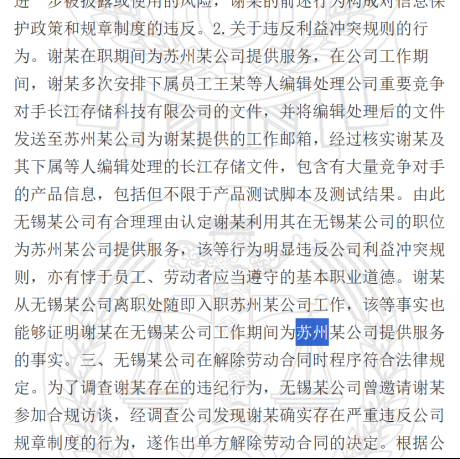
Based on this, Seagate determined that Xie’s conduct “clearly violated the company’s conflict-of-interest rules and was also contrary to a worker’s basic professional ethics,” and pointed out that he used his Seagate position to provide services to Oconno. Seagate also stated that after Xie left Seagate, he immediately joined Oconno, further proving that during his tenure he had already provided services to Oconno.
Ultimately, Seagate terminated Xie’s employment for serious violations of discipline. All of Xie’s claims for compensation were rejected in arbitration and litigation, and the final court decision held the dismissal to be lawful. This history was not mentioned by Aili Home in its transaction announcement, but it also became an inerasable gray area in Oconno’s résumé.
The “5% sincerity”: soft constraints under related-party transactions
Finally, let’s look at the most core performance “bet” arrangement in this transaction. According to the deal terms, Aili Home’s controlling shareholder, Zhangjiagang Bohua, plans to transfer 20.19% of shares to Oconno’s actual controller, Zhao Ming, and his acting-in-concert parties via agreement, at a total transfer price of about 454 million yuan. After the transaction is completed, Zhao Ming’s side becomes a related party of the listed company. That means this M&A transaction is still a related-party transaction.
According to the announcement, of the 20.19% of shares transferred by the Zhaoming party, only about 5% are designated as lock-up shares linked to the cumulative four-year net profits; they can only be unlocked upon meeting the targets. The remaining over 15% has no performance linkage. In other words, even if the performance commitment fails, the Zhaoming party still safely holds shares worth more than 340 million yuan.
The transfer payment for 454 million yuan worth of shares is delivered in advance. Only 5% of the shares are linked to performance completion, and the trigger threshold for cash compensation is also set at 80% of the cumulative committed net profit. The market already has clear doubts about the sincerity of these 230 million yuan performance commitments.
What about Aili Home’s own operations? In 2025, the company’s revenue was 1.127 billion yuan, down 13.93% year on year; net profit attributable to shareholders was 17.1777 million yuan, down 87.55% year on year; net cash flow from operating activities fell from 271 million yuan to 42.1733 million yuan, a decline of 84.46%.
Entering Q1 of 2026, Aili Home’s net cash flow from operating activities turned negative to minus 40.4825 million yuan, a year-on-year decrease of 103 million yuan. At the same time, the company expects that the net profit attributable to shareholders in the first half of this year will be a loss of between 34.5 million yuan and 40.5 million yuan, turning from profit to loss year on year.
Although this deal is still only at the intention stage and the formal plan has not been finalized, its underlying cards are already faintly discernible.