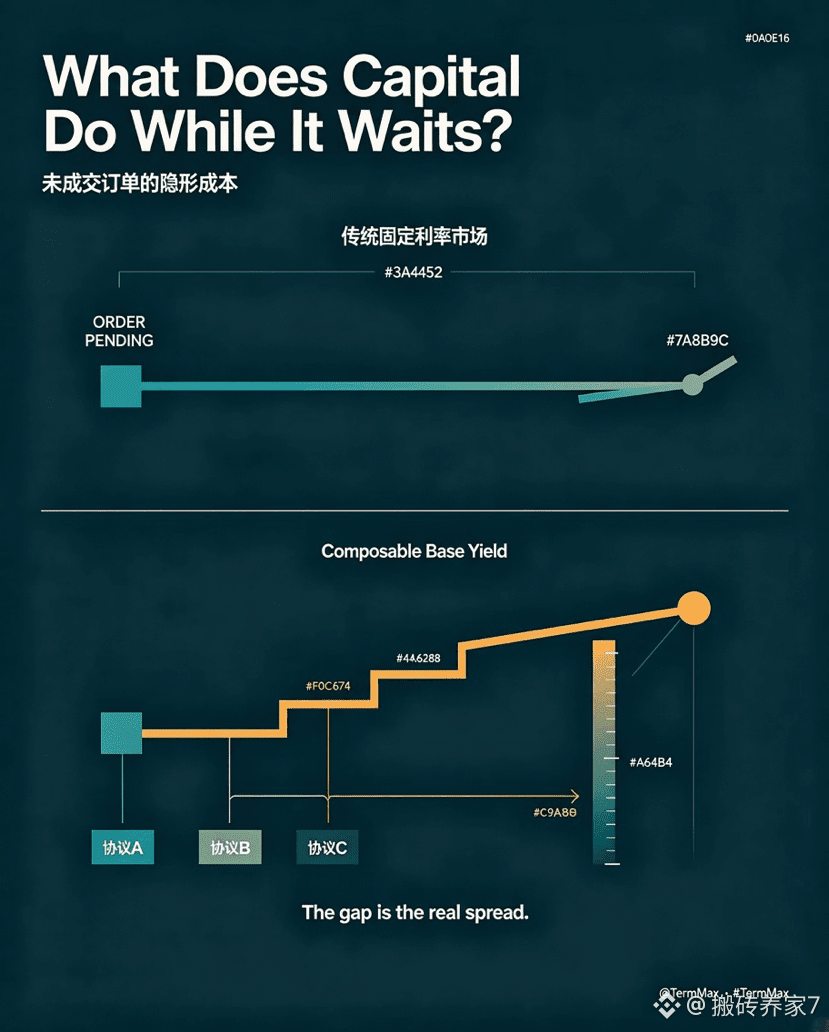
#termmax @TermMax Fixed-rate offers in DeFi have been shouted for years but still can’t get off the ground. I used to think it was a demand problem; now I think it’s more likely a cost problem—not the cost of the rate itself, but the cost of waiting.
There’s a hurdle that fixed-rate markets with an order-book design can’t get around: when you place an order and wait for the counterparty, if the trade doesn’t happen, the funds sit there idle. Floating-rate pools accrue interest at any moment, but in fixed-rate markets, idle capital that hasn’t been matched yields zero. This opportunity cost is rarely included in pricing, but it is a real spread—and it’s also why capital would rather stay in Aave.
Traditional brokerages already have a solution called a cash sweep: idle cash in your account is automatically swept into a money-market fund, no action needed.
@TermMax ’s Composable Base Yield follows the same idea. Idle funds are automatically deployed into floating-rate protocols like Aave, Morpho, and Venus, and then withdrawn when a trade is executed. It’s currently deployed across 10 EVM chains with TVL on the order of $90 million.
This creates a more interesting change: once the idle period also earns a base yield, the fixed rate borrowers demand is no longer an absolute number, but a premium over a floating benchmark—exactly how interest rate swaps have been priced for decades.
That said, we should also mention the soft spot. The base yield comes from external protocols, so risk is directly introduced; the benchmark itself is floating, and the opportunity cost is reduced—not eliminated. Funds are moved between external protocols and trade settlement, so timing and gas fees have to be accounted for.
The data above is compiled from public sources, not on-chain testing; the specific numbers will vary.
So what I want to ask is—what is the real threshold for fixed rates: is it pricing, or the cost during the time you’re waiting for the trade to be executed?
#TermMax
There’s a hurdle that fixed-rate markets with an order-book design can’t get around: when you place an order and wait for the counterparty, if the trade doesn’t happen, the funds sit there idle. Floating-rate pools accrue interest at any moment, but in fixed-rate markets, idle capital that hasn’t been matched yields zero. This opportunity cost is rarely included in pricing, but it is a real spread—and it’s also why capital would rather stay in Aave.
Traditional brokerages already have a solution called a cash sweep: idle cash in your account is automatically swept into a money-market fund, no action needed.
@TermMax ’s Composable Base Yield follows the same idea. Idle funds are automatically deployed into floating-rate protocols like Aave, Morpho, and Venus, and then withdrawn when a trade is executed. It’s currently deployed across 10 EVM chains with TVL on the order of $90 million.
This creates a more interesting change: once the idle period also earns a base yield, the fixed rate borrowers demand is no longer an absolute number, but a premium over a floating benchmark—exactly how interest rate swaps have been priced for decades.
That said, we should also mention the soft spot. The base yield comes from external protocols, so risk is directly introduced; the benchmark itself is floating, and the opportunity cost is reduced—not eliminated. Funds are moved between external protocols and trade settlement, so timing and gas fees have to be accounted for.
The data above is compiled from public sources, not on-chain testing; the specific numbers will vary.
So what I want to ask is—what is the real threshold for fixed rates: is it pricing, or the cost during the time you’re waiting for the trade to be executed?
#TermMax