



Industrial asset capability + operational capability + financial resources +
Cross-border resource + ability to connect users and capital + capability to organize long-term ecosystems.
Contents
First, the core logic of RWOA: moving from “digital assets” to “digitizing assets”
Second, First Tier: over 30 years of experience in the energy industry—RWOA’s asset-value foundation
Third, Second Tier: over 25 years of resources in the financial capital markets—connecting global investors and capital markets
Fourth, Third Tier: Industrial investment resources with 5+ years—connecting energy, infrastructure, and industrial capital
Fifth, Fourth Tier: international resources with 15+ years—an ability to organize a cross-border industrial ecosystem
6. Putting these resources together: RWOA forms a “four-layer ecosystem resource structure”
7. RWOA’s true moat: not “one project,” but a value chain
8. From “single wells” to “thousand wells”: industrial scaling is what RWOA is truly worth paying attention to
9. From the perspective of an investment bank: the core value of RWOA can be summarized as “six pools”
10. Why is a “background in industrial resources” more important than a Token narrative alone?
11. 5 years, 15 years, 25 years: what is truly worth watching is “time accumulation”
12. RWOA’s underlying positioning: not manufacturing a “virtual asset,” but redefining the digital representation of energy assets
13. Ultimately, it forms an ecosystem with a “three-in-one” structure: industry—capital—technology
14. From an investor’s perspective, how should we understand RWOA?
Conclusion: A truly strong ecosystem is not “one name,” but an accumulation of long-term capabilities.
Introduction: Truly valuable RWAs are not just “putting assets on-chain”
The core of RWA has never been simply mapping an asset to a blockchain; it is whether it can build a complete value chain—from obtaining real assets, to industrial operations, cash-flow creation, data attestation of rights, and capital connections to digital circulation.
Therefore, when judging a long-term value of an energy-class RWA project, you cannot only look at the Token, the technical architecture, or the market narrative—you should instead observe the underlying:
industrial asset capability + operational capability + financial resources + cross-border resources + the capability to connect users and capital + long-term ecosystem organizational capability.
From this dimension, what RWOA builds is not a single blockchain project, but an industrial-and-capital ecosystem formed around digitizing Canadian real oil and gas assets.
The ecosystem resources associated behind it can be summarized as:
5+ years of industrial investment resources, 15+ years of internationalized service resources, 25+ years of global finance and capital-market resources, plus 30+ years of energy-industry operational experience.
This means RWOA’s value logic does not start from a single Token, but from real energy assets and long-term industrial capabilities.
1. RWOA’s core logic: moving from “digital assets” to “asset digitalization”
The value of traditional Web3 projects is usually built on:
Community → traffic → consensus → trading → market value
But what RWOA explores is another path:
real assets → industrial operations → cash flow → data attestation of rights → digitalization → financialization → circulation → value discovery
The underlying logic of the two modes differs significantly.
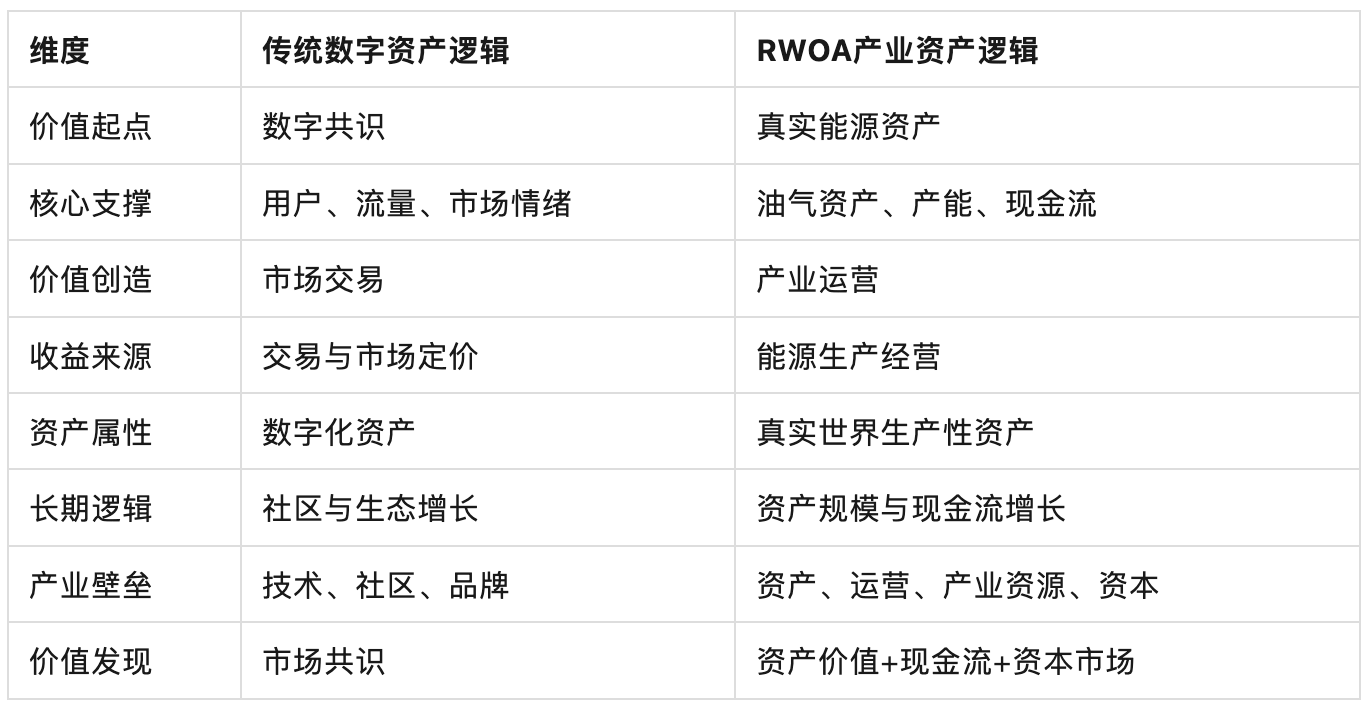
Therefore, what RWOA is truly worth watching is not the three words “blockchain” by itself, but what it is trying to accomplish:
standardization, digitalization, transparency, and financialization of energy assets.
Here, blockchain is closer to infrastructure, not value itself.
The core of where value truly comes from is still:
Oil & gas assets + operational capability + cash flow + data + capital.
2. First layer: more than 30 years of energy-industry experience—RWOA’s asset-value foundation
ECOCHINA ENERGY: from energy assets to industrial cash flow
The first layer of the RWOA ecosystem—and its most core layer—is real energy asset operational capability.
The asset operator, ECOCHINA ENERGY, is located in Alberta, Canada. Behind it is a seasoned team with more than 30 years of experience in global energy industry management and operations. Its business capabilities cover the development of energy assets, production operations, and asset value management, among other areas.
For energy-related RWAs, the importance of this layer is far greater than just technical packaging.
Because an oil well is not a “digital picture” that can simply be placed on a chain.
Behind a single oil well, at least:
mineral rights/asset interests → geological conditions → wellbore → equipment → recompletion → production → gathering & transportation → sales → cash flow → taxes → environmental responsibility → asset maintenance.
Any missing link may affect the final realization of asset value.
Therefore, the core capability to operate RWOA long-term must first come from the real energy industry.
This is also one of the most important differences between RWOA and purely digital-asset projects:
RWOA first faces oil wells, production, costs, equipment, operations, and cash flow—then blockchain.
From an investment logic perspective, this is a very important value order.
3. Second layer: 25+ years of financial capital market resources—connecting global investors with capital markets
FX168 Finance Group: an important traffic and connection hub in the global Chinese-language capital markets
Established in 2001, the FX168 Finance Group serves more than 200 million Chinese investors globally and a community of 50 million overseas Chinese, with long-term deep involvement in areas such as global financial news, foreign exchange, gold, stock markets, crypto assets, and macroeconomics.
After more than 25 years of continuous development, its core value is no longer just “finance media.”
More importantly, the long-term accumulation it forms:
Investor reach capability + financial content capability + financial institution connection capability + influence in the global Chinese-language market + capital-market brand resources.
From the perspective of industrial capital, what makes finance media truly valuable is not just the raw readership, but its underlying:
An investor network, a financial institution network, an industry expert network, capital-market recognition capabilities, and cross-border communication capabilities.
The business structure of FX168 also shows a trend of expanding from a pure information platform into a comprehensive financial-services platform, covering multiple dimensions such as financial news, fintech, investment services, brand dissemination, and industry events.
This means its potential value in the RWOA ecosystem is not just brand exposure; more importantly, it takes on the responsibility of:
a capital-market connector + an investor reach platform + a financial communication infrastructure
its ecosystem role.
For a project that needs to bring traditional energy assets into the digital-asset world, such resources have clear synergy value.
because:
Assets need capital discovery; capital needs an asset to carry it.
What RWOA solves is the problem of asset digitalization and industrial value being carried; meanwhile, a financial-capital-market ecosystem can help complete market recognition, investor education, and capital connections.
Together, they create industrial synergy rather than a simple stacking of brands.
4. Third layer: 5+ years of industrial investment resources—organizational capability connecting energy, infrastructure, and industrial capital
BITFOREST: from industrial investment to real-asset allocation
BITFOREST focuses on North American commercial investment, infrastructure, and industrial projects. Investment areas include energy development, modern facility agriculture, data centers, real estate, industrial funds, and blockchain applications.
The value of this type of industrial investment institution to the RWOA ecosystem lies in the fact that it naturally occupies:
Between industrial assets and investment capital.
In traditional financial systems, to achieve scaled development of high-quality industrial assets, it usually needs to go through:
Asset discovery → due diligence → capital entering → operations → further financing → asset tokenization/financialization
As RWA develops, the essence is exploring the further process of digitalization.
Therefore, the industrial investment resources represented by BITFOREST have strong logical synergy with RWOA:
one end connecting real industrial assets, and the other end connecting industrial capital and investors.
For RWOA’s future expansion from a single oil-and-gas asset to more real-world assets, the importance of such industrial investment resources will further increase.
5. Fourth layer: 15+ years of internationalized resources—organizational capability for a cross-border industrial ecosystem
StarRing Group: long-term cross-border resources and internationalized service capabilities
StarRing Group is headquartered in Vancouver, Canada, with more than 14 years of continuous operating experience, and has business deployments or cooperation networks across multiple Canadian provinces as well as in mainland China, Hong Kong, Macau, Taiwan, and the Philippines.
Its business covers:
Cross-border services, international education, tourism services, general aviation, China-Canada vocational education, and integration of international resources.
If viewed from single-business perspectives, these businesses have no direct relationship with oil & gas assets.
But if observed from the perspective of a cross-border industrial ecosystem, its value lies in the long-term accumulation of:
Canadian local resources + China’s capital-market resources + overseas Chinese networks + cross-border service capability + internationalized organizational capability.
For a project based on real Canadian energy assets while targeting global investors and the digital asset market, cross-border resources themselves are an important infrastructure.
What RWOA aims to achieve in the future is not just:
“Canadian oil wells on-chain.”
and further pushing:
Canadian real assets → global digital representation → international capital participation → cross-border value circulation.
This process naturally requires cross-border resources and local industrial capabilities to jointly support.
6. Putting these resources together: RWOA forms a “four-layer ecosystem resource structure”
If you look at these enterprises individually, you might only see a few brands in different fields.
But from the perspective of investment banks and industrial capital, what matters more is to observe the capability “puzzle” formed between them.
The RWOA ecosystem can be understood as four levels:
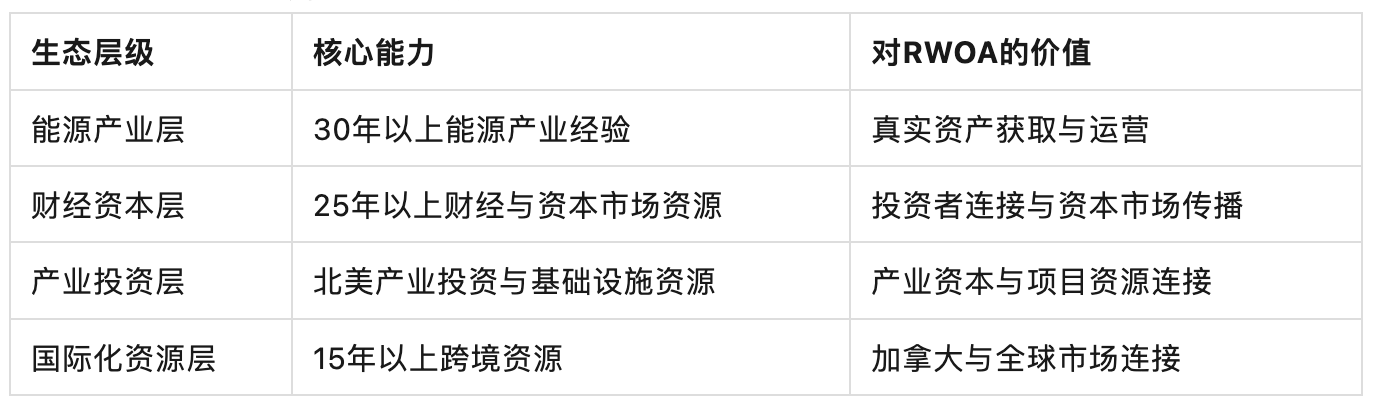
Ultimately formed:
Asset side + industrial side + capital side + market side + cross-border side
a multi-layer ecosystem structure.
This is more important than merely having a blockchain technology team.
7. RWOA’s true moat: not “one project,” but a value chain
From an investment bank perspective, a simple model can be used to judge an asset digitalization project’s long-term competitiveness:
Layer One: Is there an asset?
Without real assets, all financialization is narrative.
Second layer: Is there operational capability?
You may have assets, but if you can’t generate stable cash flow, the asset value still can’t be realized.
Layer Three: Is there data capability?
Without continuous, trustworthy, and verifiable data, assets cannot achieve transparent management.
Layer Four: Is there capital capability?
Asset scaling needs capital; for capital to enter, it needs a credible underlying asset base.
Layer Five: Is there market capability?
After asset digitalization, it also requires investors’ awareness, liquidity, and market pricing capability.
Layer Six: Does it have global resources?
Truly large-scale RWAs will ultimately move toward cross-region, cross-market, and cross-asset allocation.
From this framework, the ecosystem RWOA builds is, in fact, allocating capabilities around these six key links.
8. From “single wells” to “thousand wells”: industrial scaling is what RWOA is truly worth paying attention to
For RWOA, a single oil well is only an asset unit.
What truly has industrial significance is:
20 wells → 100 wells → 1000 wells
forming scaled asset pools.
As the number of assets increases, the project’s value structure will change.
Single-well era:
Asset value mainly comes from the single well itself.
Hundred-well era:
Asset value starts to reflect portfolio-based structuring, scaling, and cash-flow stability.
Thousand-well era:
Asset value starts to reflect asset pools, data pools, cash-flow pools, and capital-market valuation capabilities.
This is also the key path for RWOA’s transition from a single energy project to an energy asset digitalization platform.
9. From the perspective of an investment bank: the core value of RWOA can be summarized as “six pools”
If RWOA continues to expand the scale of energy assets in the future, its underlying logic can be further summarized as six pools:
1. Asset pool
continuous accumulation of mature Canadian oil & gas assets.
2. Capacity pool
Release production capacity through recompletions, operations, and asset management.
3. Cash-flow pool
Operational cash flow is formed through real energy production.
4. Data pool
Continuously accumulate production, operations, asset, and revenue data.
5. Capital pool
Connect industrial capital, digital-asset capital, and global investors.
6. Liquidity pool
By expressing digital assets, it provides traditional energy assets with new value discovery and circulation mechanisms.
Ultimately formed:
Assets generate cash flow; cash flow supports valuation. Data improves transparency; digitalization improves liquidity. Capital drives scaling; scaling further increases the value of the asset pools.
This is the complete closed loop that makes RWOA worth observing long-term.
10. Why is a “background in industrial resources” more important than a Token narrative alone?
In recent years, market assessments of Web3 projects have often focused on:
Token price, trading volume, community size, exchanges, KOL propagation.
But as RWA enters an industrialization stage, the market’s evaluation system is changing.
Truly valuable long-term RWA projects need to answer a few most fundamental questions:
Where are the assets?
Who operates?
Who generates the cash flow?
How can the data be verified?
How the legal structure is arranged?
Where does the capital come from?
How will it scale in the future?
This has already moved from purely “Web3 project evaluation” into:
industrial-capital project evaluation.
And this is exactly the most important difference between RWOA and traditional digital-asset projects.
It tries to:
The asset value of the energy industry, blockchain’s digitalization capability, and the capital market’s ability to price
put it all together.
11. 5 years, 15 years, 25 years: what is truly worth watching is “time accumulation”
One metric that the capital market is most likely to overlook is actually: time.
If a company can operate continuously for 5 years, it means it has a certain level of business survival capability;
Sustained operations for 15+ years typically means it has formed a relatively mature organization, customer base, and industrial network;
Being able to operate for 25+ years usually means it has gone through multiple economic cycles, capital-market cycles, and industry changes.
Therefore, what different resource entities in the RWOA ecosystem represent is not merely the company names.
More importantly:
credit, customers, industrial relationships, cross-border networks, capital resources, and organizational capability formed through long-term operations.
Especially for long-cycle assets like energy, infrastructure, and RWAs, time itself is a moat.
Because:
Energy assets are not short-term businesses; capital is not a short-term game.
What can truly outlast cycles is often:
assets, cash flow, industrial capability, contractual relationships, and long-term credit.
12. RWOA’s underlying positioning: not manufacturing a “virtual asset,” but redefining the digital representation of energy assets
From a broader industrial perspective, the track RWOA is on is not just Crypto.
It is actually at the intersection of three industry trends at the same time:
First trend: digitalization of energy assets
Traditional energy assets are moving from merely physical assets to:
datafication, intelligence, standardization, digitalization
directional evolution.
Second trend: RWA financialization
Real-world assets such as real estate, bonds, funds, gold, energy, mining, and infrastructure are all exploring digital representation and on-chain circulation.
Third trend: global capital asset allocation
Future capital allocation will not be limited to stocks, bonds, and traditional funds.
High-quality real assets themselves may also become an important underlying source of global digital capital markets.
The position RWOA occupies is precisely in the intersection zone of three trends:
Real energy assets × blockchain digitalization × global capital markets.
13. Ultimately, it forms an ecosystem with a “three-in-one” structure: industry—capital—technology
If we summarize the resource structure behind RWOA in one sentence:
Industry creates value, assets carry value, capital amplifies value, and technology improves the efficiency of value circulation.
further forming:
ECOCHINA ENERGY
→ provides the foundation of energy assets and industrial operations
BITFOREST
→ provides synergies between industrial investment and North American project resources
StarRing Group
→ provides cross-border resources and internationalized connectivity capabilities
FX168 Finance Group
→ provides financial communication, investor reach, and capital-market connection capabilities
RWOA
→ further digitize, standardize, and express real energy assets on-chain
Ultimately, it is composed of:
Asset side—operations side—industrial side—capital side—market side—technology side
the complete ecosystem structure.
14. From an investor’s perspective, how should we understand RWOA?
If you understand RWOA as only a Token, you will only see:
Price, trading, liquidity, and market sentiment.
If you understand RWOA as an RWA protocol, you will see that:
blockchain, asset digitalization, data attestation of rights, and on-chain circulation.
But if we observe from the perspective of investment banks, industrial capital, and long-term investors, we should further see:
What RWOA is trying to build is a real-asset ecosystem with Canadian real energy assets as the underlying base, cash flow created through industrial operations, asset digitalization achieved through digital technologies, investors connected through financial and capital resources, and cross-border industrial networks driving large-scale growth.
This is also where its long-term value is most worth observing.
Conclusion: A truly strong ecosystem is not “one name,” but an accumulation of long-term capabilities.
The endgame of RWA will never be as simple as “put assets on-chain.”
Truly industrially viable RWAs need to complete:
Real assets → real operations → real cash flow → real data → clear rights & ownership → value that can be verified → capital can enter → market can price → assets can scale.
And the ecosystem framework built by RWOA is currently allocating capabilities around this entire chain.
From more than 30 years of energy-industry experience, to more than 15 years of cross-border resource accumulation, to more than 25 years of financial capital market resources, plus the ongoing aggregation of industrial investment, infrastructure, and North American project resources—the core significance is not simply adding a few “brands.”
What is truly important is:
These long-term accumulated industrial resources, capital resources, cross-border resources, and market resources are jointly forming the ecosystem infrastructure for RWOA to enter the real-world asset track.
For an energy RWA project, what is always most worth attention is not “how big the story is,” but:
How real the assets are, how deep the industry is, how strong the cash flow is, how thick the resources are, how strong the capital-connection capability is, and whether it can continuously transform these capabilities into scaled assets.
If in the future RWOA can continuously complete the transition from:
Single-well assets → asset portfolios → hundred-well scale → thousand-well asset pools → an energy asset digitalization platform
As it evolves, its value logic will gradually shift from a purely digital-asset narrative toward:
“Real energy assets + industrial operations + cash flow + digital finance + global capital”
a comprehensive value system.
This is the true industrial logic that makes RWOA worth long-term attention.
💰 Investment and industrial resource background
Asset operator: ECOCHINA ENERGY
Headquartered in Alberta, it has a senior team with more than 30 years of experience managing and operating the full energy-industry chain globally. It focuses on exploration and development of high-quality energy assets, production operations, and asset value management. As the foundation stone of the ecosystem, it provides stable and sustainable asset-revenue support for RWOA, along with deep industrial resource backing—ensuring efficient value appreciation and compliant operations for every energy asset.
FX168 Finance Group
An international finance information and financial media platform founded more than 25 years ago; it has long focused on foreign exchange, gold, and global capital markets. It has the ability to disseminate finance content across global Chinese-language markets, and a foundation of tens of millions of financial users.
BITFOREST
A leading North American commercial investment brand, with investment and operational management for infrastructure projects. It prioritizes investing in sustainable development and environmental-protection projects in Canada and North America, including modern facility agriculture, energy development, data centers, overseas immigration, real estate development, industrial funds, and blockchain applications.
Vermillion Growers Ltd.
Relying on advanced Dutch facility-agriculture technologies, it builds a modern intelligent glass greenhouse system in Manitoba, Canada, creating a high-standard agricultural production system that integrates precise planting, automated environmental control, and data-driven operations. The project focuses on supplying localized high-quality vegetables, helps reduce Canada’s dependence on imported vegetables, and improves regional food security. At the same time, through deep integration of digital agriculture, the Internet of Things (IoT), energy recycling, and sustainable operations, it builds a new generation of modern agricultural infrastructure with economic, environmental, and social value.
StarRing Group
Headquartered in Vancouver, Canada, established for more than 14 years. It has branches in Newfoundland and Manitoba in Canada, and representative offices and partner organizations in mainland China, Hong Kong, Macau, Taiwan, and the Philippines. Its businesses cover cross-border immigration, international education, tourism services, general aviation, and China-Canada vocational education cooperation, among other areas. It has cumulatively served thousands of customers globally and has broad capabilities for integrating internationalized resources.