

"Arguing that you don't care about the right to privacy because you have nothing to hide is no different than saying you don't care about free speech because you have nothing to say."
Edward Snowden wrote that. He was talking about government surveillance. But he could've been talking about blockchain.
Here's what most people don't realize: Money is speech.
Every transaction u make tells a story. Who u trust. How much u earn. Where u struggle. What u value. On a transparent blockchain, that story is public. Forever.
A simple dinner transaction "paid you back $47" becomes a breadcrumb trail. Someone sees the amount. Someone correlates it with your other transactions. In five minutes, they know ur income, ur spending patterns, ur net worth etc
That's not decentralization. That's the opposite.
We solved the hard problem. We proved digital money could exist without banks. We proved it could be programmed. Smart contracts, DeFi, stablecoins we built all of it.
But we broke something in the process.
We built a glass house and called it freedom.
The Blockchain Transparency Paradox
Why We Built This Way (In the First Place)
When ethereum launched on 2015, transparency was revolutionary.
Think about traditional finance. U trust a bank because they have regulators, insurance, legal liability. But you never truly verify anything. You see a balance. You trust it's real. You don't have proof.
Ethereum changed that. Every transaction was visible, immutable, verifiable. No bank needed. No trust required. Just math.
It was the right choice. For a moment.
The problem: We forgot why we needed transparency in the first place.
Bitcoin needed transparency to work.
Think about it simply: If I send you money digitally, how do you know I actually have it? How do you know I didn't already send it to someone else?
Traditional banks solved this with a ledger. They kept records. Only they could see it though.
Bitcoin solved it differently: Everyone sees the ledger. That way, everyone can verify that money actually moved and wasn't double-spent.
That's a legitimate technical reason for transparency.
But here's the category error we made: We needed the protocol to be transparent. We didn't need you, the user, to be transparent.
A bank needs to verify deposits and withdrawals. It doesn't need everyone to know your salary. An exchange needs to verify trading. It doesn't need the world to know your positions. Verification and surveillance are not the same thing.
Yet we built blockchains that conflate them.
Fast forward to 2025. Stablecoins are now the hottest part of crypto multi-trillion dollars in annual settlement volume. But here's the problem: almost all of it happens on transparent rails.
This creates an impossible choice
For Neobanks: Nubank, the largest neobank in Latin America, has started integrating USDC into its payments ecosystem in Brazil through Pix. They want to move more of this on-chain. But the moment they do, the world sees their entire payroll. Every salary. Every bonus. Competitors now know their operating costs. Employee A sees what Employee B earns. Your entire org chart becomes visible. Is that really worth the settlement speed?
So most neobanks don't do it. They stay with traditional banking.
For institutions: You want to use @aave to earn yield on your stablecoin treasury. But once you deposit, everyone knows your balance. If you borrow, the world knows your strategy. Risk profile exposed. Competitors can front-run you. Adversaries know exactly who to attack.
So institutions don't touch DeFi. They park money in traditional finance.
For regular people: You want to send money to a friend who's struggling. But you don't want your ex seeing it 😉. You don't want data brokers knowing it. You don't want strangers on the internet calculating your net worth.
So you use your bank. Because banks, weirdly, still have privacy.
The Distinction Nobody Makes
This is where people get confused. They say: "But blockchain needs to be transparent! That's the whole point!"
They're half right.
The blockchain network needs to be transparent. Validators need to verify that transactions are legitimate and that money wasn't spent twice. That's non-negotiable.
But the people using the blockchain don't need to be transparent.
Here's an analogy: The internet needs routers and servers to be visible and verifiable to route packets correctly. That's why the internet works. But you don't need everyone to see the contents of your email. That's why we have HTTPS encryption at the application layer, not the protocol layer.
Blockchain forgot this distinction.
We made the protocol transparent. Then we made the users transparent too. We conflated verification with surveillance.
And now we're stuck.
Institutions won't move on-chain because it doxxes them. Institutions won't move on-chain without privacy. Developers are building real-world applications, but they're hitting friction. And regular people prefer banks because banks still have privacy
So adoption stalls. We're stuck..
For 15 years, we've been waiting for someone to separate these two things.
We've been waiting for a solution that says: "Your protocol is transparent. Your life doesn't have to be."
Satoshi Knew. We Just Weren't Ready.
This isn't a new problem.
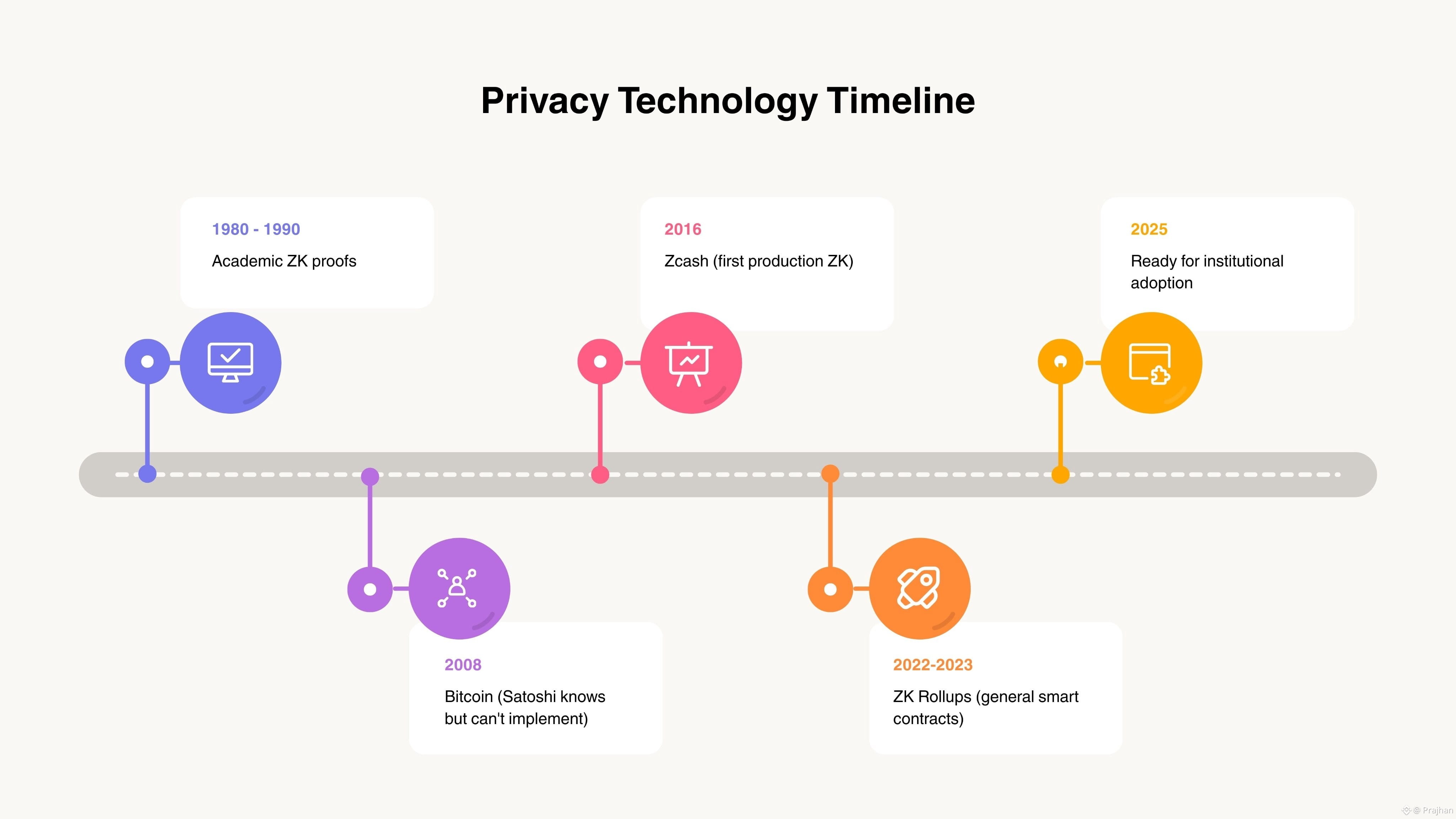
In 2008, when Satoshi Nakamoto released the Bitcoin whitepaper, he cited Zooko Wilcox a cryptographer who had been thinking about privacy in digital systems since the 1990s.
Satoshi knew what he was creating: A system that solved the double-spend problem through radical transparency. Every transaction visible. Every node verifiable. Complete public ledger.
But he also knew this was suboptimal.
In early Bitcoin forum posts, Satoshi was explicit: "Bitcoin would be much better with zk proofs."
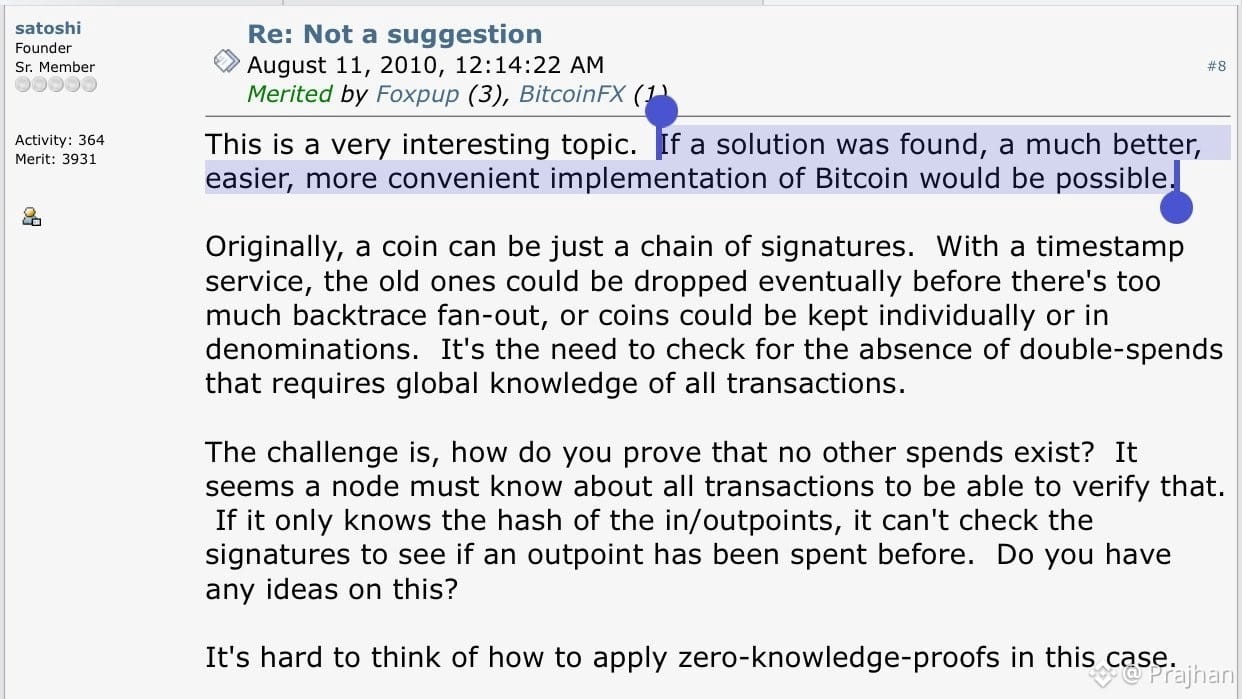
Not as a nice-to-have. Not as future research. As something essential that was missing from day one.
He understood something we've largely forgotten: transparency is a tradeoff, not a feature.
It was the right choice for Bitcoin. But it came at a cost —>privacy. And that's where things got stuck.
The Problem That Sat Unsolved for 15 Years
or a decade and a half, the question hung in the air: How do you prove a transaction is legitimate without showing who sent it, who received it, or how much moved?
It sounds like a contradiction. How can you verify without seeing?
The math to answer that question existed, but it was purely academic. Proofs in the 1980s and 1990s. All theoretical. All impossibly slow.
Then in 2016, Zooko and his team shipped something radical: A production deployment of zero-knowledge proofs in cryptocurrency.
Not just theory.
> Real code > Real transactions > Real privacy
The privacy worked. The cryptography held up. The verification process was sound. Every claim Satoshi made about zero-knowledge proofs turned out to be true.
But something unexpected happened.
Why Privacy Technology Didn't Scale
Here's the thing: The privacy technology worked perfectly. But it couldn't power an economy alone.
Because it existed alone.
It was its own chain. Its own ecosystem. Isolated from everything else in crypto. You couldn't use it with aave to earn yield. You couldn't trade on uniswap. You couldn't build a neobank on top of it. There was no liquidity. There was no institutional adoption. There was no killer app.
And without a killer app, adoption stalled.
More practically: Privacy coins are volatile. They trade as speculative assets, not money. You can't pay rent in something that swings 30% in a month. You can't tell your employees their salary is in an asset that might be worth half as much by Friday.
The technology solved privacy. It couldn't solve the "you can't actually use this for real commerce" problem.
But it proved the concept. And that was everything.
What We Forgot About Privacy
Back in the cypherpunk movement the ideology that birthed Bitcoin, there was a clear definition of privacy.
Eric Hughes wrote it in 1993:
"Privacy is not secrecy. A private matter is something one doesn't want the whole world to know, but a secret matter is something one doesn't want anybody to know. Privacy is the power to selectively reveal oneself to the world."
Read that again. "Selectively reveal."
Not hiding. Selecting.
You don't broadcast your salary. You show it to your landlord when you need to prove you can afford rent. You don't livestream your medical records. You share them with your doctor when you need treatment. You don't post your location in real-time. But you might tell a friend where you are.
You curate - You select - You choose who sees what based on context.
That's privacy. Not secrecy. Selection.
Cryptocurrency forgot this. We made everything public by default and called it freedom.
The Inflection Point Nobody Noticed
Here's where it gets interesting.
Around 2022-2023, something changed.
zK proofs stopped being academic exercises. Multiple teams deployed production zero-knowledge rollups systems that could batch thousands of transactions, generate cryptographic proofs, and settle them on ethereum securely and quickly. The technology wasn't just theoretically sound anymore.
> It was fast > It was secure > It was auditable by independent security firms > It was real
At the same time, stablecoins hit a different kind of inflection point.
The market cap grew to over $300 billion. But more importantly, annual transaction volume hit multi-trillion dollars. We're talking about real economic activity. Cross-border payments. Treasury management. Settlement flows.
Stablecoins won. They became the killer app.
But they're still stuck on transparent rails. ethereum, trondao, solana, polygon. Every transaction visible.
This created a gap nobody was talking about:
We had the privacy technology (ZK proofs). We had the payment infrastructure (stablecoins). But we had no way to combine them at scale.
Privacy coins existed but couldn't do payments. Ethereum could do payments but couldn't do privacy. And they existed in completely separate ecosystems.
But we needed someone to combine these pieces.
For 15 years, we've been waiting for technology that could say:
"You get the privacy of the cypherpunk vision. You get the composability of Ethereum. You get the stability of stablecoins. All in one system. All the time."
That wait is ending.
The market is ready. Institutions are waiting. The technology works. The timing is perfect.
And for the first time, we have the infrastructure to prove that Satoshi was right all along.
Why This Moment is Different
The convergence is happening now.
The Tech Finally Works
For years, zero-knowledge proofs were elegant in theory. Beautiful in mathematics. Useless in practice.
The proofs were slow. Verification was expensive. The infrastructure didn't exist.
That changed.
Since 2022, multiple production-grade ZK rollups have been processing millions of transactions. Starknet Scroll_ zkSync. These aren't experiments anymore. They're live networks handling real value.
ZK rollups can process transactions in seconds and settle them on Ethereum in minutes. For real-world use, that's fast enough.
More importantly, it's secure enough. Major implementations have gone through multiple rounds of independent audits. The core proving systems are no longer experimental. They're production-ready.
For the first time in history, you can run a private transaction system that is:
- Mathematically secure
- Cryptographically verified
- Independently audited
- Live on mainnet processing real transactions
The tech works. It's not theoretical anymore.
Stablecoins Reached Product-Market Fit
Stablecoins aren't a niche anymore. They're infrastructure.
Global stablecoin market cap: over $300 billion.
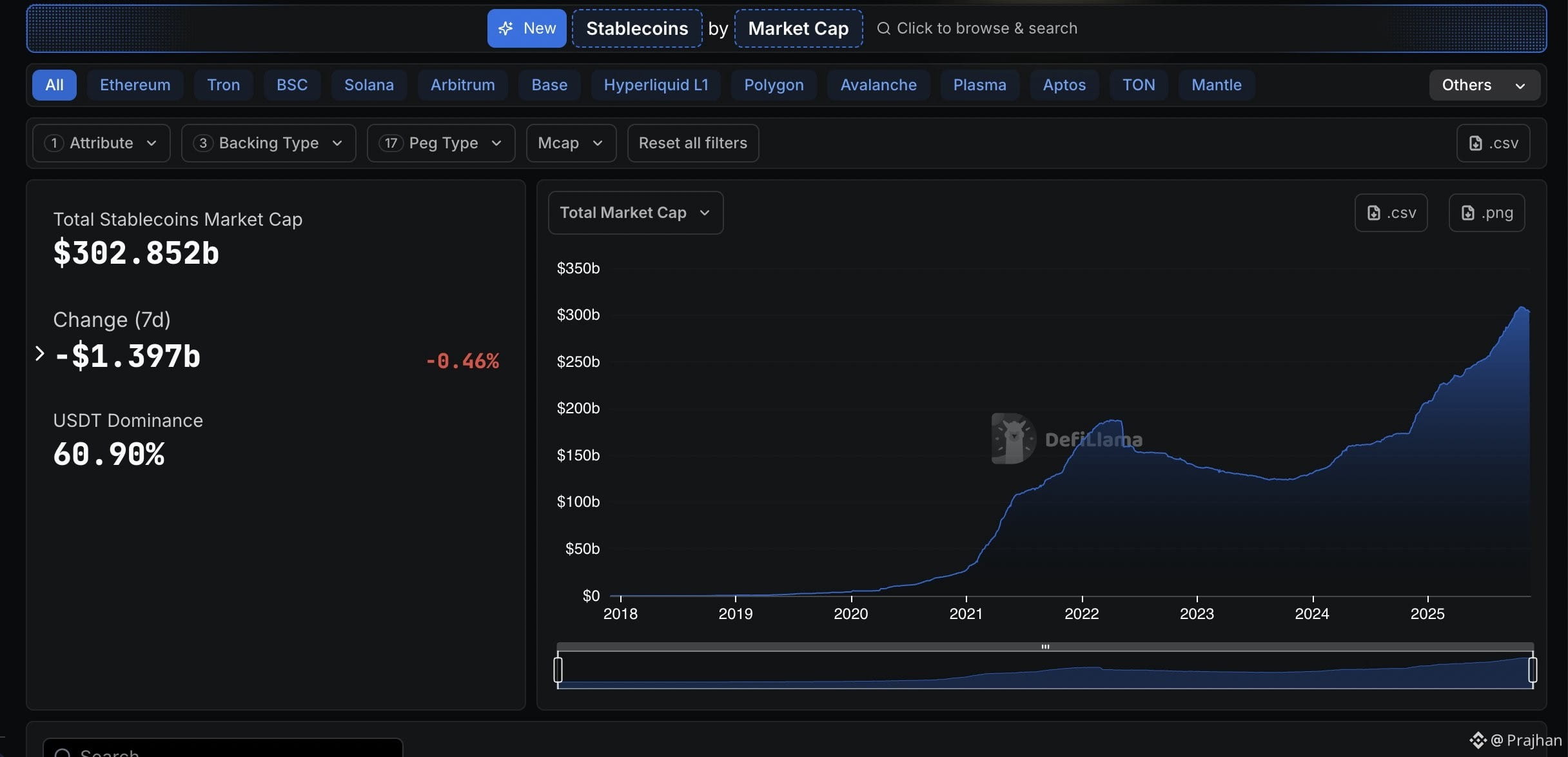
Annual transaction volume: multi-trillion dollars. Most estimates put it between 8-10 trillion USD per year and that's after filtering out bot wash and arbitrage activity.
This is real economic activity. Cross-border payments. Treasury management. Settlement flows. Institutional and retail both using stablecoins as the primary vehicle for on-chain value transfer.
Most of this volume settles on Ethereum and Tron still transparent chains. But the point is clear: stablecoins won as a technology. They're the killer app that institutions and users actually want.
And institutional investors know exactly what's coming.
Micky Malka, founder of Ribbit Capital, was direct about the timeline:
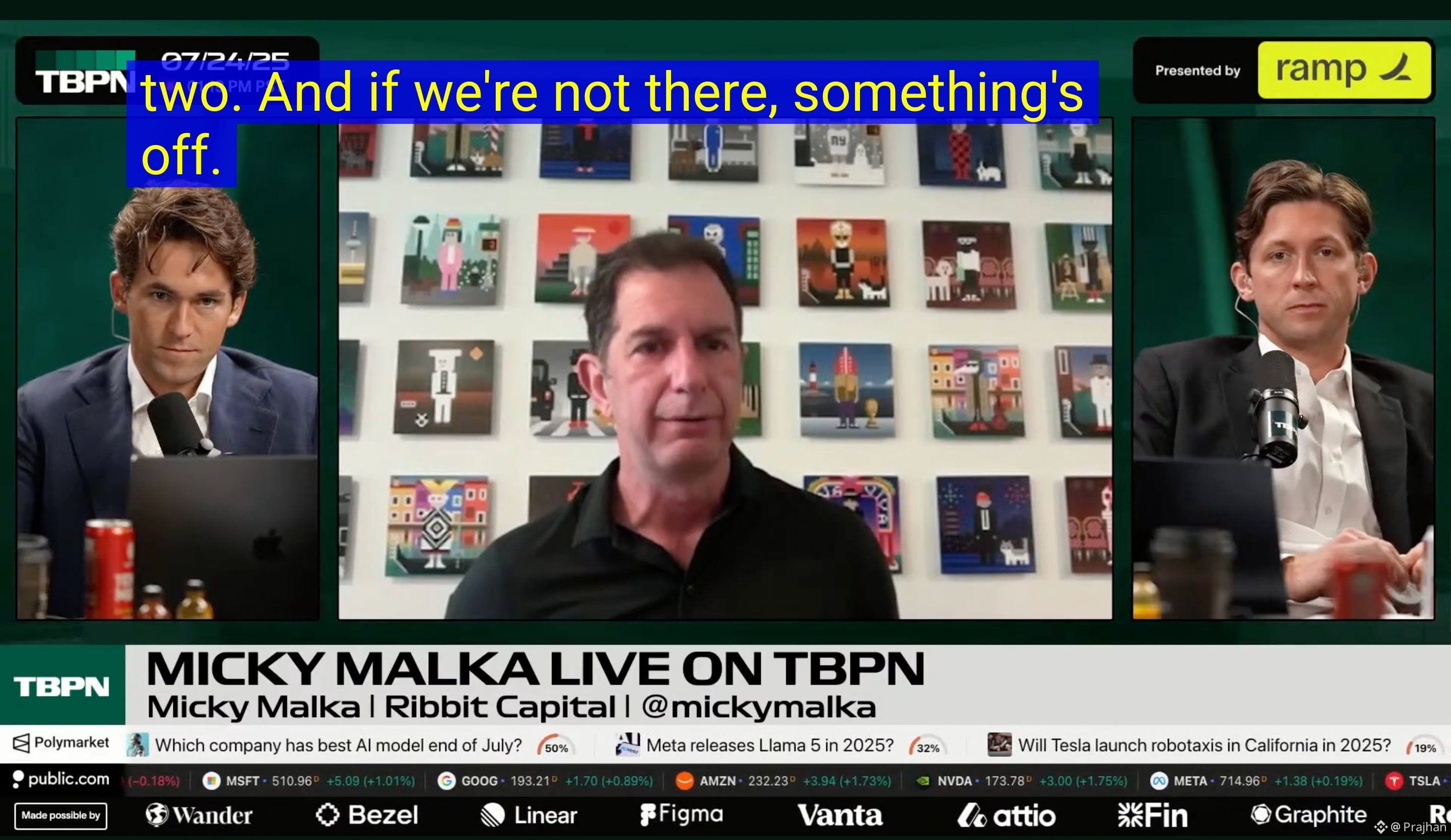
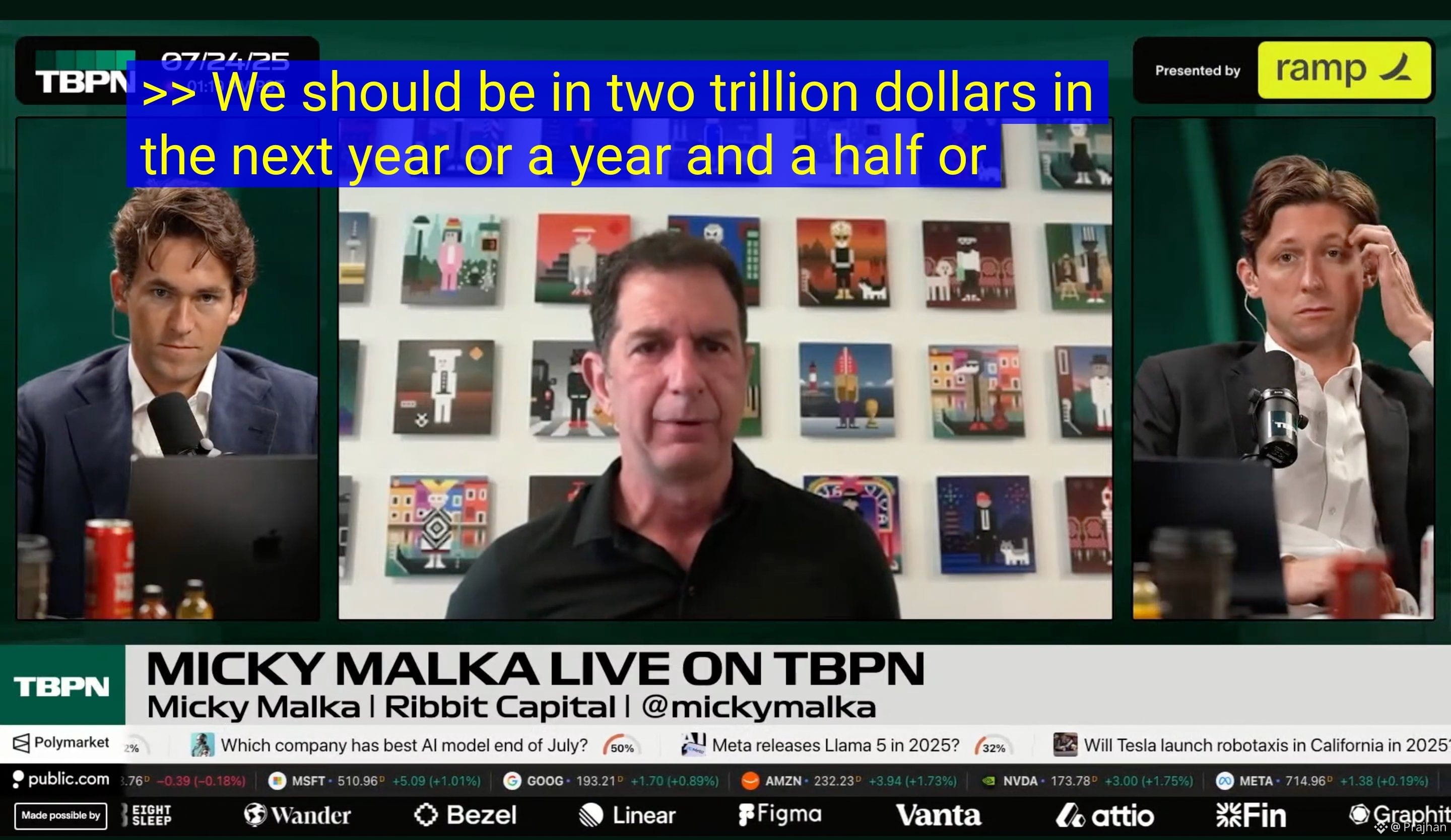
*"We should be in two trillion dollars in the next year or a year and a half.
And if we're not there, something's off."*
Notice what he said: Not "we hope to reach." Not "we predict." "If we're not there, something's off."
That's not optimism. That's conviction. That's capital already committed.
The $2 trillion stablecoin market isn't a moonshot - it's the baseline expectation.
Institutional money is locked and loaded. The timeline is 12-18 months.
The problem: that killer app is running on surveillance infrastructure.
Institutions Are Waiting
This is where it gets crucial.
Major central banks, the IMF, and researchers like Darrell Duffie (Stanford professor of finance) have all published extensively on the future of institutional payments on blockchain. The conclusion is consistent: tokenized settlement on ledgers is the future. But privacy, compliance, and system design are the primary blockers.
Not technical readiness. Institutions would move today if they could do it privately.
Duffie's work specifically frames privacy as essential for institutional adoption. The concern isn't paranoia it's competitive reality. If an institution's positions, cash flows, and risk management are visible to competitors, it's a commercial liability. Institutional capital won't migrate on-chain without strong privacy guarantees.
Research from Status and others confirms this: when you ask institutions why they're not using public blockchains for core operations, the answer is consistently privacy and compliance. Not speed. Not cost. Privacy.
The market is ready to move. It's waiting for the infrastructure.
The Market Gap is Unmistakable
Here's what we have right now:
Private technology: Exists, proven, audited
Payment infrastructure: Exists, proven, at scale
Institutional demand: Clear, documented, waiting
What's missing: A system that combines all three.
The gap is visible. Institutions are literally on the sidelines, waiting for privacy-enabled payment infrastructure at scale.
The TAM- the addressable market is enormous. It's essentially the entire institutional finance market that cannot put position-sensitive or client-sensitive data on a fully public chain. That's multi-trillion in potential capital.
The timing is now because:
The tech matured (ZK proofs are production-ready)
The killer app proved itself (stablecoins at multi-trillion scale)
Institutions are waiting (demand is documented)
The regulatory path is becoming clearer (compliance frameworks are emerging after gemini and other acts)
For 15 years, one of these pieces was always missing. Now they're all in place.
I came across a protocol recently. Most people haven't heard of it yet.
And when I looked at what it's actually doing, I realized it's solving the exact problem we just spent 4,000 words describing.
Here's the thing: it's not trying to be a replacement for anything. It's not anti-Ethereum. It's not competing with zcash or privacy coins. It's just filling a gap that everyone's been staring at without noticing.
The gap between what institutions need and what currently exists.
In simplest terms: It combines Ethereum's composability with privacy at scale.
Users get a choice. You can interact with the public Ethereum ecosystem (Aave, Uniswap, all the apps you know) OR move to a private layer where your activities are encrypted. You can do both in the same transaction. Move assets between public and private seamlessly.
This solves the isolation problem that plagued previous privacy solutions. You're not locked into a separate ecosystem. You have access to all of Ethereum's liquidity and composability, but with privacy as your default.
What does this enable?
For neobanks: You can process payroll on-chain in USDC. Employees get paid in seconds, globally. But the world doesn't see the payroll ledger.
For institutions: You can deposit into yield-bearing protocols like Aave earn returns, use DeFi without broadcasting your positions to the world.
For traders: You can settle large blocks of assets without slippage or competitors seeing your moves.
For individuals: You can bank on-chain with the same privacy expectations you have from traditional banking.
The key: Privacy isn't optional. It's not something users have to opt into and manage. It's built into the infrastructure. Developers can build applications where privacy is default, not afterthought.